Facts
The appellant was prosecuted for the murder of Manda Swapna, whose decomposed body was found near Bandam Bore, Vengalapur village.
Source reference: paras. 2–9The medical evidence indicated death by strangulation.
Source reference: paras. 29–32The prosecution alleged that the deceased was in a relationship with the appellant, had travelled by bus to meet him, and was received by him before being taken to the place of occurrence.
Source reference: paras. 2–9, 29–32The prosecution relied principally on the statements under Section 164 Cr.P.C. of the bus driver and conductor, who died before being examined at trial, the identification proceedings, the alleged recovery of a towel at the appellant’s instance, and evidence concerning the relationship between the appellant and the deceased.
Source reference: paras. 2–9, 29–32The Principal District and Sessions Judge, Jagtial, convicted the appellant under Sections 302 and 201 IPC and sentenced him to imprisonment for life and three years’ simple imprisonment, respectively.
Source reference: paras. 1, 10–14The appellant challenged the conviction in the present appeal.
Source reference: no citationIssues
Whether the prosecution proved beyond reasonable doubt that the deceased died homicidally and that the appellant caused her death by strangulation, thereby committing an offence under Section 302 IPC?
Source reference: para. 27(i)Whether the prosecution established that the appellant caused disappearance of evidence or gave false information with the intention of screening the offender from legal punishment, thereby committing an offence under Section 201 IPC?
Source reference: para. 27(ii)Whether the conviction and sentences imposed by the trial Court warranted interference in appeal?
Source reference: para. 27(iii)Law Applied
The Court applied Sections 302 and 201 IPC, requiring proof respectively of murder and of causing disappearance of evidence or giving false information with the requisite intention.
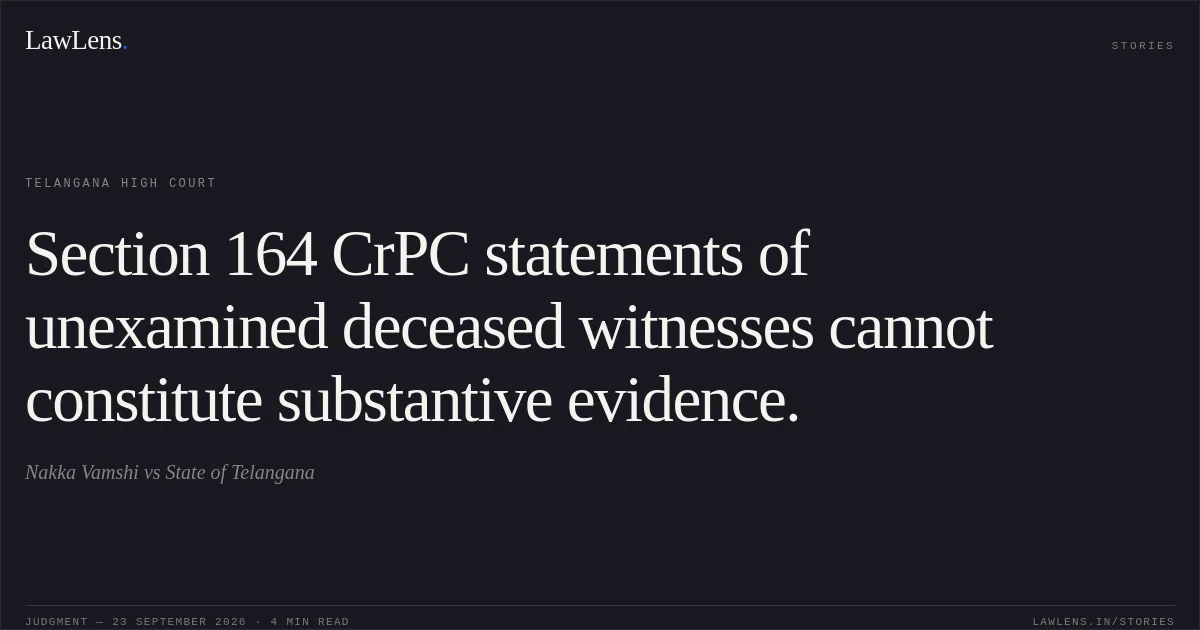
Source reference: no citationIt held that a statement recorded under Section 164 Cr.P.C. is ordinarily not substantive evidence and may be used for corroboration or contradiction; where the maker is not examined before the Court, the statement cannot ordinarily be treated as substantive proof of its contents.
Source reference: paras. 39–45; George v. State of Kerala, (1998) 4 SCC 605Under Section 27 of the Evidence Act, only that portion of information supplied by an accused in custody which distinctly relates to a fact discovered is admissible; recovery of an object alone does not establish its connection with the offence.
Source reference: paras. 50–53; Pandurang Kalu Patil v. State of Maharashtra, AIR 2002 SC 733The Court also applied the five principles governing circumstantial evidence in Sharad Birdhichand Sarda v. State of Maharashtra, (1984) 4 SCC 116: the circumstances must be fully established, consistent only with guilt, conclusive, exclude every reasonable hypothesis of innocence, and form a complete chain showing that the offence was committed by the accused.
Source reference: paras. 64–66It further recognised that a Test Identification Parade is not a substitute for substantive testimony and that medical evidence proving the cause of death does not, by itself, identify the assailant.
Source reference: paras. 31, 46–48, 57Reasoning
The Court accepted that the deceased died an unnatural and homicidal death by strangulation, but held that this fact did not identify the perpetrator.
Source reference: paras. 29–31The evidence of P.Ws.5 and 7 established only that the appellant and deceased were acquainted and intended to marry; it did not prove that they were together immediately before the death.
Source reference: paras. 33–35, 47–49The bus driver’s and conductor’s Section 164 Cr.P.C. statements could not be treated as substantive evidence because both witnesses died before entering the witness box, and the Magistrate who recorded the statements could prove only their recording, not the truth of their contents.
Source reference: paras. 36–45The identification proceedings likewise could not cure the absence of substantive testimony.
Source reference: paras. 46–48Even assuming that the towel was recovered at the appellant’s instance, the prosecution failed to establish that it belonged to the appellant, was the towel used in the strangulation, or contained any biological or other incriminating material connecting it with the deceased.
Source reference: paras. 50–54, 69, 75Consequently, the essential last-seen and recovery links were missing, and the chain of circumstances did not exclude reasonable hypotheses consistent with innocence.
Source reference: paras. 67–76Since the prosecution failed to prove the murder charge, and also failed to establish that the appellant caused disappearance of evidence with the requisite intent, the conviction under Section 201 IPC was also unsustainable.
Source reference: paras. 77–79Holding
The High Court held that the prosecution proved the homicidal death of Manda Swapna but failed to prove beyond reasonable doubt that the appellant caused her death or committed the offence under Section 201 IPC.
The appeal was allowed; the judgment dated 30 May 2025 in S.C.No.04 of 2021 was set aside, and the appellant was acquitted of the offences under Sections 302 and 201 IPC by extending the benefit of doubt.
Source reference: para. 85He was directed to be released forthwith, if not required in any other case.
Source reference: para. 86Acts & Sections Cited
7 provisions across 2 statutes referred to in this judgment. Each provision opens on LawLens.
Indian Penal Code, 18603
Code of Criminal Procedure, 19734
Original Court PDF
Nakka VamshivsState of Telangana
Click to open original judgment
Original judgment, available to read, download and summarize on LawLens.in