Facts
The petitioner, owner of several plots of land in Paschim Bardhaman, alleged that the West Bengal State Electricity Transmission Company Limited (WBSETCL) utilized their property to erect transmission towers and lay lines.
Source reference: para. 2, 3The petitioner claimed that severe damage was caused to the property and that WBSETCL failed to seek the "right of way" as mandated under Section 12 of the Telecommunications Act, 2023.
Source reference: para. 4WBSETCL contended that they exercised powers under Section 164 of the Electricity Act, 2003, read with the Indian Telegraph Act, 1885, and had already finalized a crop compensation of ₹3,45,762/-, which the petitioner refused to collect.
Source reference: para. 5, 20The petitioner challenged the sufficiency of this compensation amount.
Source reference: para. 6, 10Issues
1. Whether the provisions of the Telecommunications Act, 2023, apply to the laying of electricity transmission lines under Section 164 of the Electricity Act, 2003.
Source reference: para. 14, 152. Whether the petitioner’s remedy for a dispute regarding the sufficiency of compensation lies before the High Court or the District Judge.
Source reference: para. 21-23Law Applied
Section 164 of the Electricity Act, 2003, which empowers the government to confer powers of a "telegraph authority" upon electricity licensees.
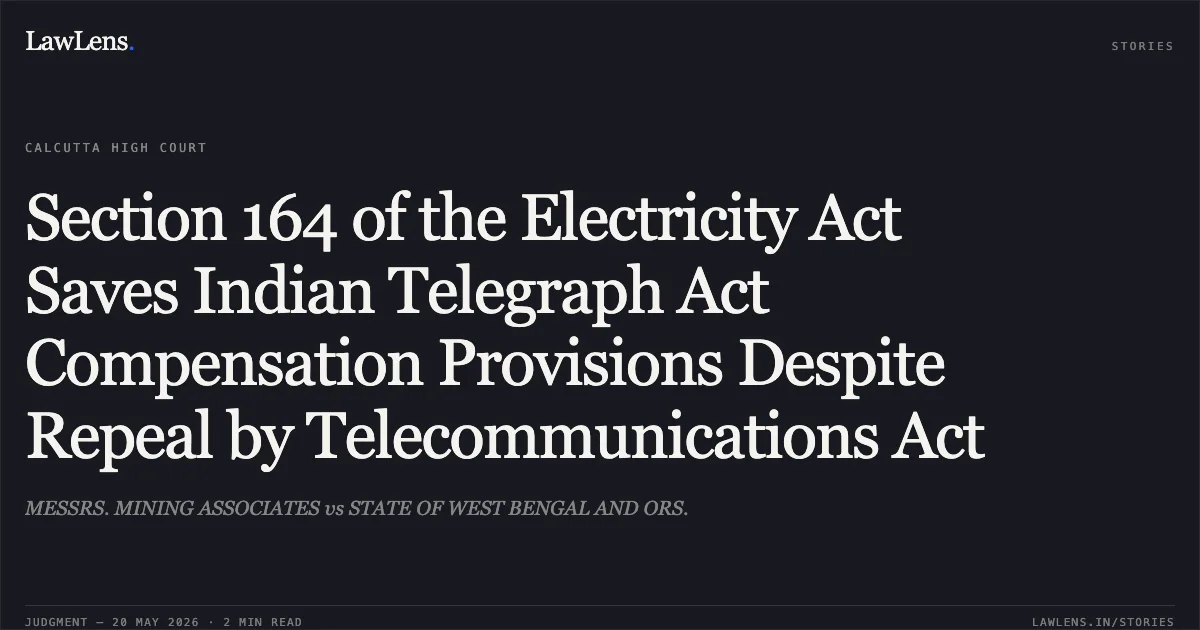
Source reference: para. 11Section 60 of the Telecommunications Act, 2023, specifically the saving clause in sub-section (3), which stipulates that Part III of the Indian Telegraph Act, 1885, remains in force for cases under Section 164 of the Electricity Act despite the general repeal of the 1885 Act.
Source reference: para. 13-14Section 10(d) of the 1885 Act mandates the payment of full compensation for damage.
Source reference: para. 17Section 16(3) of the 1885 Act provides that disputes regarding the sufficiency of such compensation must be determined by the District Judge within whose jurisdiction the property is situated.
Source reference: para. 22Reasoning
The Court rejected the petitioner’s reliance on the Telecommunications Act, 2023. It reasoned that Section 60(3) of the 2023 Act contains an express saving provision that maintains the applicability of the Indian Telegraph Act, 1885, for electricity transmission projects initiated under Section 164 of the Electricity Act.
Source reference: para. 15The Court found that since the WBSETCL was exercising powers as a telegraph authority, the statutory framework of Part III of the 1885 Act governed the proceedings.
Source reference: para. 12, 16Consequently, because the petitioner’s grievance focused solely on the "sufficiency" of the compensation determined for their "Shali" (agricultural) land, the court determined that the petitioner must follow the specific statutory procedure provided under Section 16(3) of the 1885 Act rather than seeking a writ remedy.
Source reference: para. 21, 23Holding
The Court held that the Telecommunications Act, 2023, does not supersede the Indian Telegraph Act, 1885, in matters regarding electricity transmission lines under Section 164 of the 2003 Act.
The Court directed that since the dispute concerns the sufficiency of compensation, the petitioner must approach the jurisdictional District Judge as per Section 16(3) of the 1885 Act. The writ petition was disposed of with liberty to the petitioner to approach the appropriate authority in accordance with law.
Source reference: para. 23, 24Acts & Sections Cited
5 provisions across 3 statutes referred to in this judgment. Each provision opens on LawLens.
Telecommunications Act, 2023.2
Indian Telegraph Act, 18852
Electricity Act, 20031
Original Court PDF
MESSRS. MINING ASSOCIATESvsSTATE OF WEST BENGAL AND ORS.
Click to open original judgment
Original judgment, available to read, download and summarize on LawLens.in