01Facts
On 3 September 2009, the deceased was travelling in a Tata-608 Tempo with Opponent No. 1, the driver, in connection with his work as a cleaner-cum-labour. Near Moti-Rajsthali, Meldi-Maa Temple, the tempo was allegedly driven rashly and at excessive speed, lost control, overturned, and caused fatal injuries to the deceased.
pp. 1–2 · ¶ 1–2.2An FIR was registered against the driver under Sections 279, 304-A, 337 and 338 of the IPC and relevant provisions of the Motor Vehicles Act. The deceased’s legal heirs filed MACP No. 818 of 2009. The Motor Accident Claims Tribunal awarded Rs.1,83,800 with interest at 7.5% per annum from the date of the claim petition until realization.
pp. 1–2 · ¶ 1–2.2The High Court noted that the deceased was travelling in the tempo as an unauthorized passenger.
p. 3 · ¶ 602Issues
i.1. Whether, despite the breach of the insurance policy arising from the deceased’s status as an unauthorized passenger, the insurance company should be held directly liable or directed to pay the compensation first and recover it from the owner and driver?
pp. 2–3 · ¶ 3.1ii.2. Whether the amendment introducing Section 164 of the Act, replacing Section 163A and prescribing fixed compensation for death, applies retrospectively to an accident that occurred before the amendment came into force?
p. 3 · ¶ 3.2 · pp. 7–8 · ¶ 8–903Law Applied
The Court exercised appellate jurisdiction under Section 173 of the Motor Vehicles Act, 1988.
p. 1 · ¶ 1It applied the pay-and-recover principle recognized in National Insurance Co. Ltd. v. Swaran Singh, followed in National Insurance Co. Ltd. v. Laxmi Narain Dhut, and reaffirmed in Shamanna v. Oriental Insurance Co. Ltd., under which an insurer may be directed to satisfy the award in the first instance despite a policy breach and thereafter recover the amount from the owner.
pp. 3–6 · ¶ 7The Court also relied on Manuara Khatun v. Rajesh Kumar Singh, Saju P. Paul v. National Insurance Co. Ltd., and Oriental Insurance Co. Ltd. v. Nanjappan, which support pay and recover, particularly where innocent third-party claimants would otherwise be prejudiced.
pp. 5–6 · ¶ 7On retrospectivity, the Court followed New India Assurance Co. Ltd. v. Urmila Halder, holding that the beneficial amendment introducing Section 164 could be applied retrospectively and that the enhanced fixed compensation of Rs.5,00,000 for death was available even where the accident predated the amendment.
pp. 3, 7–9 · ¶ 4, 8–9Provisions in the judgment · 10 · Linked ones open on LawLens
Motor Vehicles Act, 1988 Section 173Section 177Section 184Section 134Section 163Section 164Section 147
Indian Penal Code, 1860 Section 279Section 337Section 338
04Reasoning
The evidence established that the deceased died in an accident caused by the overturning of the tempo while it was being driven at excessive speed.
p. 3 · ¶ 5Although his travel as an unauthorized passenger constituted a breach of the policy terms, the Court treated the claimants as third parties who should not be denied compensation on account of a technical or contractual breach attributable to the insured.
pp. 3–7 · ¶ 7Applying Shamanna and Manuara Khatun, it held that the insurer should satisfy the award initially, while retaining the right to recover the amount from the driver and owner in the same proceedings.
pp. 3–7 · ¶ 7The Court further treated Section 164 as a beneficial legislative measure and, following Urmila Halder, applied the fixed compensation of Rs.5,00,000 notwithstanding that the accident occurred in 2009, before the amendment came into force.
pp. 7–9 · ¶ 8–905Holding
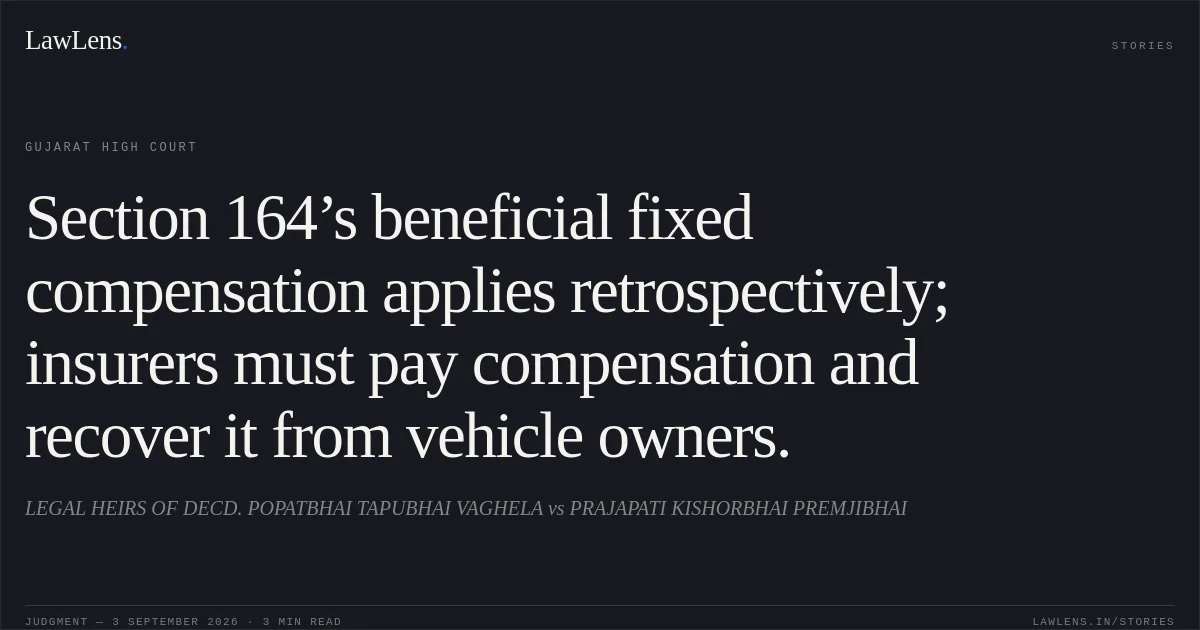
The appeal was partly allowed. The Tribunal’s award was modified, and the claimants were held entitled to fixed compensation of Rs.5,00,000, with interest at 7.5% per annum from the date of the claim petition until realization.
p. 9 · ¶ 10.2Opponent Nos. 1 and 2—the driver and owner—were held substantively liable to pay the compensation.
p. 9 · ¶ 10.1–10.4However, Opponent No. 3, the insurance company, was directed to satisfy the award in the first instance and was granted liberty to recover the amount from Opponent Nos. 1 and 2 by executing the High Court’s order.
p. 9 · ¶ 10.1–10.4Original Court PDF
LEGAL HEIRS OF DECD. POPATBHAI TAPUBHAI VAGHELAvsPRAJAPATI KISHORBHAI PREMJIBHAI
Click to open original judgment
Original judgment, available to read, download and summarize on LawLens.in