Facts
On 22 February 2005, the claimant was travelling in Truck No. GJ-7-X-3237, loaded with iron rods and proceeding from Bhavnagar to Surat. Near Palej, the truck’s front tyre suddenly burst and the truck collided with Truck No. GJ-7-Z-5951, which was parked in the compound of Anand Hotel. The claimant sustained injuries, and an offence was registered at Nabipur Police Station.
Source reference: p.2, paras. 2–2.1, p.3, para. 6The claimant was travelling in the goods vehicle as an unauthorised/gratuitous passenger.
Source reference: p.2, paras. 2–2.1, p.3, para. 6The Motor Accident Claims Tribunal, in MACP No. 270 of 2006, awarded compensation of Rs.1,54,400 with interest at 7.5% per annum from the date of the claim petition until realization.
Source reference: p.1, paras. 1–2.3The appeal challenged the Tribunal’s award, particularly the insurer’s liability and the applicability of the amended statutory compensation regime.
Source reference: p.1, paras. 1–2.3Issues
Whether, despite the claimant having travelled as an unauthorised or gratuitous passenger in the goods vehicle, the insurer should be held directly liable, or whether a direction to “pay and recover” should be issued on account of breach of the policy terms?
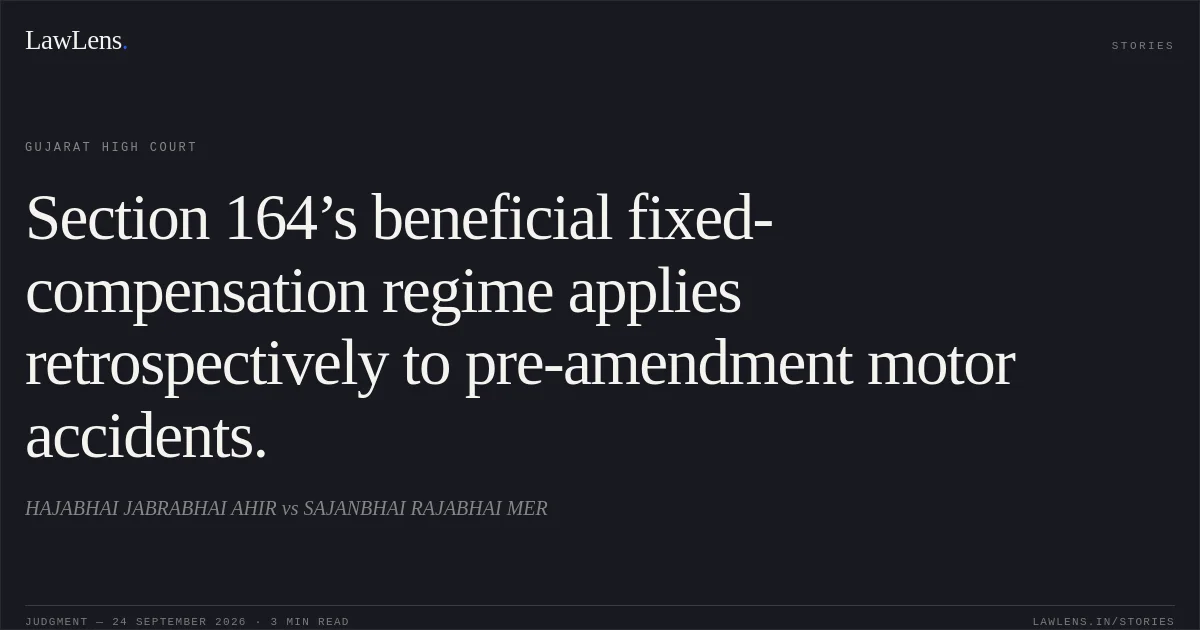
Source reference: p.2, para. 3.1Whether Section 164 of the Motor Vehicles Act, which replaced Section 163A and prescribed fixed compensation, would apply retrospectively to an accident that occurred before the amendment?
Source reference: p.2, para. 3.2; p.6, para. 8Law Applied
The Court exercised appellate jurisdiction under Section 173 of the Motor Vehicles Act, 1988.
Source reference: p.1, para. 1It applied the principle that, where a gratuitous passenger is not covered by the insurance policy, the insurer may nevertheless be directed to first satisfy the award and thereafter recover the amount from the insured in the same proceedings, as recognised in National Insurance Co. Ltd. v. Swaran Singh, National Insurance Co. Ltd. v. Laxmi Narain Dhut, Shamanna v. Oriental Insurance Co. Ltd., Manuara Khatun v. Rajesh Kumar Singh, and Saju P. Paul v. National Insurance Co. Ltd.
Source reference: pp.3–6, para. 7The recovery may be undertaken before the executing court without requiring a separate suit, following Oriental Insurance Co. Ltd. v. Nanjappan.
Source reference: p.5, para. 7The Court further relied on New India Assurance Co. Ltd. v. Urmila Halder for the principle that a beneficial amendment concerning statutory compensation may operate retrospectively where it merely clarifies the computation or modality of compensation.
Source reference: pp.2, 6–8, paras. 4, 8–9The same pay-and-recover approach was reaffirmed with respect to gratuitous passengers in Bharatbhai Shamjibhai Jambucha v. Mukeshbhai Usmanbhai Desai and Kaminiben v. Oriental Insurance Co. Ltd.
Source reference: pp.3–6, 8–10, paras. 7, 9.1Reasoning
The evidence established that the claimant was travelling in the offending goods vehicle when its tyre burst and the vehicle collided with another truck, causing the injuries.
Source reference: p.3, para. 5Although his status as an unauthorised/gratuitous passenger constituted a breach of the policy conditions and ordinarily relieved the insurer of ultimate contractual liability, the Court applied the benevolent object of the Motor Vehicles Act and the Supreme Court’s pay-and-recover jurisprudence.
Source reference: pp.3–6, paras. 6–7Since the claimant was a third-party victim, he was not required to suffer delay or undertake separate recovery proceedings; therefore, Opponent No. 3-insurer was directed to satisfy the award initially and recover it from the vehicle owners and other liable parties.
Source reference: pp.3–6, paras. 6–7; p.10, paras. 10.3–10.4On the quantum, the Court treated Section 164 as a beneficial amendment and followed Urmila Halder, holding that the amended fixed-compensation regime could be applied to the pending claim notwithstanding the earlier date of accident.
Source reference: pp.6–8, paras. 8–9Because the present case involved injury rather than death, the claimant was held entitled to fixed compensation of Rs.2,50,000 with interest.
Source reference: p.10, para. 10.2Holding
The appeal was partly allowed.
The Tribunal’s award was modified, and the claimant was held entitled to Rs.2,50,000 with interest at 7.5% per annum from the date of the claim petition until realization.
Source reference: p.10, paras. 10.1–10.2Opponent Nos. 1, 2 and 6/1 to 6/5 were declared liable for the compensation.
Source reference: p.10, para. 10.3However, Opponent No. 3-insurance company was directed to first satisfy the award and was granted liberty to recover the paid amount from Opponent Nos. 1, 2 and 6/1 to 6/5 by executing the order, consistent with the pay-and-recover doctrine.
Source reference: p.10, paras. 10.3–10.4All other directions of the Tribunal were maintained, and the Registry was directed to return the record and proceedings to the concerned court.
Source reference: p.11, para. 11Acts & Sections Cited
4 provisions across 1 statute referred to in this judgment. Each provision opens on LawLens.
Motor Vehicles Act, 19884
Original Court PDF
HAJABHAI JABRABHAI AHIRvsSAJANBHAI RAJABHAI MER
Click to open original judgment
Original judgment, available to read, download and summarize on LawLens.in