Facts
Manoj Saha was engaged as a Sub-Assistant Engineer at Konnagar Municipality in 2008 and later applied for a regular post reserved for Scheduled Caste candidates, relying on a caste certificate issued in 2012.
Source reference: para. 2–3After an objection to his caste status, the certificate was cancelled; following an inquiry into ancestral records, the competent authority confirmed his membership of the “Sunri” community and issued a fresh certificate in 2022.
Source reference: para. 4–5Opposite Party No. 2 then lodged a complaint alleging that Saha had obtained a reserved appointment through a false caste certificate.
Source reference: para. 6–7The police registered a case and filed a charge sheet under Sections 182, 417, 420 and 34 IPC, while recording that the allegations of forgery, personation and document tampering were not substantiated.
Source reference: para. 6–7Saha sought quashing of the proceedings under Sections 482 and 401 CrPC.
Source reference: para. 1Issues
1. Whether a court may take cognizance of an offence under Section 182 IPC on a police charge sheet, despite the bar in Section 195(1)(a)(i) CrPC.
Source reference: para. 102. Whether a caste certificate issued and validated by the competent statutory authority may be disregarded at the threshold when considering a petition under Section 482 CrPC.
Source reference: para. 103. Whether receipt of salary for work performed can constitute cheating under Sections 417 or 420 IPC where the petitioner’s Scheduled Caste status has been verified and allegations of forgery and personation were not substantiated.
Source reference: para. 104. Whether continuation of the criminal proceedings amounted to an abuse of process within the principles in *State of Haryana v. Bhajan Lal*.
Source reference: para. 10Law Applied
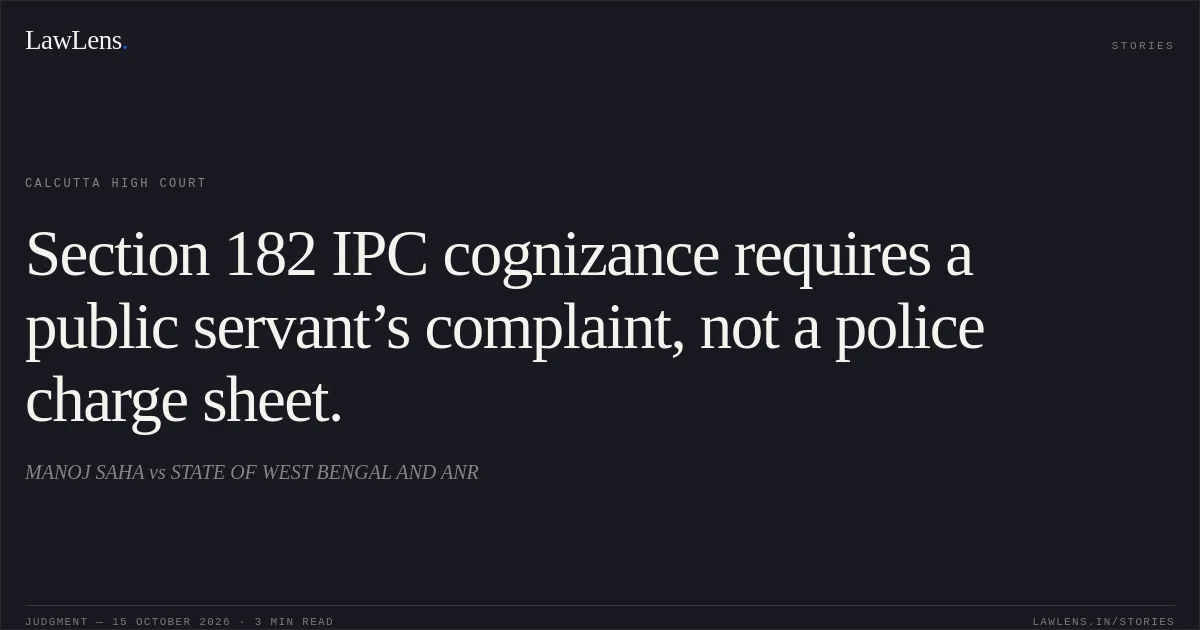
Section 195(1)(a)(i) CrPC bars a court from taking cognizance of an offence under Section 182 IPC except upon a written complaint by the public servant concerned or an administratively superior public servant; a police report under Section 173 CrPC does not satisfy that requirement (*State of U.P. v. Mata Bhikh*; *Daulat Ram v. State of Punjab*).
Source reference: para. 11Section 468(2)(b) CrPC provides a one-year limitation period for offences punishable with imprisonment not exceeding one year.
Source reference: para. 12Under Sections 415, 417 and 420 IPC, cheating requires fraudulent or dishonest intention at the inception, with Section 420 additionally requiring dishonest inducement to deliver property or valuable security (*Mohammed Ibrahim v. State of Bihar*; *VESA Holdings v. State of Kerala*; *Jupally Lakshmikantha Reddy v. State of Andhra Pradesh*).
Source reference: para. 14The court also relied on Section 74 of the Evidence Act concerning public documents, *Anita Malhotra v. Apparel Export Promotion Council* on considering unimpeachable public documents in Section 482 proceedings, and the categories for quashing stated in *Bhajan Lal*.
Source reference: para. 13, 17Reasoning
The court held that the Section 182 charge could not proceed on a police charge sheet, in the absence of the complaint required by Section 195(1)(a)(i) CrPC; it also found the prosecution initiated in 2022 for conduct alleged to have occurred in 2012–13 barred by limitation.
Source reference: para. 11–12It treated the inquiry report and the 2022 caste certificate, supported by ancestral records and the State’s report, as public material confirming Saha’s Scheduled Caste status.
Source reference: para. 13–14Since the investigation had not substantiated forgery or personation, and Saha had performed the work for which he received remuneration, the court found no prima facie dishonest inducement or deception to support Sections 417 or 420 IPC.
Source reference: para. 14–15It further considered the complainant’s alleged suppression of Saha’s earlier service and the circumstances of the complaint indicative of mala fides, bringing the case within categories (1), (3) and (7) of *Bhajan Lal*.
Source reference: para. 16–18Holding
The court answered the issues in Saha’s favour and held that the statutory bar, limitation, verified caste status, absence of prima facie cheating, and circumstances indicating abuse of process warranted quashing.
It allowed the revision and quashed the Uttarpara Police Station case, corresponding G.R. Case No. 1619 of 2022, including the charge sheet under Sections 182, 417, 420 and 34 IPC, insofar as Saha was concerned.
Source reference: para. 19–20Pending applications were disposed of, interim orders vacated, and no order as to costs was made.
Source reference: para. 21–23Acts & Sections Cited
14 provisions across 2 statutes referred to in this judgment. Each provision opens on LawLens.
Code of Criminal Procedure, 19735
Original Court PDF
MANOJ SAHAvsSTATE OF WEST BENGAL AND ANR
Click to open original judgment
Original judgment, available to read, download and summarize on LawLens.in


