Facts
A dispute arose over road widening and alleged encroachments on a public road connecting Gunda and Hogaranal.
Source reference: paras. 2–3, pp. 3–5The complainant alleged that the appellants and another accused trespassed into his premises, assaulted him and others with weapons, and used caste-based slurs.
Source reference: paras. 2–3, pp. 3–5The FIR invoked provisions of the Bharatiya Nyaya Sanhita, 2023, and Sections 3(1)(r), 3(1)(s), 3(1)(w)(i)–(ii) and 3(2)(v) of the SC/ST (Prevention of Atrocities) Act, 1989 (“SC/ST Act”).
Source reference: paras. 2–3, pp. 3–5The Special Judge rejected the appellants’ anticipatory-bail application.
Source reference: para. 2, p. 3The appellants appealed under Section 14A(2) of the SC/ST Act, seeking anticipatory bail.
Source reference: para. 2, p. 3Issues
1. Whether the allegations and material disclosed a prima facie offence under the SC/ST Act, thereby attracting the bar on anticipatory bail.
Source reference: paras. 7–10, pp. 8–122. Whether the appellants were entitled to anticipatory bail in the circumstances of the case, subject to appropriate conditions.
Source reference: paras. 11–15, pp. 13–15Law Applied
Section 14A(2) of the SC/ST Act provides for an appeal against an order of the Special Court or Exclusive Special Court.
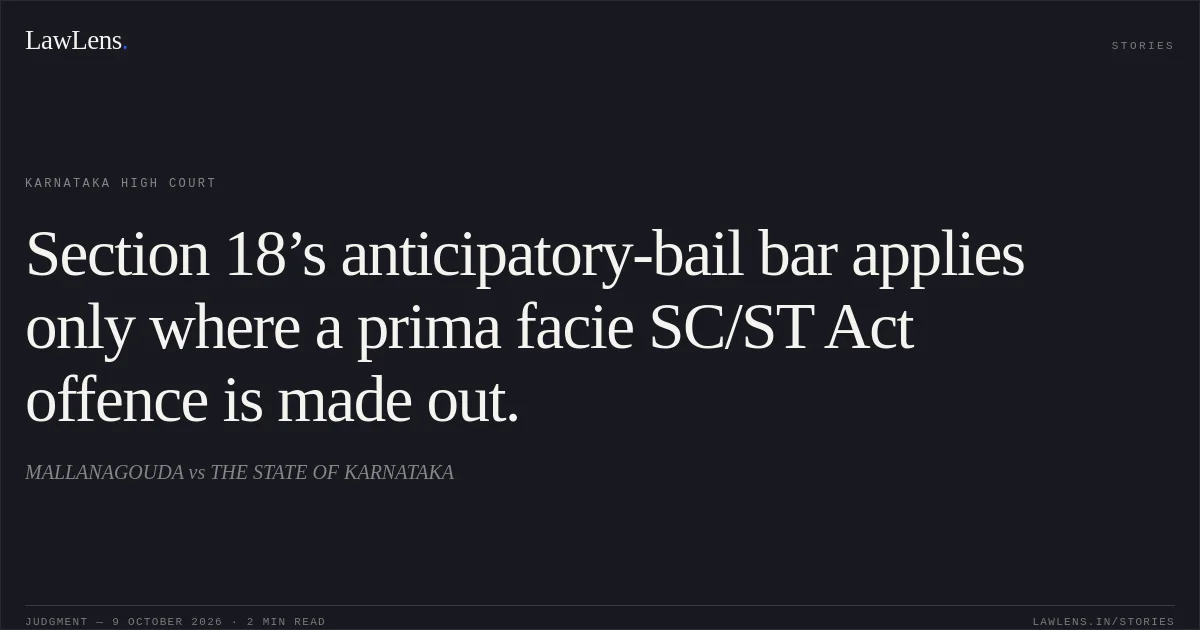
Source reference: no citationThe Court applied the principle that the statutory bar under Section 18 of the SC/ST Act does not preclude anticipatory bail where the allegations and material do not make out a prima facie offence under that Act.
Source reference: para. 10, pp. 10–12In support, it referred to Prathvi Raj Chauhan v. Union of India and Hitesh Verma v. State of Uttarakhand, as well as coordinate-bench decisions concerning anticipatory bail under the Act.
Source reference: para. 10, pp. 10–12The Court also considered the appellants’ local residence, absence of disclosed antecedents, the injured persons’ discharge from hospital, and whether the prosecution’s investigation-related concerns could be addressed by imposing conditions.
Source reference: paras. 12–15, pp. 13–15Reasoning
The Court considered the road-widening dispute to be the genesis of the incident and found no prima facie material at that stage showing that the appellants intended to insult or humiliate the complainant or others on the basis of caste.
Source reference: paras. 7–10, pp. 8–12It therefore held that the bar under the SC/ST Act did not justify refusing anticipatory bail.
Source reference: paras. 7–10, pp. 8–12In considering bail on the other allegations, the Court noted that the appellants were permanent local residents, no prior antecedents had been shown, the injured persons had been discharged, and the prosecution had not identified a special ground warranting refusal.
Source reference: paras. 12–15, pp. 13–15It found that concerns about cooperation, witness tampering and investigation could be addressed by conditions, including attendance before the Investigating Officer and a prohibition on tampering.
Source reference: paras. 12–15, pp. 13–15Holding
The High Court allowed the appeal and set aside the Special Judge’s order dated 12 August 2026.
It directed that appellants/accused Nos. 1 and 3 to 5 be released on bail in the event of arrest, subject to conditions including execution of personal bonds of ₹2,00,000 each with two sureties, cooperation with the investigation, attendance before the Court when directed, and non-interference with witnesses or the investigation.
Source reference: para. 16, pp. 15–17The order permits the Investigating Officer, with prior permission of the Special Judge or trial Court, to take the appellants into custody if custodial interrogation is required.
Source reference: para. 16, p. 17Acts & Sections Cited
14 provisions across 4 statutes referred to in this judgment. Each provision opens on LawLens.
Scheduled Castes and the Scheduled Tribes (Prevention of Atrocities) Act, 19892
Bharatiya Nyaya Sanhita, 2023
Bharatiya Nagarik Suraksha Sanhita, 20231
Code of Criminal Procedure, 19731
Original Court PDF
MALLANAGOUDAvsTHE STATE OF KARNATAKA
Click to open original judgment
Original judgment, available to read, download and summarize on LawLens.in