Facts
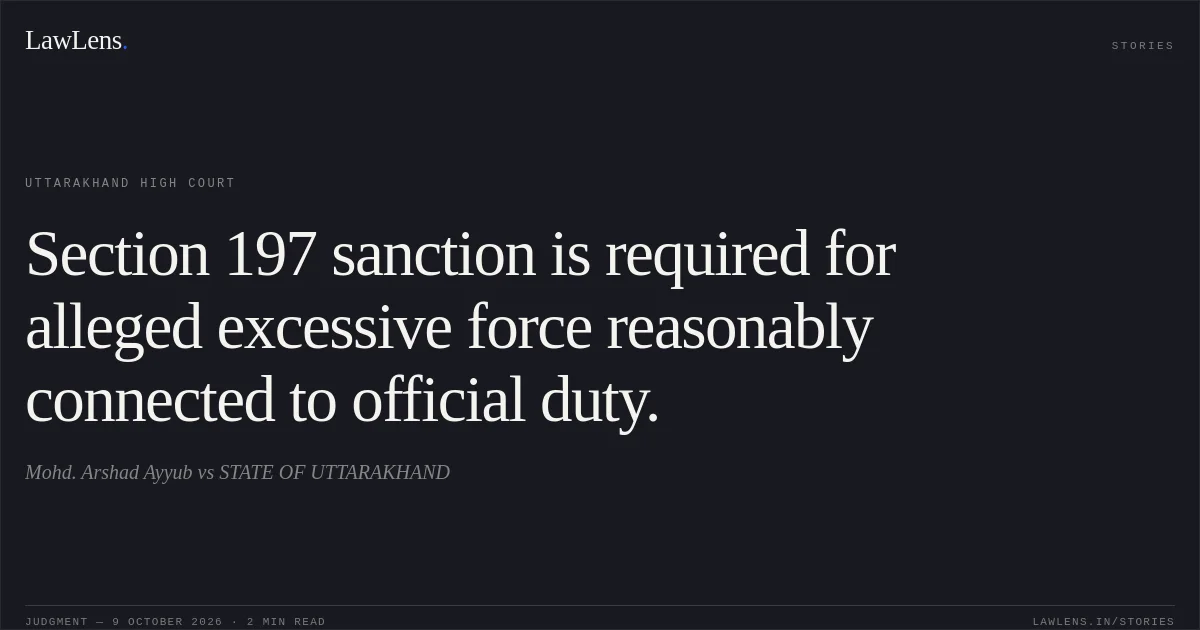
The applicant alleged that on 16 January 2017, during an operation to remove encroachments, respondent nos. 3 and 4 and others beat him with lathis, fracturing his leg. After police allegedly took no action, he filed a complaint.
Source reference: para. 2The Judicial Magistrate summoned respondent nos. 3 and 4 under Sections 324, 504 and 506 IPC. On their revision, the Sessions Judge set aside the summoning order, holding that the alleged acts had a connection with their official duty and that prior sanction under Section 197 CrPC was required. The applicant challenged that order under Section 482 CrPC.
Source reference: paras. 12–17Issues
1. Whether the Sessions Judge was justified in setting aside the summoning order on the ground that prior sanction under Section 197 CrPC was required
Source reference: paras. 3–9, 14–172. Whether the alleged assault, occurring during an operation to remove encroachments, was sufficiently connected with the respondents’ official duties to attract Section 197 CrPC
Source reference: paras. 21–25Law Applied
Section 197(1) CrPC bars a court from taking cognizance of an offence alleged against a qualifying public servant for an act committed while acting or purporting to act in the discharge of official duty, unless the requisite prior sanction is obtained.
Source reference: para. 10The protection is limited to acts reasonably connected with official duty and does not extend to acts for which official position is merely a cloak; the relevant inquiry concerns the quality of the act and its connection with the duty, including whether failure to perform the act could expose the public servant to a charge of dereliction of duty (State of Orissa v. Ganesh Chandra Jew, as quoted in Shadakshari v. State of Karnataka).
Source reference: para. 8An act involving excessive force is not automatically outside the protection if it was done in the performance or purported performance of official duty (Sankaran Moitra v. Sadhna Das).
Source reference: para. 22Reasoning
The Court found that respondent nos. 3 and 4 had been deployed, along with other officers and personnel, to prevent encroachment pursuant to directions in a public-interest proceeding, and that the alleged incident occurred during that operation.
Source reference: paras. 12–17, 24Relying on Sankaran Moitra, it rejected the applicant’s contention that an act causing a fracture could never be connected to official duty; the alleged use of force did not, by itself, remove the matter from Section 197’s scope.
Source reference: paras. 21–24It therefore considered the Sessions Judge’s order reasoned and saw no basis to interfere under Section 482 CrPC.
Source reference: paras. 20, 25–27Holding
The High Court held that the alleged acts were sufficiently connected with the respondents’ official duties for Section 197 CrPC to apply, and upheld the Sessions Judge’s decision setting aside the summoning order.
It dismissed the application under Section 482 CrPC.
Source reference: paras. 26–28Acts & Sections Cited
7 provisions across 2 statutes referred to in this judgment. Each provision opens on LawLens.
Code of Criminal Procedure, 19734
Indian Penal Code, 18603
Original Court PDF
Mohd. Arshad AyyubvsSTATE OF UTTARAKHAND
Click to open original judgment
Original judgment, available to read, download and summarize on LawLens.in