Facts
The petitioner was appointed as a Constable through a regular recruitment process on 03.06.2013 and was undergoing probation when he met with an accident on 29.06.2014.
Source reference: paras. 1–2, 7He subsequently suffered 100% disability, as certified by the competent Medical Board on 25.01.2018.
Source reference: paras. 1–2, 7The respondents terminated his services by order dated 19.06.2018 with effect from 29.06.2014, holding him incapable of performing the duties of a Constable.
Source reference: paras. 1–2, 7The termination order granted him service gratuity under Clause 10 of the Memorandum dated 09.05.2013.
Source reference: paras. 1–2, 7The petitioner challenged the termination, contending that Section 20 of the Rights of Persons with Disabilities Act, 2016 prohibited termination on account of disability acquired during service and required adjustment to another post or appointment against a supernumerary post.
Source reference: para. 3The respondents argued that, being a probationer-trainee who had not been confirmed, the petitioner was not entitled to the protections or service benefits available to a regular employee.
Source reference: para. 5Issues
Whether a probationer appointed through a regular recruitment process is an “employee” entitled to protection under Section 20(4) of the Rights of Persons with Disabilities Act, 2016?
Source reference: paras. 7–10Whether the respondents could terminate the petitioner’s services solely because he acquired a disability during service and was unable to perform the duties of a Constable?
Source reference: paras. 1, 7, 12–14Whether the petitioner was entitled to be shifted to another post or retained on a supernumerary post, together with consequential service benefits, instead of being terminated?
Source reference: paras. 3, 7, 12–16Whether Clause 10 of the Memorandum dated 09.05.2013 could be applied to the petitioner to grant only service gratuity and NPS-related benefits?
Source reference: paras. 2, 5, 15Law Applied
The Court primarily applied Section 20 of the Rights of Persons with Disabilities Act, 2016, which prohibits a Government establishment from dispensing with or reducing in rank an employee who acquires a disability during service; where the employee is unsuitable for the existing post, the employer must shift him to another post carrying the same pay scale and service benefits, and if that is not possible, retain him on a supernumerary post until a suitable post becomes available or superannuation, whichever is earlier.
Source reference: para. 7The Court held that Section 20 contains no distinction between confirmed, temporary, or probationary employees.
Source reference: paras. 8–10It relied on Union of India v. Pramod Sadashiv Thakre, holding that statutory protection against disability-based termination extends to a probationer; V.P. Ahuja v. State of Punjab, recognising that a probationer cannot be terminated arbitrarily or punitively; and Pawan Kumar v. Delhi Transport Corporation, holding that relief under the corresponding Section 47 of the 1995 Act cannot be denied merely because the employee was on probation.
Source reference: paras. 8–11The Court also relied on Bhagwan Dass v. Punjab State Electricity Board, which required reinstatement and consequential service benefits where termination violated disability-protection provisions, and Union of India v. Bali Ram, which affirmed that protection is unconditional and applies irrespective of how the disability was acquired.
Source reference: paras. 12–13Reasoning
The Court reasoned that the petitioner had entered service through a regular selection process and was therefore an “employee” within the meaning of Section 20, notwithstanding his probationary status.
Source reference: paras. 7–10Section 20(4) does not restrict its protection to confirmed employees, and the respondents could not use the petitioner’s non-confirmation as a basis to defeat the statutory guarantee against disability-based termination.
Source reference: paras. 8–11Since the petitioner acquired the disability during service and was found incapable of performing the duties of a Constable, the respondents were required first to explore accommodation, alternative employment with the same pay and service benefits, or retention on a supernumerary post.
Source reference: paras. 12–14Termination was therefore contrary to the statutory scheme.
Source reference: paras. 12–14The Court further held that Clause 10 of the 09.05.2013 Memorandum concerned government servants who died during probation and could not lawfully be applied to a surviving employee whose service was protected by Section 20.
Source reference: para. 15In light of the eight-year delay in approaching the Court, however, the Court limited the monetary relief to 50% of salary arrears.
Source reference: para. 16(ii)Holding
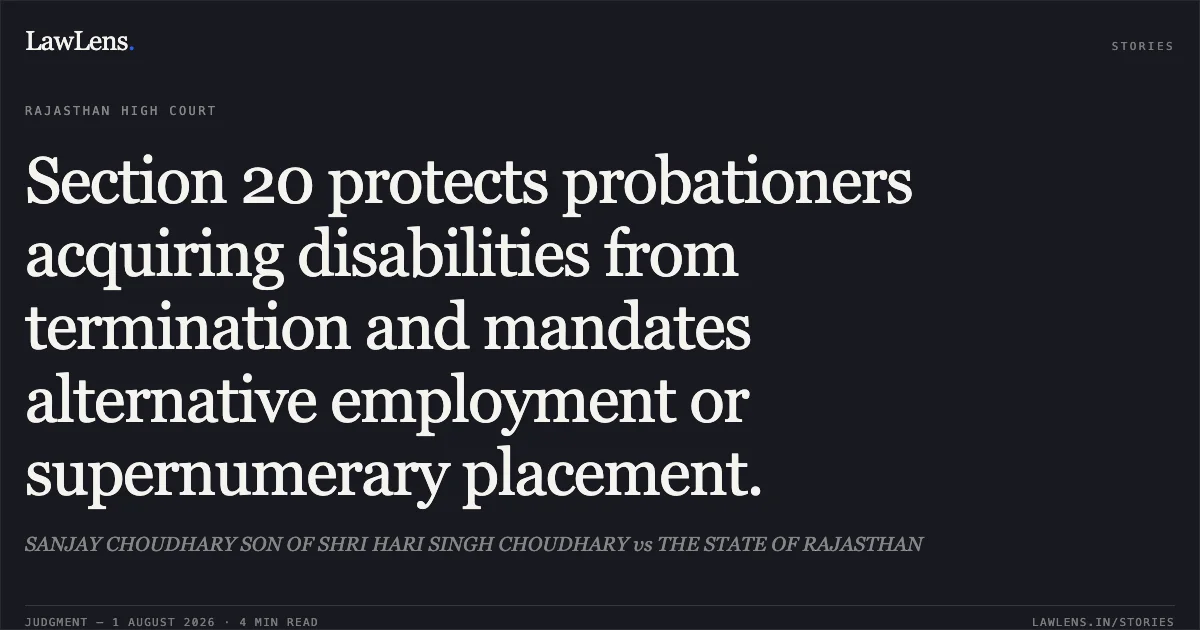
The Court held that the petitioner, although a probationer, was protected by Section 20 of the Rights of Persons with Disabilities Act, 2016, and that his termination solely on the ground of disability was illegal.
The termination order dated 19.06.2018 was quashed and set aside.
Source reference: para. 16The petitioner was directed to be deemed in service and reinstated immediately.
Source reference: para. 16(i)He was awarded 50% of salary arrears from 29.06.2014 to 11.02.2026, subject to adjustment of any service gratuity, NPS payments, or other amounts already received.
Source reference: para. 16(ii), (v)He was also granted consequential service benefits, including grade increments and promotion up to superannuation, and retiral benefits in accordance with law.
Source reference: para. 16(iii)–(iv)The arrears were directed to be paid within six weeks, failing which they would carry interest at 6% per annum.
Source reference: para. 16(vi)Acts & Sections Cited
1 provisions across 1 statute referred to in this judgment. Each provision opens on LawLens.
Rights of Persons with Disabilities Act, 2016.1
Original Court PDF
SANJAY CHOUDHARY SON OF SHRI HARI SINGH CHOUDHARYvsTHE STATE OF RAJASTHAN
Click to open original judgment
Original judgment, available to read, download and summarize on LawLens.in