Facts
The disputed plot was settled in favour of Achhaibar Singh by the Maharaja of Banaras. The petitioner subsequently obtained a decree under Sections 59/61 of the U.P. Tenancy Act, 1939, declaring him a hereditary tenant; the decree was affirmed by the Board of Revenue on 16 March 1956.
Source reference: para. 3After zamindari abolition, the Gaon Sabha instituted proceedings under Section 212 of the U.P. Zamindari Abolition and Land Reforms Act, 1950, seeking the petitioner’s ejectment on the ground that the plot was a tank. The Sub-Divisional Officer decreed the ejectment suit on 29 October 1966.
Source reference: para. 3The Additional Commissioner allowed the petitioner’s appeal on 4 January 1971, holding that the tank was a tenant’s tank and had not vested in the State under Section 6 of the 1950 Act. The Board of Revenue subsequently allowed the Gaon Sabha’s second appeal on 1 October 1980 and restored the ejectment order.
Source reference: para. 4The petitioner challenged both orders before the High Court, contending that his pre-existing hereditary tenancy could not be displaced merely because the land was subsequently recorded as a tank and that no compensation had been awarded under Section 212.
Source reference: para. 5Issues
Whether the petitioner, notwithstanding the prior decree recognising him as a hereditary tenant, could be ejected under Section 212 of the U.P. Zamindari Abolition and Land Reforms Act, 1950, on the ground that the disputed plot was a tank of public utility?
Source reference: para. 8Whether the revenue entries describing the plot as a tank were sufficient, without further proof regarding the nature of the land at the time of the petitioner’s admission and the circumstances in which the tank was constructed, to attract Section 212?
Source reference: paras. 9, 18Whether the ejectment order was independently invalid for failure to determine or award compensation as required by Section 212?
Source reference: para. 21Law Applied
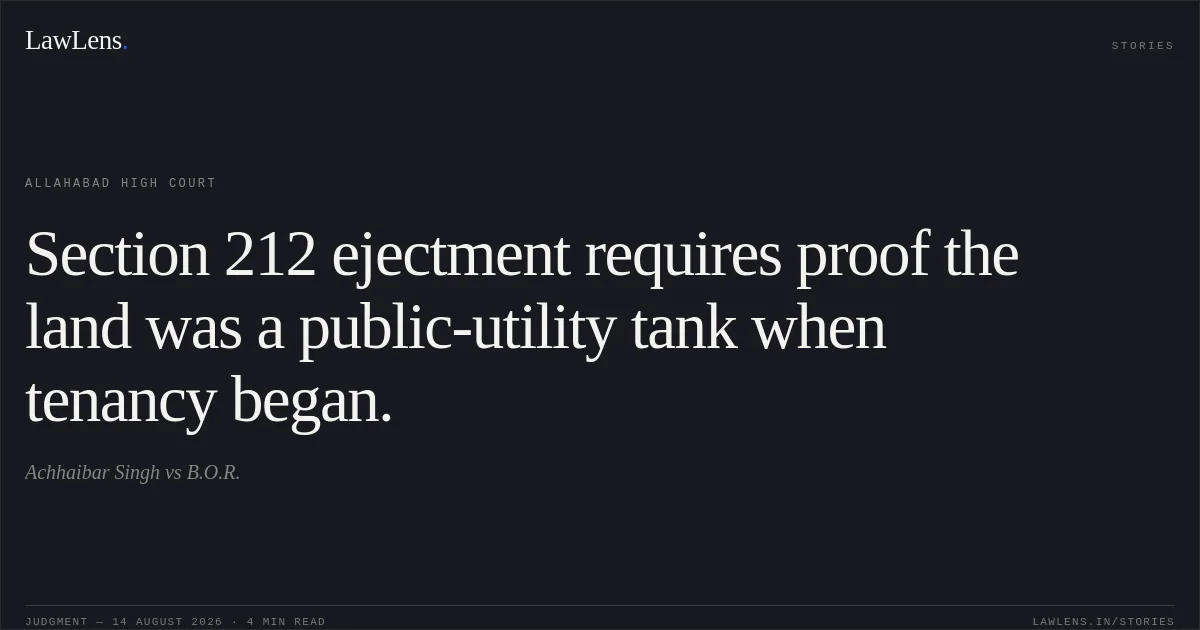
Section 212 of the U.P. Zamindari Abolition and Land Reforms Act, 1950 applies only where the statutory foundational facts are established—namely, that a person was admitted as a tenure-holder or grove-holder, on or after 8 August 1946, upon land recorded as or constituting customary public-utility land such as a tank, pond, pasture, cremation or burial ground, pathway or khalian.
Source reference: para. 9Section 6 concerns vesting of the intermediary’s rights, title and interest in the State and does not automatically extinguish independently acquired tenancy rights.
Source reference: para. 15Under Section 19, land held immediately before vesting by a hereditary tenant is deemed to have been settled by the State with that tenant, who becomes entitled to retain possession as a sirdar, subject to the Act and its exceptions.
Source reference: para. 19The prior decree under Sections 59/61 of the U.P. Tenancy Act, 1939 conclusively recognised the petitioner’s status as hereditary tenant, although it did not by itself determine whether Section 212 independently applied.
Source reference: paras. 10–12Revenue entries are relevant evidence but are not conclusive of either the legal character of the tenancy or the circumstances in which a tank came into existence.
Source reference: para. 13The Court relied on Nirjhin Kumari v. Gram Samaj, 1980 RD 164, and Gaon Sabha, Domanpur v. Jagannath Singh, 1984 AWC (Supp.) 27, for the principle that a tank or pond constructed by a tenant on lawfully held tenancy land does not necessarily vest in the State merely because of zamindari abolition.
Source reference: para. 15Ejectment under Section 212 is also subject to payment of prescribed compensation.
Source reference: para. 21Reasoning
The High Court held that the petitioner’s hereditary tenancy, judicially recognised before the date of vesting, could not be ignored in the Section 212 proceedings.
Source reference: paras. 10–12The Gaon Sabha relied principally on revenue entries from 1319 Fasli to 1369 Fasli describing the plot as a tank used for irrigation, but such entries did not establish that the petitioner had originally been admitted as a tenant upon a customary or public-utility tank.
Source reference: paras. 6, 13The petitioner’s consistent case was that the land had initially been settled with him as tenancy land and that the tank was subsequently constructed by him. If established, that factual distinction would preserve his pre-existing tenancy rights and prevent the subsequent description of the plot as a tank from, by itself, attracting Section 212.
Source reference: paras. 14–16The Sub-Divisional Officer failed to reconcile the petitioner’s recognised tenancy status with the finding that the land was a public-utility tank and did not adequately determine whether the plot was a tank at the time of settlement or whether it became one subsequently.
Source reference: paras. 17–18The Board of Revenue likewise relied mainly on the revenue entries and failed to examine the original settlement, the earlier tenancy decree and the circumstances of the tank’s construction.
Source reference: para. 22Further, the ejectment order contained no determination or direction regarding the compensation mandated by Section 212.
Source reference: para. 21Holding
The Court held that the Gaon Sabha failed to establish the statutory conditions necessary to invoke Section 212 against the petitioner.
The petitioner’s adjudicated hereditary tenancy, together with the unresolved material indicating that the tank may have been constructed subsequently on tenancy land, was not displaced by the revenue entries.
Source reference: para. 23The High Court quashed the Board of Revenue’s order dated 1 October 1980, restored the Additional Commissioner’s order dated 4 January 1971, set aside the Sub-Divisional Officer’s ejectment order dated 29 October 1966, and dismissed the Gaon Sabha’s ejectment suit.
Source reference: para. 24–25The writ petition was accordingly allowed.
Source reference: para. 24–25Acts & Sections Cited
5 provisions across 2 statutes referred to in this judgment. Linked provisions open on LawLens.
U.P. Zamindari Abolition and Land Reforms Act, 19503
United Provinces Tenancy Act, 19392
Original Court PDF
Achhaibar SinghvsB.O.R.
Click to open original judgment
Original judgment, available to read, download and summarize on LawLens.in