Facts
The respondent-plaintiff sued for specific performance of an agreement dated 17 April 2019 concerning the supply of mineral stone, and for a permanent injunction.
Source reference: pp. 2, 5The plaint alleged that the petitioner-defendant had received an advance of ₹1,19,74,254, which remained due, and that the agreed quantity of stone had not been supplied
Source reference: pp. 2, 5After the written statement and framing of issues, when the matter had reached the plaintiff’s evidence, the plaintiff sought to amend the plaint to add an alternative prayer for recovery of the advance. The trial court allowed the amendment on 19 March 2026; the defendant challenged that order under Article 227, arguing that the plaintiff had not shown due diligence as required by the proviso to Order VI Rule 17 CPC
Source reference: pp. 2–3Issues
1. Whether the proviso to Order VI Rule 17 CPC barred an amendment sought after commencement of trial when the applicant had not established due diligence, despite the amendment seeking an alternative relief under Section 22 of the Specific Relief Act, 1963
Source reference: pp. 6–82. Whether the trial court’s order allowing the amendment warranted interference under Article 227 of the Constitution
Source reference: pp. 8, 13Law Applied
Order VI Rule 17 CPC generally permits amendments necessary to determine the real questions in controversy, but its proviso restricts amendments after commencement of trial unless the court is satisfied that, despite due diligence, the matter could not have been raised earlier
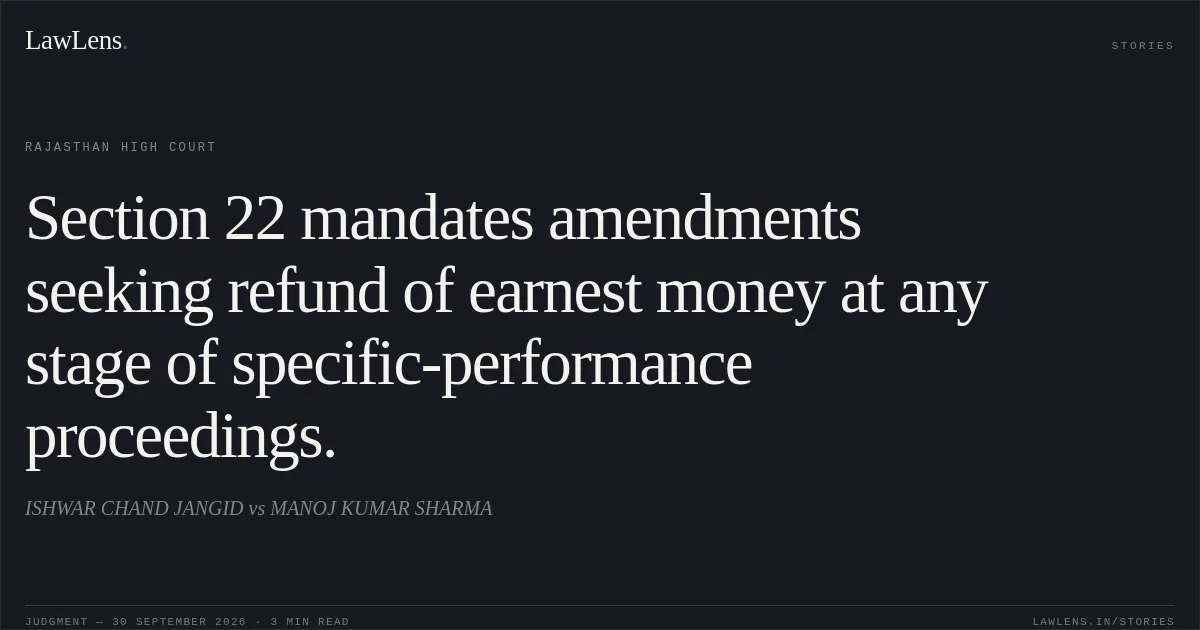
Source reference: p. 7The court held that Section 22(1)–(2) of the Specific Relief Act, 1963, including its non-obstante clause and proviso allowing amendment “at any stage,” overrides that restriction when the amendment seeks a relief within Section 22, including refund of earnest money or a deposit
Source reference: pp. 6–8Relying on K.R. Suresh v. R. Poornima, 2025 SCC OnLine SC 1014, the court treated the Section 22 proviso as requiring the court to allow such an amendment at any stage
Source reference: pp. 9–10It also referred to LIC v. Sanjeev Builders Private Limited and Shri Mohammadrafi v. Bandenawz on amendment principles and alternative or ancillary reliefs based on existing pleadings
Source reference: pp. 8, 10–12Under Article 227, interference is limited to cases involving patent perversity, manifest illegality, jurisdictional infirmity, or comparable injustice
Source reference: p. 13Reasoning
The proposed recovery relief concerned the advance paid under the same transaction and fell, in the court’s view, within Section 22.
Source reference: pp. 5–6, 12The original plaint had already pleaded both payment of the advance and that it remained due; the amendment therefore added an alternative relief based on existing foundational facts rather than introducing a new cause of action
Source reference: pp. 5–6, 12Applying K.R. Suresh, the court held that the due-diligence requirement in Order VI Rule 17’s proviso did not bar this Section 22 amendment, notwithstanding that the trial had commenced
Source reference: pp. 9–10, 12It found no perversity, illegality, or jurisdictional infirmity in the trial court’s decision that would justify supervisory intervention
Source reference: p. 13Holding
The court held that the amendment seeking alternative recovery of the advance was permissible under Section 22 of the Specific Relief Act, notwithstanding the absence of a due-diligence showing under Order VI Rule 17 CPC.
It found no ground for interference under Article 227 and dismissed the writ petition; the stay application and any pending applications were also disposed of
Source reference: pp. 12–14Acts & Sections Cited
3 provisions across 2 statutes referred to in this judgment. Each provision opens on LawLens.
Specific Relief Act, 19632
Code of Civil Procedure, 19081
Original Court PDF
ISHWAR CHAND JANGIDvsMANOJ KUMAR SHARMA
Click to open original judgment
Original judgment, available to read, download and summarize on LawLens.in
![Employees with a departmental promotion avenue are not entitled to compete for other departments’ promotional quotas.. GIRIDHARI MAHTO vs RAILWAY. CAT - ['Patna']. LawLens](/stories/thumbnails/employees-with-a-departmental-promotion-avenue-are-not-entitled-to-compete-for-other-depar-c9ded0df251e4fcbadf25af299538fa0.webp)
![CAT lacks jurisdiction over redevelopment challenges that do not concern service matters.. Dr Devinder kumar vs DIRECTORATE OF TRANING & TECHNICAL EDUCATION (GNCTD). CAT - ['Delhi']. LawLens](/stories/thumbnails/cat-lacks-jurisdiction-over-redevelopment-challenges-that-do-not-concern-service-matters-65327fe13042460cb5fc06d4be8b907b.webp)
![Casual presenters who hold no civil post fall outside the Tribunal’s jurisdiction.. DINESH CHANDRA JHA vs All India Radio. CAT - ['Patna']. LawLens](/stories/thumbnails/casual-presenters-who-hold-no-civil-post-fall-outside-the-tribunals-jurisdiction-58712bb7af604542b7f330a13641534b.webp)