01Facts
The petitioner, accused no. 4, was arrested on 30.12.2021 in R.C. No. 32/2021/NIA/DLI, registered under IPC ss. 120B, 121A, 122 and UAPA ss. 13, 17, 18, 18B, 38, 39, concerning alleged radicalisation and recruitment for LeT/TRF.
¶ 4His bail was dismissed by the trial court on 10.09.2024, and this Court dismissed his appeal on 07.07.2025.
¶ 4The Supreme Court passed an order in his SLP on 18.05.2026.
¶ 5Charges were framed on 11.05.2026, and prosecution evidence began thereafter.
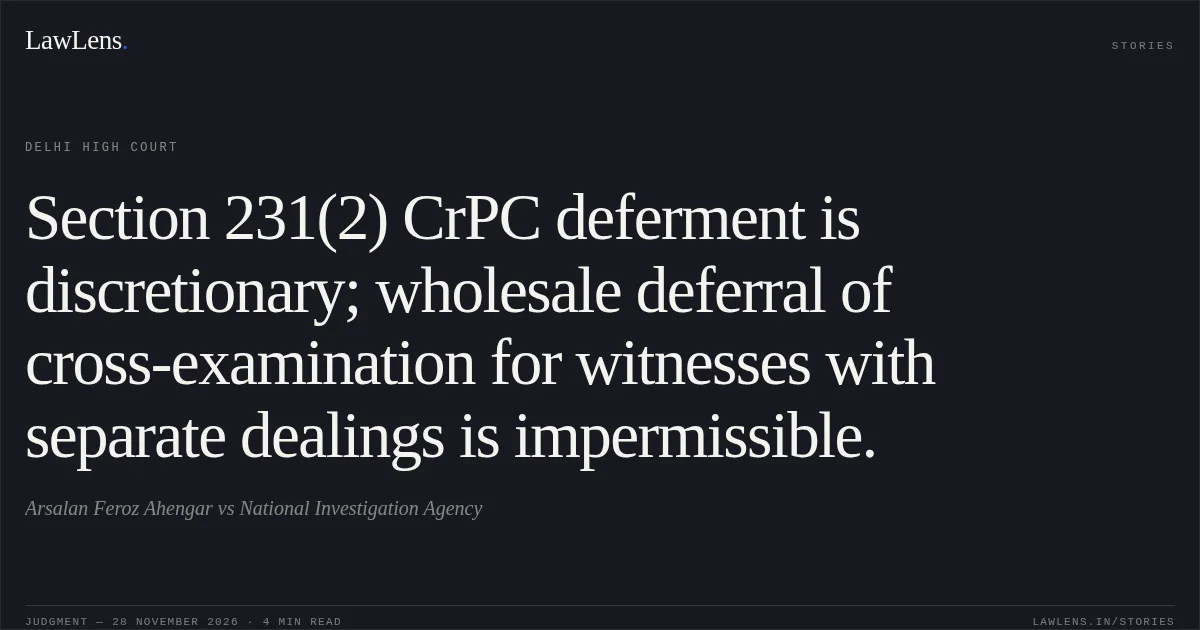
¶ 6The petitioner then applied under s. 231(2) CrPC seeking deferment of the cross-examination of LW-10, LW-18, LW-23 and LW-24 until the examination-in-chief of all 24 witnesses was recorded.
¶ 3, 6He contended that the witnesses' statements under ss. 161 and 164 CrPC overlap substantially.
¶ 7At the hearing, he sought recording of all examinations-in-chief first, followed by quick cross-examinations.
¶ 13The NIA opposed, arguing the discretion lies with the trial court and each witness speaks to distinct dealings with the petitioner.
¶ 15The Special Court (Ex-01, NIA Act) dismissed the application on 16.10.2026, holding that the witnesses had dealt with the petitioner individually, not collectively, and so did not witness the same facts.
¶ 8–10, 21The Special Court further held that cross-examining 24 witnesses on one day was impossible, and that most witnesses were childhood friends, school friends or neighbours, raising a risk of influence.
¶ 8–10, 21The present petition under s. 528 BNSS read with Art. 227 challenges that order.
¶ 302Issues
i.1. Whether a challenge to an interlocutory order under s. 231(2) CrPC, which regulates the sequence of witness examination, is maintainable under s. 528 BNSS given the bar in s. 397(2) CrPC.
¶ 16(i)ii.2. Whether the Special Court's refusal to defer cross-examination of four witnesses was arbitrary, perverse, or contrary to settled principles, warranting interference.
¶ 16(i)–(ii), 17–18iii.3. Whether the risk of disclosure of the defence, the overlap of witness testimony, and the risk of witness influence justify deferment of cross-examination.
¶ 19–2103Law Applied
Section 231(2) CrPC vests in the trial court discretion over the sequence of witness examination.
¶ 15, 16(i)Section 397(2) CrPC bars revision against interlocutory orders.
¶ 16(i)Madhu Limaye v. State of Maharashtra, (1977) 4 SCC 551 holds that the s. 397(2) CrPC bar cannot be circumvented through inherent powers except in rare cases of abuse of process or to secure the ends of justice, and that interference is warranted only where the discretion is exercised arbitrarily or perversely.
¶ 16(i)Vijay Kumar v. State (NCT of Delhi), 2017 SCC OnLine Del 9012, provides that where multiple witnesses speak to the same fact, deferment may be granted for two of them and need not extend to all, and does not contemplate wholesale deferment.
¶ 16(ii), 18State of Kerala v. Rasheed, 2018 SCC OnLine SC 2251, para. 23, directs balancing the accused's rights against the prosecution's right to lead evidence, considering threats or influence on witnesses, tailoring of later testimony, memory loss, and delay under s. 309 CrPC.
¶ 21Provisions in the judgment · 14 · Linked ones open on LawLens
Bharatiya Nagarik Suraksha Sanhita, 2023 Section 528
Code of Criminal Procedure, 1973 Section 231Section 161Section 164Section 397Section 482Section 242Section 309
Indian Penal Code, 1860 Section 122
Unlawful Activities (Prevention) Act, 1967 Section 13Section 17Section 18Section 38Section 39
04Reasoning
The order concerns only the sequence of examination, does not determine rights or liabilities, and is interlocutory, so s. 397(2) CrPC applies. Interference was therefore limited to arbitrary or perverse exercise of discretion.
¶ 16(i)Under Vijay Kumar, deferment is not required for all witnesses on the same fact, and the petitioner's request for deferral of all remaining 18 witnesses would stall the trial.
¶ 17–18The relief sought in revision differed from the relief sought before the trial court, and the impugned order could not be faulted for deciding the prayer as framed.
¶ 17Some disclosure of the defence is unavoidable where several witnesses speak to the same allegations. Since each witness speaks of separate dealings with the petitioner, nearly every witness would speak to some fact in the charge, and deferment on that basis would be untenable.
¶ 19–20Given the witnesses' personal relationships with the petitioner, a long gap between examination-in-chief and cross-examination would heighten the risk of influence and memory loss, and so weighed against deferment under Rasheed.
¶ 2105Holding
The petition under s. 528 BNSS was maintainable only to the extent that the impugned interlocutory order could be examined for arbitrariness or perversity under Madhu Limaye.
¶ 16(i)The Special Court's refusal to defer cross-examination was neither arbitrary nor perverse, and deferment of the witnesses' cross-examination would stall the trial and heighten influence risks.
¶ 16(i)–(ii), 17–21The petition was dismissed and no merit was found. The petitioner's s. 231(2) CrPC application remains refused, and the trial court may proceed with the cross-examination of LW-10, LW-18, LW-23 and LW-24.
¶ 22Original Court PDF
Arsalan Feroz AhengarvsNational Investigation Agency
Click to open original judgment
Original judgment, available to read, download and summarize on LawLens.in