Facts
The appellant claimed ownership of lands in Survey No.67 and Survey Nos.68/1 and 68/2, measuring approximately 1 acre and 41 cents at Alapakkam Village, Chengalpattu Taluk, where she operated a rice mill.
Source reference: p.2–3The lands were acquired under a notification dated 17.07.1989 under the Land Acquisition Act, 1894, for a Tamil Nadu Housing Board scheme, and Award No.4 of 1992 was passed on 28.08.1992.
Source reference: p.2–3As ownership was disputed among competing claimants, compensation of Rs.41,636/- was deposited before the Civil Court, Chengalpattu, under Sections 30 and 31(2) of the 1894 Act.
Source reference: p.2–3Possession of Survey Nos.68/1 and 68/2 was taken by the Housing Board on 17.07.2006, while possession of Survey No.67 continued with the appellant due to an interim order against dispossession obtained in 2009.
Source reference: p.3After the 2013 Act came into force, the appellant filed W.P.No.3560 of 2016 seeking a declaration that the acquisition had lapsed under Section 24(2) of the Right to Fair Compensation and Transparency in Land Acquisition, Rehabilitation and Resettlement Act, 2013.
Source reference: p.3–4The learned Single Judge rejected the claim, holding that compensation had been deposited in court and that the acquisition had not lapsed.
Source reference: p.3–4The present writ appeal challenged that order.
Source reference: no citationIssues
1. Whether the acquisition proceedings had lapsed under Section 24(2) of the 2013 Act on the ground that the appellant had not personally received compensation and possession of part of the land had not been taken.
Source reference: p.3–4, 6–82. Whether deposit of compensation before the Civil Court under Sections 30 and 31(2) of the 1894 Act, owing to a dispute regarding title, constituted payment or deposit of compensation for the purposes of Section 24(2) of the 2013 Act.
Source reference: p.4–73. Whether the validity of the 1992 award could be challenged in the writ appeal on the ground that it was allegedly made beyond the period prescribed under Section 11 of the 1894 Act.
Source reference: p.8Law Applied
The Court applied Section 24(2) of the 2013 Act, as interpreted by the Constitution Bench in Indore Development Authority v. Manoharlal, (2020) 8 SCC 129.
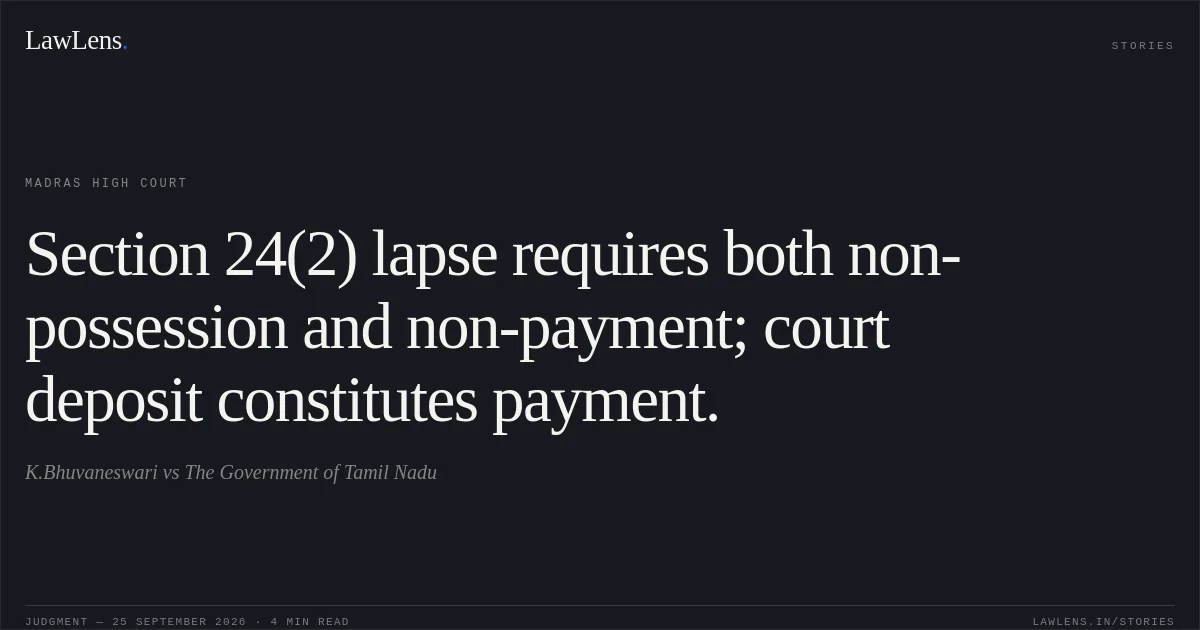
Source reference: p.6–7Under that interpretation, the expressions relating to non-taking of possession and non-payment of compensation operate conjunctively; lapse occurs only when both conditions coexist—possession has not been taken and compensation has neither been paid nor deposited.
Source reference: p.6–7Deposit of compensation under Section 31 of the 1894 Act, particularly where direct payment is prevented by a dispute as to title or entitlement, constitutes payment for Section 24(2) purposes.
Source reference: p.6–7Sections 30 and 31(2) of the 1894 Act permit deposit of compensation before the competent civil court where rival claims or disputes regarding entitlement exist.
Source reference: p.4–6A belated challenge to the validity of an award, not raised in the original writ petition and brought after several decades, is liable to be rejected on grounds of delay, laches and the impermissibility of introducing a new relief in appeal.
Source reference: p.8Reasoning
The Court found that the respondents’ contemporaneous records established that the award amount of Rs.41,636/- had been transmitted by demand draft and deposited before the Civil Court, Chengalpattu, shortly after the award, together with the statutory court-reference documents identifying the competing claimants.
Source reference: p.4–6Since the compensation was deposited in court because ownership was disputed, the appellant’s lack of personal receipt of the amount did not amount to non-payment under Section 24(2).
Source reference: p.6–7Applying Indore Development Authority, the Court held that satisfaction of either statutory limb was sufficient to prevent lapse; in any event, possession of Survey Nos.68/1 and 68/2 had been taken in 2006, and the continued possession of Survey No.67 resulted from the appellant’s own interim order.
Source reference: p.6–8The Court also declined to consider the challenge to the award’s alleged delay under Section 11 of the 1894 Act because that ground was absent from the original writ petition, sought to introduce a new challenge in appeal, and was raised against a decades-old award after prolonged acquiescence.
Source reference: p.8Holding
The Court held that the acquisition had not lapsed under Section 24(2) of the 2013 Act because compensation had been lawfully deposited before the Civil Court and possession of a substantial portion of the acquired land had been taken.
The challenge to the validity of the 1992 award was rejected as impermissible and belated.
Source reference: p.8The writ appeal was dismissed, the order of the learned Single Judge was affirmed, and the connected miscellaneous petitions were closed without any order as to costs.
Source reference: p.9Acts & Sections Cited
1 provisions across 1 statute referred to in this judgment. Each provision opens on LawLens.
Right to Fair Compensation and Transparency in Land Acquisition, Rehabilitation and Resettlement Act, 20131
Original Court PDF
K.BhuvaneswarivsThe Government of Tamil Nadu
Click to open original judgment
Original judgment, available to read, download and summarize on LawLens.in