01Facts
The Respondent No. 1, Khandelwal Jain Society, filed an eviction petition under the Delhi Rent Control Act, 1958 (“DRC Act”) before the learned Rent Controller, seeking eviction on the ground of bona fide requirement.
p. 1 · ¶ 1The Petitioner’s application for leave to defend was dismissed by order dated 14 August 2025, followed by an eviction order dated 30 August 2025 in RC ARC No. 39/19.
p. 1 · ¶ 1Before the High Court, the Petitioner expressly abandoned the challenge to the order dated 14 August 2025 and confined the revision to the eviction order.
p. 1 · ¶ 2The Petitioner contended that the Rent Controller lacked jurisdiction because the Respondent was a lessee under the Government Grants Act, 1895, and relied on a Government lease and on Union of India v. Sir Sobha Singh.
pp. 2–3 · ¶ 4–7 · p. 7 · ¶ 24The Petitioner also alleged that the Respondent possessed sufficient alternative accommodation, vacant land, and other premises capable of satisfying its claimed requirement.
p. 3 · ¶ 802Issues
i.Whether the Rent Controller lacked jurisdiction under the DRC Act because the premises were allegedly governed by the Government Grants Act, 1895?
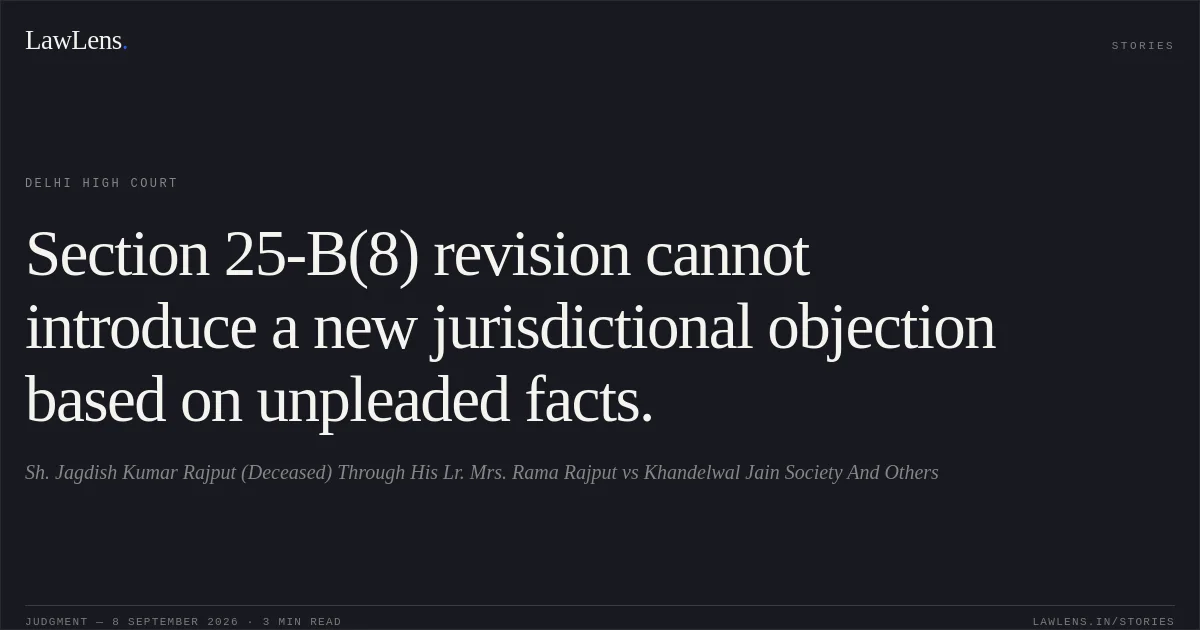
pp. 2–3 · ¶ 4–7 · pp. 6–7 · ¶ 21–25ii.Whether the Petitioner could raise the Government Grants Act jurisdictional objection for the first time in revision under Section 25-B(8) of the DRC Act?
p. 7 · ¶ 24iii.Whether the allegations regarding the Respondent’s vacant land, halls, and other premises disclosed a triable issue concerning suitable alternative accommodation?
p. 3 · ¶ 8 · pp. 7–9 · ¶ 26–32iv.Whether the eviction order disclosed a jurisdictional error, manifest illegality, material irregularity, perversity, or an error apparent on the face of the record warranting interference in revisional jurisdiction?
pp. 4–6 · ¶ 14–20 · p. 9 · ¶ 2903Law Applied
The Court applied Section 25-B(8) of the DRC Act, under which the High Court exercises limited supervisory and revisional jurisdiction over the Rent Controller’s decision and does not act as an appellate court.
pp. 4–6 · ¶ 15–19Relying on Sarla Ahuja v. United India Insurance Co. Ltd., Hindustan Petroleum Corporation Ltd. v. Dilbahar Singh, and Abid-Ul-Islam v. Inder Sain Dua, the Court held that interference is warranted only for an error apparent on the face of the record, absence of adjudication, jurisdictional error, manifest illegality, material irregularity, perversity, or a wholly unreasonable conclusion; the High Court cannot substitute its own view merely because another view is possible.
pp. 4–6 · ¶ 15–19The Court also relied on Pankaj Pahwa v. Prem Wati & Ors. and Sanjeev Hiranandani v. Sunny Grover on the restricted scope of revision under Section 25-B(8).
pp. 4–6 · ¶ 16–19The Court considered Union of India v. Sir Sobha Singh, which dealt with the applicability of the DRC Act to premises covered by a Government grant, but held that its ratio did not assist the Petitioner on the materially different facts of the present case.
pp. 6–7 · ¶ 21–23Provisions in the judgment · 4
Delhi Rent Control Act, 1958 Section 25BSection 25BSection 25B
Government Grants Act, 1895 Section 3
04Reasoning
The Court rejected the jurisdictional objection because the Petitioner was not the original lessee under the Government of India; rather, he claimed tenancy under the Respondent, which itself was the Government lessee.
p. 7 · ¶ 21–23Accordingly, Sir Sobha Singh, concerning the original lessee-lessor relationship, was factually distinguishable.
p. 7 · ¶ 21–23Further, the objection had never been pleaded or urged before the Rent Controller, and raising it in revision would require introduction of a new factual foundation, impermissible within the limited scope of Section 25-B(8).
p. 7 · ¶ 24On alternative accommodation, the Court found that the Rent Controller had considered the alleged vacant land, hall, and individual residential premises.
pp. 7–9 · ¶ 26–32The Rent Controller correctly distinguished between vacant open land and the covered accommodation allegedly required by the Respondent, and noted the absence of photographs, rent receipts, site plans, MCD records, or other supporting documents establishing that the premises were vacant, suitable, usable, and available.
pp. 7–9 · ¶ 26–32The Respondent had provided specific explanations regarding the status of each premises, including existing tenancies, pending litigation, lack of possession, or other impediments.
pp. 7–9 · ¶ 26–32Since the Rent Controller had considered the material pleas and reached a reasoned conclusion, no permissible ground for revisional interference was made out.
p. 9 · ¶ 27–2905Holding
The High Court held that the Government Grants Act objection was both factually inapplicable and impermissibly raised for the first time in revision.
p. 10 · ¶ 30–31It further held that the allegations concerning alternative accommodation were unsupported by cogent material and did not raise a triable issue.
p. 10 · ¶ 30–31Finding no jurisdictional error, manifest illegality, material irregularity, perversity, or error apparent on the face of the record, the Court dismissed RC.REV. 401/2025 and disposed of all pending applications.
p. 10 · ¶ 30–31Original Court PDF
Sh. Jagdish Kumar Rajput (Deceased) Through His Lr. Mrs. Rama RajputvsKhandelwal Jain Society And Others
Click to open original judgment
Original judgment, available to read, download and summarize on LawLens.in