Facts
The petitioner-landlady challenged the judgment dated 14 May 2018 by the learned ACJ-CCJ-ARC, East District, Delhi, dismissing her eviction petition under Section 14(1)(e) of the Delhi Rent Control Act, 1958, concerning the ground floor of property No. 30/477, Extra 30 Block, Trilokpuri, Delhi.
Source reference: paras. 1–2; pp. 1–2She claimed that the respondent was her tenant under a rent agreement dated 28 September 2013 and that she required the premises for herself and her visiting son and his family.
Source reference: para. 29; pp. 9–10The respondent denied the tenancy, alleged that he had occupied the premises since 1997, and contended that the petitioner and her family were permanently settled in Uttar Pradesh.
Source reference: para. 29; p. 10After a full-fledged trial, the ARC found that the rent agreement had not been proved, the landlord-tenant relationship was not established, the petitioner was not residing in the premises, and the respondent’s family had occupied it prior to the alleged tenancy.
Source reference: paras. 29–30; pp. 10–12The ARC also held, suo motu, that the premises stood on Government land.
Source reference: para. 29; p. 12Issues
Whether the ARC committed a jurisdictional error, material irregularity, or perversity in finding that the rent agreement was not proved and that no landlord-tenant relationship existed between the parties?
Source reference: paras. 30–36; pp. 12–14Whether the ARC materially misappreciated the evidence in finding that the petitioner and her family resided in Uttar Pradesh and that the respondent’s family had occupied the premises before the alleged tenancy?
Source reference: paras. 38–42; pp. 14–16Whether the ARC’s finding that the premises stood on Government land was legally sustainable, and whether that finding affected the dismissal of the eviction petition?
Source reference: paras. 43–48; pp. 16–17Whether interference was warranted in exercise of the High Court’s limited revisional jurisdiction under the proviso to Section 25-B(8) of the DRC Act?
Source reference: paras. 22–28, 47–51; pp. 7–9, 17–18Law Applied
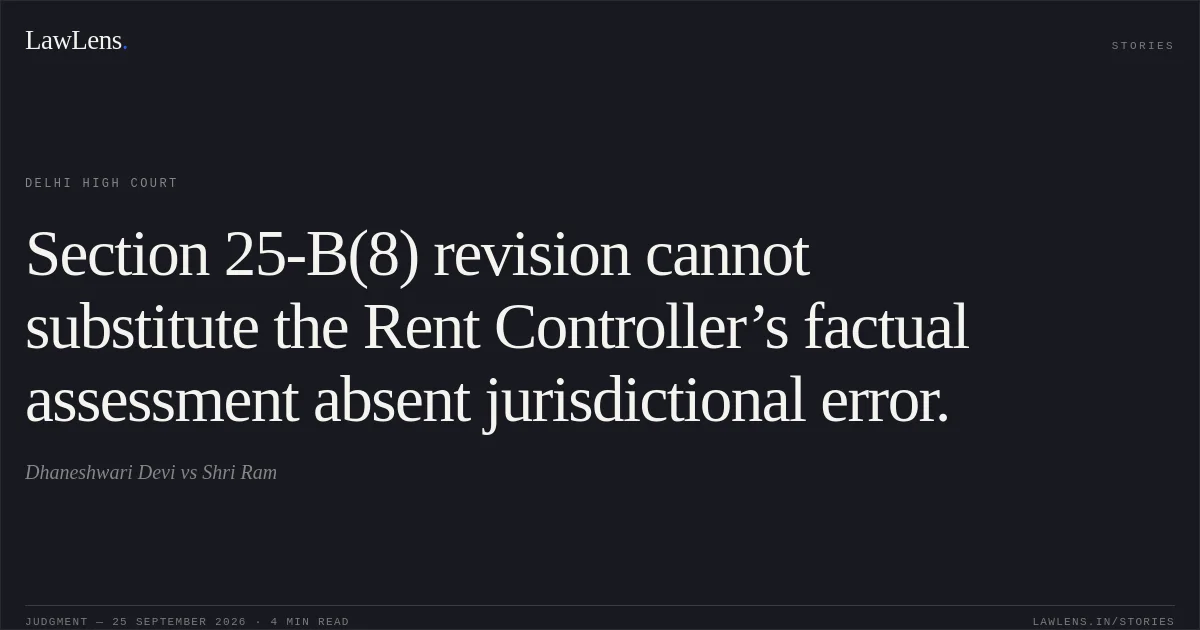
The Court applied the proviso to Section 25-B(8) of the Delhi Rent Control Act, 1958, under which the High Court exercises supervisory and revisional, not appellate, jurisdiction.
Source reference: paras. 23–27; pp. 7–9Relying on Sarla Ahuja v. United India Insurance Co. Ltd., (1998) 8 SCC 119, Hindustan Petroleum Corporation Ltd. v. Dilbahar Singh, (2014) 9 SCC 78, and Abid-Ul-Islam v. Inder Sain Dua, (2022) 6 SCC 30, the Court held that it could interfere only for jurisdictional error, manifest illegality, material irregularity, perversity, an error apparent on the face of the record, or failure of adjudication; it could not reappreciate evidence or substitute its own view merely because another view was possible.
Source reference: paras. 23–27; pp. 7–9The Court also relied on Pankaj Pahwa v. Prem Wati and Sanjeev Hiranandani v. Sunny Grover for the restricted scope of revisional scrutiny.
Source reference: para. 24; p. 7As a substantive requirement for eviction under Section 14(1)(e), the petitioner was required to establish the foundational landlord-tenant relationship and the factual basis of her pleaded occupation and bona fide requirement.
Source reference: paras. 35–37; pp. 13–14Reasoning
The Court held that the ARC did not reject the rent agreement arbitrarily. The respondent had denied its execution, the circumstances pleaded by the petitioner were considered inconsistent with the alleged execution, and the ARC noticed apparent differences between the respondent’s signatures on the rent agreement and his affidavit.
Source reference: paras. 30–32; p. 13The respondent’s photograph, police verification form, and voter identity card did not, by themselves, prove execution of the agreement or the existence of a tenancy.
Source reference: paras. 33–35; pp. 13–14On residence and prior occupation, the ARC had considered the petitioner’s electoral roll, ration card, bank statement, the testimony of PW-1 regarding his permanent settlement in Jaunpur, and evidence concerning the employment and residence of the petitioner’s sons in Uttar Pradesh.
Source reference: paras. 38–41; pp. 14–16School records showing the premises as the address of the respondent’s granddaughter and son supported the finding that the respondent’s family occupied the premises before the alleged tenancy.
Source reference: para. 40; p. 15Reassessing this evidence would have exceeded the Court’s revisional jurisdiction.
Source reference: para. 41; p. 15The Court agreed that the ARC’s finding regarding Government ownership was not supported by a specific claim or title document and could be regarded as an overreach.
Source reference: paras. 43–44; p. 16However, that finding was unnecessary to the result because the eviction petition independently failed for want of proof of the landlord-tenant relationship and the petitioner’s pleaded occupation of the premises.
Source reference: para. 45; p. 16Holding
The Court answered the principal issues against the petitioner. It held that the ARC’s findings regarding the unproved rent agreement, absence of an established landlord-tenant relationship, and the petitioner’s failure to establish occupation of the premises did not suffer from jurisdictional error, material irregularity, perversity, or patent illegality.
The finding concerning Government land, even if excluded, did not affect the outcome because the dismissal was independently supported by the other findings.
Source reference: paras. 43–48; pp. 16–17Accordingly, the revision petition was dismissed, the impugned judgment was upheld, and the pending applications, if any, were disposed of. No order was made as to costs.
Source reference: paras. 51–54; p. 18Acts & Sections Cited
1 provisions across 1 statute referred to in this judgment. Each provision opens on LawLens.
delhi rent control act, 19581
Original Court PDF
Dhaneshwari DevivsShri Ram
Click to open original judgment
Original judgment, available to read, download and summarize on LawLens.in