Facts
On 24 June 2006, acting on secret information, a police party raided the appellant’s house. The appellant allegedly attempted to flee but was apprehended, and a country-made pistol loaded with a live cartridge was recovered from his possession. A search of his house allegedly resulted in the seizure of four crude bombs kept in a polythene bag. No licence or valid documents were produced for the seized articles, and a seizure list was prepared
Source reference: p. 2, para. 3An FIR was registered under Sections 25(1-B)(a), 26 and 35 of the Arms Act and Sections 3 and 4 of the Explosive Substances Act.
Source reference: p. 2, para. 4Following investigation, a charge-sheet was filed and the matter proceeded as Sessions Trial No. 165 of 2007.
Source reference: p. 2, para. 5The Trial Court convicted the appellant under Sections 25(1-B)(a) and 26(1) of the Arms Act and Section 4 of the Explosive Substances Act, sentencing him to concurrent terms of imprisonment and fines.
Source reference: p. 3, para. 9In appeal, the appellant did not challenge the conviction on merits and primarily sought reduction of sentence on the basis of the period already undergone and the prolonged pendency of the case.
Source reference: p. 4, para. 10Issues
Whether the conviction under Section 25(1-B)(a) of the Arms Act and Section 4 of the Explosive Substances Act was sustainable on the evidence regarding recovery of the pistol, live cartridge and crude bombs?
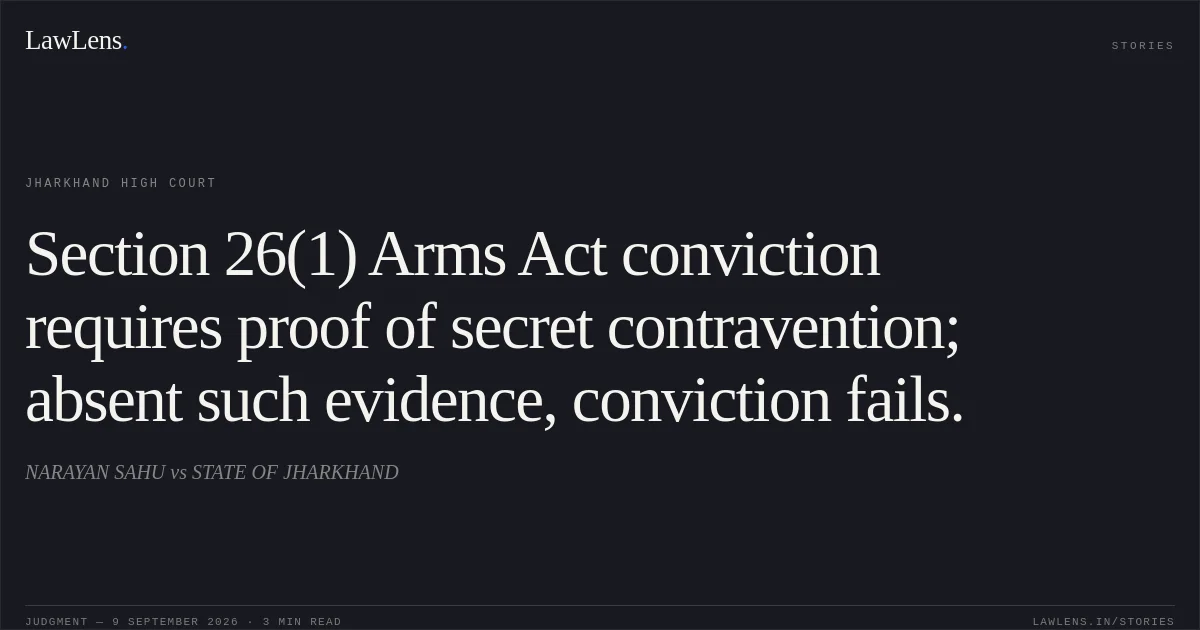
Source reference: p. 5, para. 12Whether the conviction under Section 26(1) of the Arms Act was sustainable in the absence of evidence of secret contravention as contemplated by that provision?
Source reference: p. 5, para. 12Whether the sentence imposed on the appellant should be reduced to the period of imprisonment already undergone, considering the period of custody and the prolonged pendency of the proceedings?
Source reference: pp. 4–6, paras. 10–14Law Applied
The Court applied Section 25(1-B)(a) of the Arms Act to the unauthorised possession of the country-made pistol and live cartridge, and Section 4 of the Explosive Substances Act to the possession of explosive substances in the form of crude bombs.
Source reference: p. 5, para. 12It also considered Section 26(1) of the Arms Act, which, as applied by the Court, required proof of a secret contravention; in the absence of such proof, conviction under that provision could not stand.
Source reference: p. 5, para. 12On sentencing, the Court exercised its appellate discretion to modify the punishment in view of the appellant having undergone approximately three years of custody, the occurrence having taken place in 2006, and the prolonged agony of trial.
Source reference: pp. 5–6, paras. 13–14Reasoning
The Court found that the recovery evidence established that the appellant was apprehended with a country-made pistol and live cartridge without a valid licence. The Sergeant Major’s report confirmed that the pistol was functional, supporting the conviction under Section 25(1-B)(a) of the Arms Act.
Source reference: p. 5, para. 12The four crude bombs recovered from the appellant’s house were defused, examined by the forensic laboratory and proved to be explosive articles, thereby sustaining the conviction under Section 4 of the Explosive Substances Act.
Source reference: p. 5, para. 12However, the prosecution failed to establish the specific element of secret contravention necessary for Section 26(1) of the Arms Act. The Court therefore set aside that conviction and sentence.
Source reference: p. 5, para. 12Considering that the appellant had already remained in custody for about three years, exceeding the two-year sentence imposed under Section 25(1-B)(a), and had faced the proceedings for more than two decades, the Court reduced the custodial sentences for the surviving convictions to the period already undergone.
Source reference: pp. 5–6, paras. 13–14Holding
The appeal was dismissed on merits with modification. The convictions under Section 25(1-B)(a) of the Arms Act and Section 4 of the Explosive Substances Act were upheld, while the conviction and sentence under Section 26(1) of the Arms Act were set aside for want of proof of secret contravention.
The sentences for the surviving offences were modified to imprisonment for the period already undergone.
Source reference: p. 6, para. 14As the appellant was on bail, he was discharged from the liability of his bail bond and his sureties were also discharged.
Source reference: p. 6, para. 16Acts & Sections Cited
5 provisions across 2 statutes referred to in this judgment. Each provision opens on LawLens.
Arms Act, 19593
Original Court PDF
NARAYAN SAHUvsSTATE OF JHARKHAND
Click to open original judgment
Original judgment, available to read, download and summarize on LawLens.in