Facts
The respondent-assessee, a partnership firm engaged in manufacturing corrugated boxes, filed its return for Assessment Year 2021–22 declaring total income of ₹44,17,760.
Source reference: p.4Its assessment under Section 143(3) read with Section 144B of the Income-tax Act, 1961 was completed on 29 November 2022, accepting the returned income.
Source reference: p.4The Principal Commissioner of Income Tax (“PCIT”) thereafter invoked Section 263, alleging that the Assessing Officer had failed to make proper inquiries regarding unsecured loans aggregating to ₹2,34,60,000, particularly concerning the creditors’ creditworthiness and the genuineness of the transactions.
Source reference: pp.4–5, 11–12The PCIT set aside the assessment and directed a fresh assessment after further inquiry and verification.
Source reference: p.5The Income Tax Appellate Tribunal (“ITAT”) reversed the PCIT’s order, finding that the assessee had furnished books of account, bank statements, loan details, confirmations, balance sheets, income-tax returns of the lenders and other supporting documents during assessment proceedings.
Source reference: pp.8–10The Revenue challenged the ITAT’s decision under Section 260A.
Source reference: no citationIssues
1. Whether the ITAT was correct in holding that the PCIT could not invoke revisional jurisdiction under Section 263 despite the alleged failure of the Assessing Officer to conduct the inquiry contemplated under Explanation 2(a) to Section 263(1).
Source reference: pp.2–32. Whether the assessment order was erroneous and prejudicial to the interests of the Revenue because the Assessing Officer allegedly failed to examine the creditworthiness of the creditors and the genuineness of the unsecured loans.
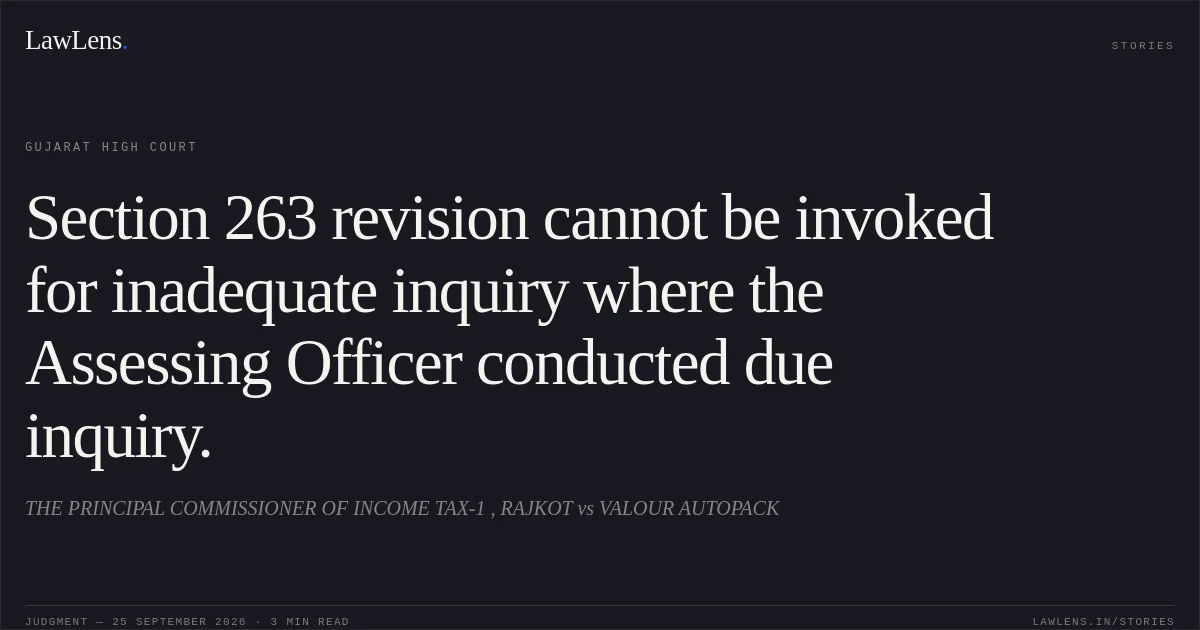
Source reference: pp.2–33. Whether the case involved “lack of inquiry,” warranting revision under Section 263, or merely “inadequate inquiry,” which could not justify revision merely because the PCIT held a different view.
Source reference: p.3Law Applied
Section 263 of the Income-tax Act permits revision only where an assessment order is both erroneous and prejudicial to the interests of the Revenue.
Source reference: no citationUnder the distinction recognized in *CIT v. Sunbeam Auto Ltd.*, inquiry that is merely inadequate does not, by itself, justify revision; revision may be warranted where there is a complete lack of inquiry.
Source reference: pp.13–15Under *Malabar Industrial Co. Ltd. v. CIT*, every loss of revenue does not make an assessment order prejudicial; where the Assessing Officer adopts one of two legally permissible views, the order is not erroneous unless the view taken is unsustainable in law.
Source reference: pp.12, 14–16The Court also relied on *Ranka Jewellers v. Addl. CIT* for the principle that once an issue has been considered by the Assessing Officer, the Commissioner cannot invoke Section 263 merely to substitute his own view.
Source reference: p.16The Tribunal had additionally referred to *CIT v. Ayachi Chandrashekhar*, concerning the relevance of subsequent repayment of loans.
Source reference: pp.9–10Reasoning
The High Court upheld the ITAT’s factual finding that the Assessing Officer had made inquiries regarding the unsecured loans and that the assessee had supplied the requested documentary material, including loan confirmations, financial records, bank statements and income-tax returns of the lenders.
Source reference: pp.6–10The fact that the assessment order did not discuss each document or record the inquiry in elaborate detail did not establish a complete absence of inquiry.
Source reference: pp.8–10The Court applied the distinction between “lack of inquiry” and “inadequate inquiry,” holding that the extent of inquiry required in an assessment is primarily within the Assessing Officer’s domain; the PCIT could not exercise Section 263 jurisdiction merely because he considered further verification desirable or preferred a different view.
Source reference: pp.13–17Since the Assessing Officer had adopted a legally permissible view after considering the material placed on record, the statutory conditions of an order being both erroneous and prejudicial to the Revenue were not satisfied.
Source reference: pp.14–17Holding
The Gujarat High Court held that the PCIT was not justified in invoking Section 263 on the ground of alleged lack of inquiry into the unsecured loans.
The ITAT correctly found that the case involved, at most, an allegation of inadequate inquiry, not a complete absence of inquiry, and that the assessment order was neither shown to be erroneous nor prejudicial to the interests of the Revenue.
Source reference: p.17No substantial question of law arose from the ITAT’s order. The Revenue’s appeal was accordingly dismissed.
Source reference: p.18Acts & Sections Cited
7 provisions across 1 statute referred to in this judgment. Linked provisions open on LawLens.
Income Tax Act, 19617
Original Court PDF
THE PRINCIPAL COMMISSIONER OF INCOME TAX-1 , RAJKOTvsVALOUR AUTOPACK
Click to open original judgment
Original judgment, available to read, download and summarize on LawLens.in