01Facts
On 19 June 2010, the Sub Inspector of Perumpadappu Police Station allegedly seized 150 grams of dry ganja from the appellant, Rasheed, who was found holding a plastic cover in a bye-lane near Jas Jewellery, Perumbadappu.
¶ 3 · pp. 10–13After his arrest, the appellant allegedly made a disclosure statement that further ganja had been concealed in his residential house. Acting on the disclosure, the police proceeded with him to House No. P.P.18/296, where he allegedly took out two packets of ganja weighing 905 grams and 995 grams respectively from the eastern bedroom, totalling 1,900 grams.
¶ 3, 12 · pp. 14–16The Special Court under the NDPS Act, Vatakara, convicted him under Section 20(b)(ii)(B) of the Narcotic Drugs and Psychotropic Substances Act, 1985, and sentenced him to three years’ rigorous imprisonment, a fine of ₹75,000, and one year’s rigorous imprisonment in default.
¶ 4–5 · pp. 3–4The appellant challenged the conviction principally on the ground that the house belonged to his mother and was occupied by several family members, making exclusive conscious possession of the 1,900 grams doubtful.
¶ 6, 18 · pp. 4, 21–2202Issues
i.Whether the prosecution established that the appellant was in conscious possession of the 1,900 grams of ganja recovered from the residential house, notwithstanding that the house was occupied by the appellant and other family members.
¶ 10, 18–20ii.Whether the conviction under Section 20(b)(ii)(B) of the NDPS Act required interference.
¶ 10iii.Whether the sentence imposed by the Special Court warranted reduction.
¶ 2103Law Applied
The Court applied Section 20(b)(ii)(B) of the NDPS Act, which penalises possession of cannabis in a quantity greater than small quantity but less than commercial quantity.
¶ 3, 5It applied the concept of “conscious possession” under the NDPS Act, requiring possession coupled with knowledge and control over the contraband.
The Court also relied on Section 27 of the Indian Evidence Act, 1872, under which so much of information supplied by an accused in custody as distinctly relates to the fact discovered may be proved.
¶ 9, 19The Court distinguished State of Rajasthan v. Dulichand, (2009) 12 SCC 84, where recovery from a family house did not establish the accused’s exclusive possession because the place of recovery was accessible to other family members and there was no evidence connecting the accused to it.
¶ 7, 19The Court also referred to Mohd. Alam Khan v. Narcotics Control Bureau, (1996) 9 SCC 462, in the context of the statutory provisions under the NDPS Act.
¶ 8Provisions in the judgment · 7 · Linked ones open on LawLens
Narcotic Drugs and Psychotropic Substances Act, 1985 Section 18Section 20Section 50Section 57Section 66
Code of Criminal Procedure, 1973 Section 374Section 428
04Reasoning
The Court found the prosecution evidence of PW8, the detecting officer, corroborated by PW1 and the independent witness PW7, reliable regarding both the initial seizure and the subsequent recovery.
¶ 11–17Unlike in Dulichand, the contraband was not merely found in a common or accessible portion of a family residence. The appellant, while in custody, disclosed that additional ganja had been concealed in the house and thereafter personally led the police to the eastern bedroom and took out the packets from beneath the cot.
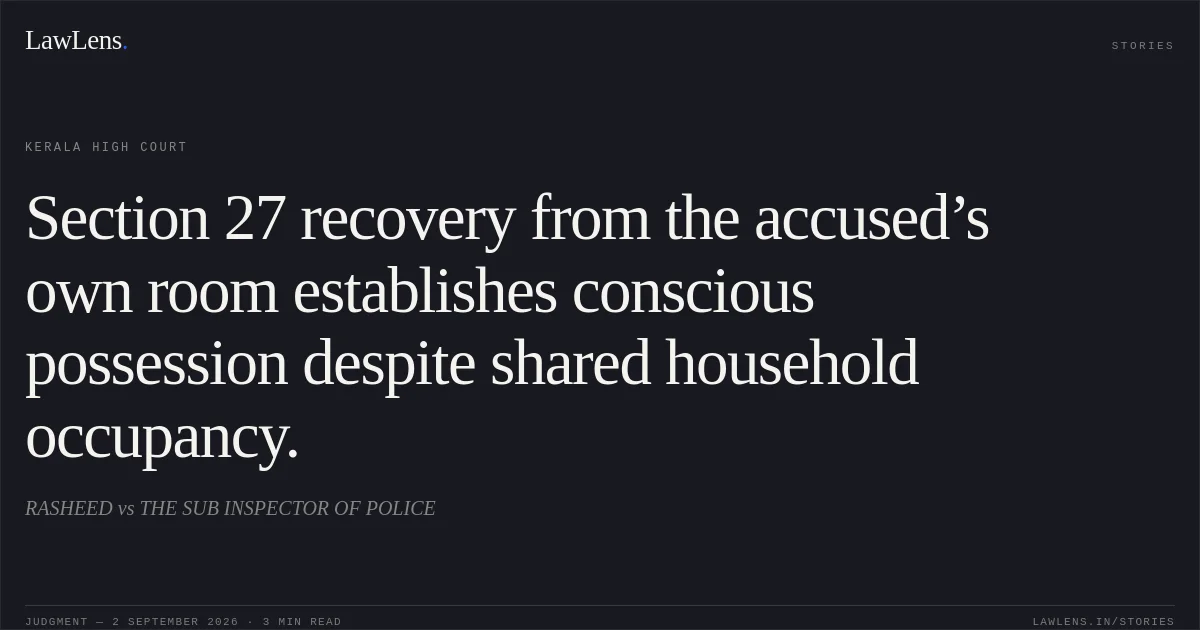
¶ 17, 19This conduct, together with the fact that the recovery directly followed his disclosure, established his knowledge, control, and conscious possession of the contraband.
¶ 19The Court therefore held that the presence of other family members in the house did not create reasonable doubt regarding the appellant’s individual possession.
¶ 19Finding no material defect in the seizure or appreciation of evidence, the Court upheld the conviction under Section 20(b)(ii)(B) of the NDPS Act.
¶ 20However, considering the circumstances urged on sentence, it reduced the imprisonment from three years to two years while retaining the fine.
¶ 2105Holding
The appeal was allowed in part. The appellant’s conviction under Section 20(b)(ii)(B) of the NDPS Act was confirmed, the Court holding that the recovery from the bedroom pursuant to his disclosure established conscious possession.
¶ 19–20The sentence was modified to two years’ rigorous imprisonment and a fine of ₹75,000, with six months’ rigorous imprisonment in default of payment of fine.
¶ 21The order suspending sentence and granting bail was cancelled, and the appellant was directed to surrender before the Special Court forthwith; failing surrender, the Special Court was directed to execute the sentence.
¶ 21Original Court PDF
RASHEEDvsTHE SUB INSPECTOR OF POLICE
Click to open original judgment
Original judgment, available to read, download and summarize on LawLens.in