Facts
The appeal challenged the judgment dated 01.07.2022 of the Sessions Judge, Goalpara, in Sessions Case No. 191/2014, acquitting respondent Nos. 2–4 of offences under Sections 302/34 and 392/34 IPC.
Source reference: para. 2, p. 3The deceased, Subudh Saha, was found dead in his bedroom on 05.01.2014 with his hands and legs allegedly tied.
Source reference: para. 3, p. 3His maid, PW-3, discovered him when she arrived for work, and respondent No. 3, who was the deceased’s nephew, lodged the FIR dated 06.01.2014, leading to registration of Dudhnoi P.S. Case No. 4/2014 under Section 302 IPC.
Source reference: para. 3, p. 3During investigation, three accused persons were arrested: two were employees of the deceased and one was his nephew and the informant.
Source reference: para. 4, p. 3The prosecution examined 16 witnesses. There was no eyewitness, although the doctor opined that the deceased died from homicidal ante-mortem asphyxia.
Source reference: para. 6, p. 4The appellants relied principally on the alleged recovery of the deceased’s mobile phone pursuant to respondent No. 3’s disclosure statement and the alleged recovery of Rs.30,610 from respondent No. 2 and Rs.3,500 from the shop’s cash box.
Source reference: paras. 7–9, pp. 4–5The Trial Court acquitted the accused, finding that the prosecution had failed to establish guilt beyond reasonable doubt.
Source reference: para. 5, p. 4Issues
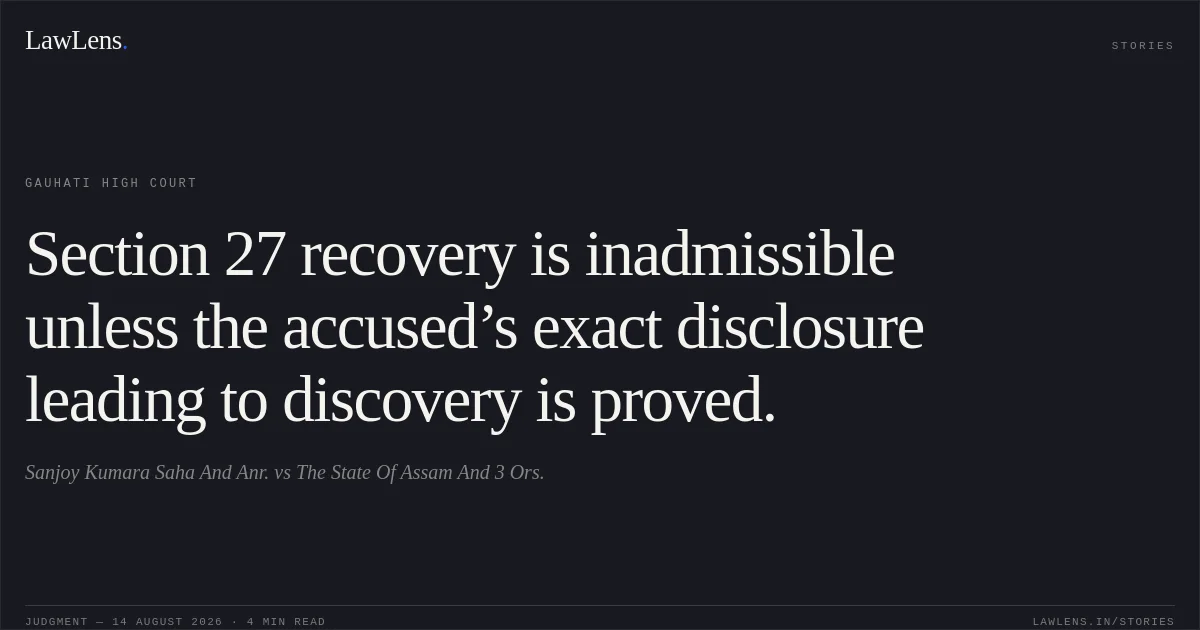
Whether the alleged recovery of the deceased’s mobile phone was admissible and proved under Section 27 of the Evidence Act as a discovery made pursuant to information supplied by respondent No. 3 while in police custody?
Source reference: paras. 15–21, pp. 6–11Whether the alleged recovery of money from respondent No. 2 and the cash box established that the money belonged to, or had been stolen from, the deceased?
Source reference: para. 22, p. 11Whether the surrounding circumstances, including the respondents’ alleged absence from the deceased’s house, established a complete chain of circumstantial evidence proving their guilt under Sections 302/34 and 392/34 IPC?
Source reference: paras. 23–25, pp. 12–13Whether the Appellate Court was justified in interfering with the order of acquittal where the Trial Court’s view was a possible view on the evidence?
Source reference: paras. 24–25, pp. 12–13Law Applied
The Court applied Sections 302/34 and 392/34 IPC concerning murder and robbery committed in furtherance of common intention.
Source reference: para. 2, p. 3Under Section 27 of the Evidence Act, only so much of information supplied by an accused in police custody as distinctly relates to the fact discovered is admissible; the prosecution must prove the accused’s information, preferably through a recorded disclosure statement, or otherwise establish the exact words used by the accused.
Source reference: paras. 17–21, pp. 7–11Relying on Mehboob Ali v. State of Rajasthan, Ghanashyam Das v. State of Assam, Boby v. State of Kerala, State of Karnataka v. David Rozario, and Subramanya v. State of Karnataka, the Court held that mere recovery of an article is insufficient unless the statutory requirements of discovery are established; conduct may, in an appropriate case, be considered under Section 8 of the Evidence Act.
Source reference: paras. 17–20, pp. 7–10The Court also applied the rule that circumstantial evidence must form a complete chain pointing only to the guilt of the accused.
Source reference: paras. 24–25, pp. 12–13In an appeal against acquittal, interference is warranted only for compelling and substantial reasons, such as patent perversity, misreading of evidence, or where guilt is the only possible conclusion; if the Trial Court’s view is reasonably possible, the acquittal cannot be overturned merely because another view is possible, relying on Tulasareddi @ Mudakappa v. State of Karnataka.
Source reference: paras. 24–25, pp. 12–13Reasoning
The Court found that the alleged mobile-phone recovery was not proved under Section 27.
Source reference: para. 15, p. 6The prosecution evidence was materially inconsistent: some witnesses stated that the phone was recovered from the bank of a pond, while others stated that it was recovered from the pond itself.
Source reference: para. 15, p. 6No witness who actually recovered the phone was examined, no written disclosure statement by respondent No. 3 was produced, and none of the witnesses testified to the exact information or words allegedly given by him.
Source reference: paras. 15–21, pp. 6–11Moreover, the seizure list did not mention the deceased’s mobile phone.
Source reference: para. 21, p. 11The alleged recovery of Rs.30,610 also did not connect the money with the deceased, and the relevant seizure list was not exhibited.
Source reference: para. 22, p. 11The alleged recovery of Rs.3,500 similarly did not establish robbery.
Source reference: para. 22, p. 11The respondents’ absence from the deceased’s house, their conduct after the incident, and the request for early cremation raised, at most, suspicion; they did not complete the chain of circumstances or establish common intention.
Source reference: paras. 23–25, pp. 12–13Since the Trial Court’s acquittal was a possible view based on the evidentiary deficiencies, the appellate standard did not permit interference.
Source reference: paras. 24–25, pp. 12–13Holding
The Court held that the prosecution failed to prove that the mobile phone was discovered pursuant to a legally admissible disclosure statement by respondent No. 3, failed to establish that the recovered money belonged to or had been stolen from the deceased, and failed to prove a complete chain of circumstantial evidence connecting respondents Nos. 2–4 with the offences under Sections 302/34 and 392/34 IPC.
Finding no patent perversity or other compelling reason to interfere with the acquittal, the Court dismissed the appeal and directed that the Trial Court Record be returned.
Source reference: paras. 26–28, p. 14Acts & Sections Cited
4 provisions across 2 statutes referred to in this judgment. Each provision opens on LawLens.
Indian Penal Code, 18603
Code of Criminal Procedure, 19731
Original Court PDF
Sanjoy Kumara Saha And Anr.vsThe State Of Assam And 3 Ors.
Click to open original judgment
Original judgment, available to read, download and summarize on LawLens.in