Facts
SAP India Private Limited (“Petitioner”) had invoked arbitration against Cox and Kings Limited (“Respondent”) in respect of unpaid amounts under a software and implementation contract.
Source reference: paras. 3–7Pursuant to the Supreme Court’s order dated 2 January 2019, a three-member tribunal presided over by Justice Madan Lokur was constituted.
Source reference: paras. 3–7SAP filed its Statement of Claim, while the Respondent filed a Counter-claim.
Source reference: paras. 3–7After the pleadings were completed, the Respondent was admitted into CIRP on 22 October 2019, triggering the Section 14 moratorium under the Insolvency and Bankruptcy Code, 2016; consequently, the Justice Lokur Tribunal adjourned the proceedings sine die on 5 November 2019.
Source reference: paras. 3–7The Respondent subsequently invoked a fresh arbitration against SAP and its parent company, SAP SE.
Source reference: paras. 8–13The Supreme Court appointed Justice Mohit Shah as sole arbitrator on 9 September 2024, leaving SAP’s jurisdictional objections open.
Source reference: paras. 8–13SAP unsuccessfully challenged the jurisdiction of the Justice Shah Tribunal before that Tribunal, the Bombay High Court and the Supreme Court; its SLP was dismissed on 23 January 2026.
Source reference: paras. 8–13SAP thereafter sought resumption of the proceedings before the Justice Lokur Tribunal.
Source reference: paras. 14–16, 21–37The Respondent opposed the request, contending that the tribunal was functus officio, that SAP had failed to show sufficient cause under Section 29A(5) of the Arbitration and Conciliation Act, 1996, and that SAP’s claim had been admitted in the liquidation process.
Source reference: paras. 14–16, 21–37The Justice Lokur Tribunal directed SAP to approach the High Court for an extension of its mandate.
Source reference: para. 16Issues
Whether the Court could extend the mandate of the Justice Lokur Tribunal under Section 29A of the Arbitration and Conciliation Act, 1996, despite the expiry of the prescribed period.
Source reference: para. 52(A)Whether SAP had demonstrated “sufficient cause” under Section 29A(5) for extending the tribunal’s mandate.
Source reference: paras. 21, 52(A)–(B)Whether the Respondent’s CIRP, the resulting moratorium, the subsequent constitution of the Justice Shah Tribunal, and SAP’s pursuit of jurisdictional challenges constituted circumstances beyond SAP’s control and negated any allegation of deliberate delay or “fence-sitting”.
Source reference: paras. 41–45, 52(D)–(E)Whether the Respondent’s liquidation, admission of SAP’s claim by the Liquidator, or the possibility of inconsistent findings justified refusing an extension.
Source reference: paras. 31–36, 52(F)Law Applied
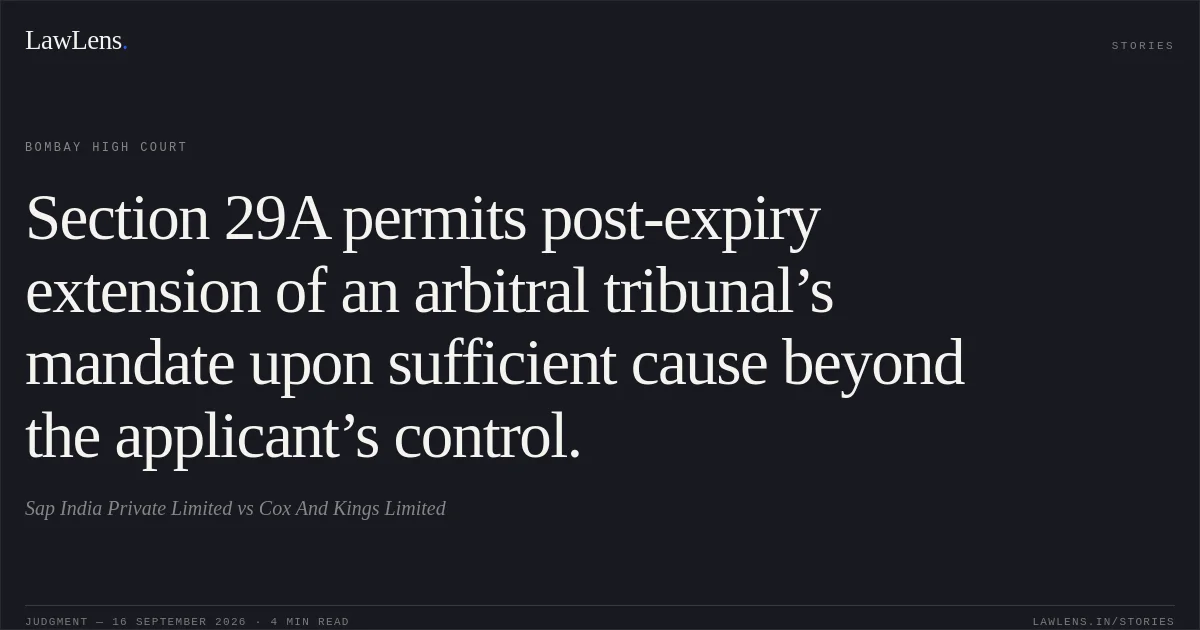
Section 29A of the Arbitration and Conciliation Act, 1996 permits the Court to extend the time for making an arbitral award, including after expiry of the statutory or consensually extended period, provided sufficient cause is shown.
Source reference: para. 52(A)The Court relied on Rohan Builders (India) Pvt. Ltd. v. Berger Paints India Ltd. for the maintainability of an extension application filed after expiry of the mandate.
Source reference: para. 52(A)It relied on C. Velusamy v. K. Indhera for the principle that extension under Section 29A is discretionary and must not be granted mechanically.
Source reference: para. 52(B)It further applied Ajay Protech Pvt. Ltd. v. General Manager for the proposition that “sufficient cause” must be assessed consistently with arbitration’s underlying objective of effective resolution of disputes through the agreed mechanism, particularly where delay is not attributable to wilful or negligent default.
Source reference: para. 52(B)The Court distinguished Rajendra Kumar v. National Highways Authority of India and Bilkish Mohammed Umar Khatri v. Sarabjit Singh Arora, where extension was refused because the delay was unexplained.
Source reference: para. 52(C)It also considered Regulation 29 of the Insolvency and Bankruptcy Board of India (Liquidation Process) Regulations, 2016, which recognises mutual credits and set-offs in liquidation.
Source reference: para. 52(F)Reasoning
The Court held that the proceedings were interrupted after completion of pleadings because the Respondent entered CIRP and became subject to the statutory moratorium, rather than because of any default by SAP or the tribunal.
Source reference: para. 52(D)The Respondent then pursued substantially the same dispute before the Justice Shah Tribunal.
Source reference: para. 52(D)Since the Supreme Court had expressly preserved SAP’s right to raise jurisdictional objections, SAP was justified in pursuing those objections before the Justice Shah Tribunal and thereafter before the High Court and Supreme Court.
Source reference: para. 52(D)SAP approached the Justice Lokur Tribunal shortly after the Supreme Court dismissed its SLP, demonstrating that it had not abandoned the original arbitration or acted as a “fence-sitter”.
Source reference: para. 52(E)The Court also found that refusing an extension would effectively prevent SAP’s claim from being adjudicated: the Respondent had withdrawn its Counter-claim from the Justice Lokur arbitration while opposing continuation of that arbitration on the basis that SAP’s claim had been dealt with in liquidation.
Source reference: para. 52(F)The Liquidator’s admission of the claim at a nominal value did not conclusively determine the claim’s merits or quantum, and issues concerning liquidation, set-off and enforceability could be raised before the tribunal.
Source reference: para. 52(F)These matters therefore did not negate sufficient cause under Section 29A(5).
Source reference: para. 52(F)In the circumstances, the delay was not deliberate, wilful or negligent, and denying an extension would defeat the purpose of arbitration.
Source reference: para. 52(G)Holding
The Bombay High Court held that SAP had established sufficient cause under Section 29A(5) and that the mandate of the Justice Lokur Tribunal ought to be extended.
The Petition was allowed, and the time for the tribunal to make an award was extended by one year, commencing from the date on which a copy of the order was uploaded.
Source reference: Order, clauses (i)–(iii)There was no order as to costs.
Source reference: Order, clauses (i)–(iii)Acts & Sections Cited
5 provisions across 2 statutes referred to in this judgment. Each provision opens on LawLens.
Arbitration and Conciliation Act, 19963
Insolvency and Bankruptcy Code, 2016.2
Original Court PDF
Sap India Private LimitedvsCox And Kings Limited
Click to open original judgment
Original judgment, available to read, download and summarize on LawLens.in