01Facts
The dispute pertains to a family partnership firm, M/s Sri Narayan Rajkumar, constituted in 1973 and reconstituted in 1974, comprising Shri Nityanand Yadav, the Appellant, and Respondent No. 1 as partners.
¶ 4-6The firm acquired a perpetual lease for a property at Plot No. Y-10, Naraina, New Delhi, in 1980.
¶ 8Following the death of partner Nityanand Yadav in 2003, Respondent No. 1 alleged that the Appellant and her husband (Shri Vishnu Kumar Surekha) fabricated several partnership deeds to usurp the firm's assets and illegally sold portions of the subject property.
¶ 12-19Respondent No. 1 invoked arbitration via notice on March 23, 2015.
¶ 20The Sole Arbitrator, in an award dated January 2, 2023, held that the subsequent partnership deeds were not proved and, since the 1974 deed remained valid, the property should be partitioned equally (50-50) between the two surviving partners.
¶ 29The Appellant’s challenge under Section 34 of the Arbitration & Conciliation Act, 1996 ("the Act") was dismissed by a Single Judge on February 21, 2025.
¶ 3002Issues
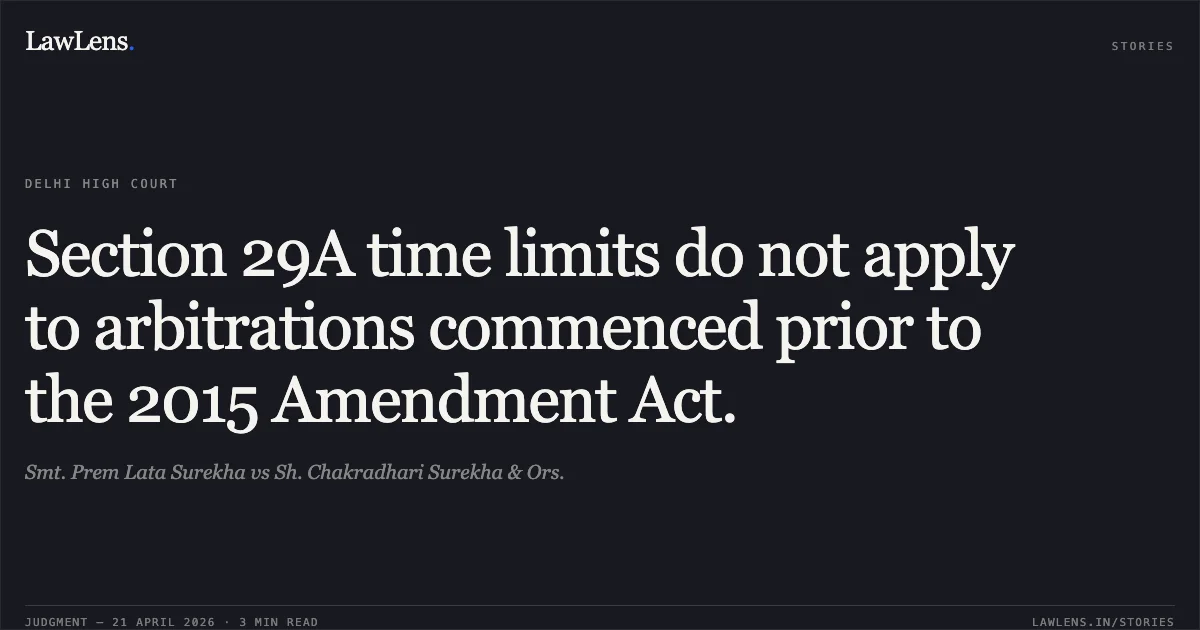
i.1. Whether the arbitral proceedings were governed by the time limits prescribed under Section 29A of the Act (as introduced by the 2015 Amendment) and if the Arbitrator had become functus officio.
¶ 49-50ii.2. Whether the Arbitrator erred in ignoring the alleged re-constitution of the firm and the rights of other potential beneficiaries/legal heirs.
¶ 32, 59iii.3. Whether the High Court, in its appellate jurisdiction under Section 37, should interfere with the concurrent findings of the Arbitrator and the Single Judge.
¶ 6203Law Applied
The Court applied Section 21 of the Act, which stipulates that arbitral proceedings commence on the date the request for arbitration is received by the respondent.
¶ 50It further applied Section 26 of the Arbitration and Conciliation (Amendment) Act, 2015, which provides that the amendment applies prospectively and does not affect proceedings commenced prior to October 23, 2015, unless otherwise agreed.
¶ 50, 53Regarding partnership law, the Court relied on Sections 32 and 43 of the Partnership Act, 1932, regarding the retirement of partners and the dissolution of a partnership at will.
¶ 29(IV)(A)For the scope of judicial review, the Court followed the principles laid down in MMTC Limited v. Vedanta Limited and Konkan Railway Corporation Limited v. Chenab Bridge Project, which restrict interference under Section 37 to the same narrow grounds as Section 34, prohibiting independent merit assessments.
¶ 63, 64Provisions in the judgment · 11 · Linked ones open on LawLens
Arbitration and Conciliation Act, 1996 Section 9Section 11Section 16Section 17Section 21Section 34Section 37
Indian Partnership Act, 1932 Section 30Section 31Section 32Section 43
04Reasoning
The Court rejected the Appellant’s contention regarding the Arbitrator’s mandate, noting that the first notice invoking arbitration was issued on March 23, 2015, prior to the 2015 Amendment; thus, the time limits under Section 29A were inapplicable.
¶ 53-55On the merits, the Court observed that the Appellant failed to produce original copies of the subsequent deeds and did not enter the witness box, leading the Arbitrator to rightly conclude that those documents were not proven.
¶ 29(I)-29(II)The Court noted that the legal heirs of the deceased partner, Nityanand Yadav, had disclaimed interest in the firm, and the minor beneficiary, Smt. Rachna Kedia, had withdrawn from the proceedings, leaving only two active partners.
¶ 56-58The Court emphasized that under Section 37, it cannot substitute its own view for that of the Arbitrator if the Arbitrator's findings are plausible and not perverse.
¶ 64-65The Appellant’s conduct, including the unauthorized sale of a portion of the subject property, was found to lack bona fides.
¶ 6705Holding
The Court dismissed the appeal, affirming the order of the Single Judge and the arbitral award.
¶ 65-66It held that the 1974 partnership deed was the only valid governing document and the 50-50 partition of the property was just.
¶ 61The Court imposed costs of Rs. 1,00,000/- on the Appellant to be paid to Respondent No. 1, citing the Appellant's non-bonafide conduct and refusal of amicable resolution.
¶ 67The matter was listed for compliance on May 25, 2026.
¶ 68Original Court PDF
Smt. Prem Lata SurekhavsSh. Chakradhari Surekha & Ors.
Click to open original judgment
Original judgment, available to read, download and summarize on LawLens.in