Facts
The applicant, owner of agricultural land cultivated by the complainant’s family on a sharecropping basis, allegedly borrowed ₹60,000 from the complainant, promising to repay it after sale of the remaining cotton crop.
Source reference: p.2 / para. 2On 4 March 2017, when the complainant’s wife demanded repayment and requested weighing of the harvested cotton, the applicant allegedly refused, told her to “do whatever you can,” and handed her a bottle of pesticide, which she consumed and subsequently died.
Source reference: p.2 / para. 2On this basis, an FIR was registered at Patanvaav Police Station for offences under Sections 306, 406 and 420 of the Indian Penal Code, 1860, read with Section 3(2)(va) of the Scheduled Castes and Scheduled Tribes (Prevention of Atrocities) Act, 1989.
Source reference: p.1 / para. 1The applicant invoked the High Court’s inherent jurisdiction under Section 482 CrPC seeking quashing of the FIR.
Source reference: p.1 / para. 1Issues
Whether the allegations in the FIR prima facie disclosed abetment of suicide under Sections 306 and 107 IPC, warranting continuation of the criminal proceedings against the applicant.
Source reference: pp.8–11, 14 / paras. 13–14Whether the alleged non-repayment of ₹60,000 constituted criminal breach of trust under Section 406 IPC.
Source reference: pp.12–15 / paras. 15–17Whether the allegations disclosed cheating under Section 420 IPC, including dishonest intention from the inception of the transaction.
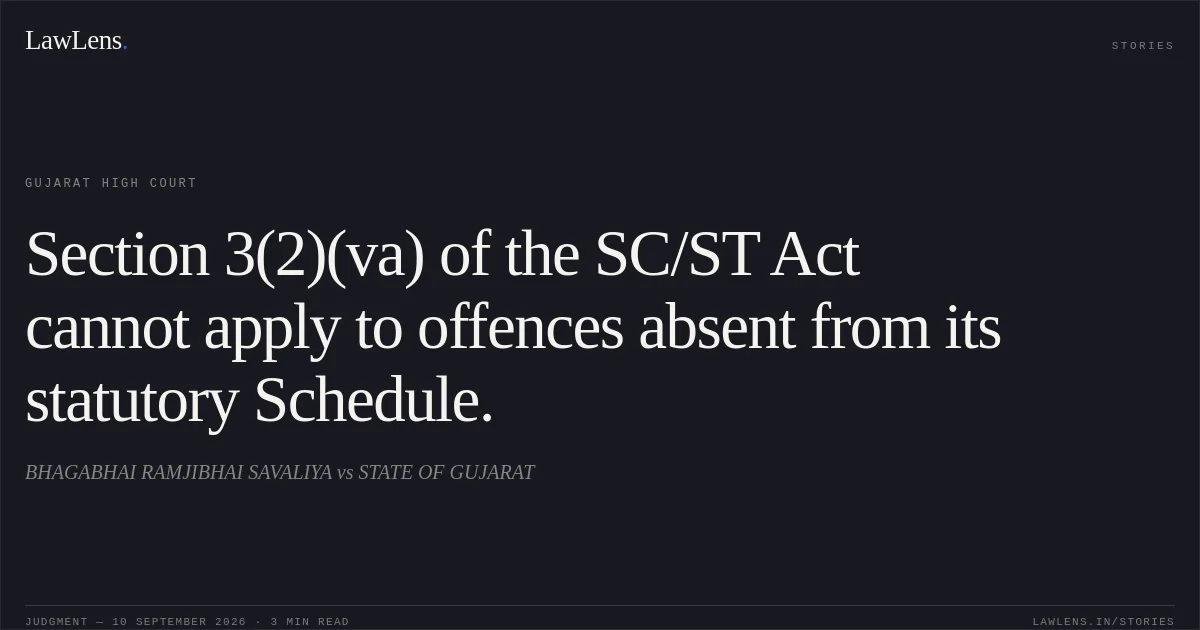
Source reference: pp.12–15 / paras. 15–17Whether Section 3(2)(va) of the SC/ST (Prevention of Atrocities) Act was attracted when the alleged IPC offences were not offences specified in the Schedule to that Act.
Source reference: p.16 / para. 18Law Applied
The Court applied Section 482 CrPC concerning the High Court’s inherent power to prevent abuse of process and secure the ends of justice.
Source reference: p.1 / para. 1For Section 306 IPC, read with Section 107 IPC, the Court held that abetment requires instigation, conspiracy or intentional aid, and that there must be a direct or indirect act of incitement having a proximate nexus with the suicide; mere harassment is insufficient.
Source reference: pp.8–11 / paras. 13–13.5For Sections 406 and 420 IPC, the Court relied on Delhi Race Club (1940) Ltd. v. State of Uttar Pradesh , 2024 SCC OnLine SC 2248, holding that Section 406 requires entrustment or dominion over property followed by dishonest misappropriation, whereas Section 420 requires deception, inducement to deliver property and dishonest intention from the inception; the two offences are conceptually distinct and cannot ordinarily coexist on the same factual basis.
Source reference: pp.12–14 / paras. 15–16Section 3(2)(va) of the Atrocities Act applies only where a non-SC/ST person commits an offence specified in the statutory Schedule against a person or property belonging to an SC/ST member, with the requisite knowledge.
Source reference: p.16 / para. 18Reasoning
The Court held that the allegation that the applicant personally handed pesticide to the deceased while refusing repayment and telling her to “do whatever you can” constituted a direct and proximate act allegedly connected with her suicide.
Source reference: p.11 / para. 14At the quashing stage, this allegation—treated as the deceased’s statement reproduced in the FIR—prima facie disclosed instigation and sufficient material to allow the Section 306 IPC allegation to proceed.
Source reference: p.11 / para. 14Section 406 IPC was not made out because the ₹60,000 was allegedly advanced as a loan, not entrusted to the applicant in a fiduciary capacity or subject to a trust; therefore, the essential element of entrustment was absent.
Source reference: p.15 / para. 17However, the Court found that the alleged promise to repay, followed by refusal to repay or even weigh the cotton, could prima facie indicate dishonest intention from the inception and therefore permitted the Section 420 IPC allegation to continue.
Source reference: p.15 / para. 17Section 3(2)(va) was held inapplicable because Sections 306, 406 and 420 IPC were not offences specified in the Schedule to the Atrocities Act, as considered by the Court.
Source reference: p.16 / para. 18Holding
The application was partly allowed.
The FIR and all consequential proceedings were quashed only to the extent of Section 406 IPC and Section 3(2)(va) of the Atrocities Act.
Source reference: pp.16–17 / paras. 18–20The allegations under Sections 306 and 420 IPC were allowed to continue.
Source reference: p.17 / paras. 20.1–20.2The applicant’s request to extend protection against coercive steps for four weeks was rejected, and any interim relief previously granted was vacated.
Source reference: p.17 / paras. 20.1–20.2; further orderActs & Sections Cited
12 provisions across 3 statutes referred to in this judgment. Each provision opens on LawLens.
Code of Criminal Procedure, 19732
Scheduled Castes and the Scheduled Tribes (Prevention of Atrocities) Act, 19892
Indian Penal Code, 18608
Original Court PDF
BHAGABHAI RAMJIBHAI SAVALIYAvsSTATE OF GUJARAT
Click to open original judgment
Original judgment, available to read, download and summarize on LawLens.in