01Facts
The appellants, Mana Munda and his wife Sambari Munda, were prosecuted for allegedly assaulting Tuna Munda during a dispute regarding his share in ancestral land. According to the prosecution, Sambari restrained Tuna while Mana approached him with a *budia* (axe). Tuna’s stepmother, Radhi Munda, intervened to protect him, whereupon Mana struck her twice on the head with the axe, causing her death at the spot.
pp. 2–4 · ¶ 2The FIR was lodged on 19 August 2008, and the appellants were charge-sheeted under Sections 341, 109, 506, 294, 307, 302 and 34 of the IPC.
p. 4 · ¶ 2The Sessions Court convicted both appellants under Sections 341, 506, 307 and 302 read with Section 34 IPC, while acquitting them under Section 294 IPC and acquitting Sambari under Section 109 IPC.
p. 2 · ¶ 5During the appeal, Sambari died and the appeal abated as against her; the proceedings continued only against Mana Munda.
p. 2The High Court principally relied upon the eyewitness testimony of Tuna, the medical evidence, the seizure of the axe, and the evidence of the post-occurrence witnesses.
pp. 9–14 · ¶ 9–1502Issues
i.Whether the testimony of Tuna, the related eyewitness, was sufficiently reliable to establish that Mana Munda inflicted the fatal axe blow on Radhi Munda?
pp. 9–14 · ¶ 9–15ii.Whether the fatal assault amounted to murder under Section 300 IPC, or culpable homicide not amounting to murder under Section 304 IPC, particularly where Radhi was an unintended victim who intervened to protect Tuna?
pp. 14–21 · ¶ 16–25iii.Whether Mana Munda was liable under Section 307 IPC for attempting to murder Tuna?
pp. 21–22 · ¶ 26iv.Whether his convictions under Sections 341 and 506 IPC, and with the aid of Section 34 IPC, were sustainable?
pp. 22–24 · ¶ 27–3003Law Applied
The Court applied Sections 299, 300, 301 and 304 Part II IPC, holding that death caused by an accused must still be tested against the four clauses of Section 300 before it can be classified as murder; knowledge that an act is likely to cause death, without the requisite intention to cause death or the particular fatal injury, may attract Section 304 Part II.
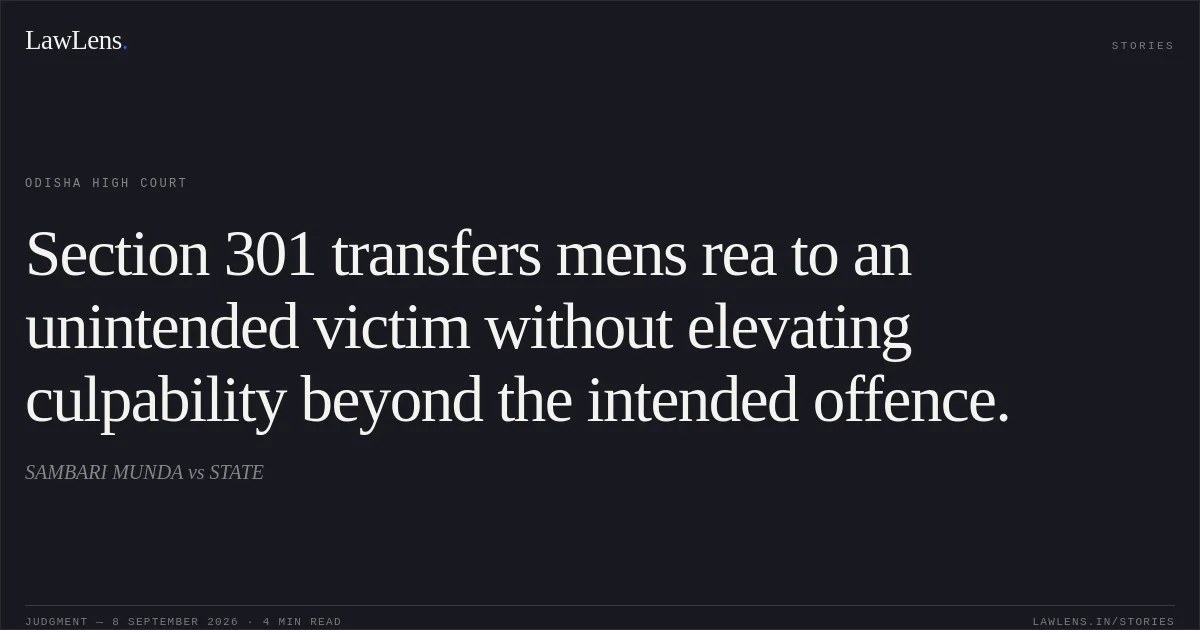
pp. 14–20 · ¶ 17–24Section 301 IPC embodies the doctrine of transferred malice, attributing the consequence to the unintended victim but not elevating the degree of homicide beyond the mens rea accompanying the original act.
pp. 16–18 · ¶ 20–21The Court also considered Exception 4 to Section 300 concerning sudden fights, but held that it was unnecessary to rely on the exception once murder itself was not established.
pp. 20–21 · ¶ 25On evidence, the Court relied on *Shivaji Sahabrao Bobade v. State of Maharashtra*, (1973) 2 SCC 793, for the principle that minor discrepancies do not discredit the core of reliable rural testimony, and *State of Rajasthan v. Kalki*, (1981) 2 SCC 752, for distinguishing a related witness from an interested witness.
pp. 10–12 · ¶ 10–11It further relied on *Anbazhagan v. State of Tamil Nadu*, (2024) 20 SCC 500, for the requirement that the prosecution must establish that the act falls within one of the four clauses of Section 300.
pp. 14–15 · ¶ 17Sections 307, 341, 506 and 34 IPC were applied according to their requirements of murderous intention, wrongful restraint, criminal intimidation and participation pursuant to common intention, respectively.
pp. 21–24 · ¶ 26–30Provisions in the judgment · 12 · Linked ones open on LawLens
Code of Criminal Procedure, 1973 Section 374
Indian Penal Code, 1860 11 provisions
Section 34Section 109Section 294Section 299Section 300Section 301Section 302Section 304Section 307Section 341Section 50604Reasoning
The Court found Tuna’s account of the material occurrence substantially consistent: Mana came armed with the axe, Radhi intervened, and Mana struck her on the head.
pp. 9–12 · ¶ 10–12The discrepancies concerning the timing of the FIR and Tuna’s communication to another witness were treated as minor, while the medical and surrounding evidence corroborated the assault.
pp. 10–14 · ¶ 10–15However, the Court distinguished between the fatal nature of the injury and the intention required under Section 300. Mana had initially proceeded to assault Tuna, and Radhi was struck only after intervening.
pp. 16–20 · ¶ 20–24Although the use of an axe and the blow to the head established knowledge that the act was likely to cause death, the prosecution did not prove an intention to kill or to inflict the specific injury sufficient in the ordinary course of nature to cause death.
pp. 16–20 · ¶ 20–24Under Section 301, the unintended death of Radhi could not attract a graver liability than would have arisen from the intended assault on Tuna.
pp. 16–20 · ¶ 20–24The Court consequently held the act to be culpable homicide not amounting to murder under Section 304 Part II.
pp. 16–20 · ¶ 20–24Section 307 was not established because no assault was actually carried out against Tuna and the requisite intention to cause death was absent.
pp. 21–22 · ¶ 26Sections 341 and 506 were also not proved against Mana, as the restraint was specifically attributed to Sambari and the alleged threat was remote and insufficiently connected with the occurrence.
pp. 22–23 · ¶ 27–28Finally, the mere relationship and presence of the accused did not establish common intention under Section 34 IPC.
p. 23 · ¶ 2905Holding
The High Court partly allowed the appeal.
pp. 23–24 · ¶ 30–31It set aside Mana Munda’s convictions under Sections 302, 307, 341 and 506 read with Section 34 IPC, and modified the conviction to Section 304 Part II IPC.
pp. 23–24 · ¶ 30–31Considering his age of more than 72 years and the fact that the occurrence occurred in 2008, the Court sentenced him to 10 years’ rigorous imprisonment.
p. 25 · ¶ 32Since he had already undergone that period, it directed that the period of detention be set off and ordered his release forthwith, unless required in any other case.
p. 25 · ¶ 32Original Court PDF
SAMBARI MUNDAvsSTATE
Click to open original judgment
Original judgment, available to read, download and summarize on LawLens.in