Facts
The Appellant, Veer Pal, married the deceased, Sarvesh, in 1996
Source reference: para 6On the intervening night of July 3 and 4, 1999, Sarvesh died due to suspected poisoning after consuming tea
Source reference: para 4, 24The prosecution alleged that the Appellant harassed and tortured the deceased for a dowry demand of ₹50,000, of which ₹30,000 was paid by her brother (PW-1), leaving a balance of ₹20,000
Source reference: para 6The deceased was taken to several medical facilities before succumbing at Maharaja Agarsain Hospital at 4:40 AM
Source reference: para 4The Trial Court convicted the Appellant under Sections 498-A and 304-B of the IPC, sentencing him to seven years of rigorous imprisonment
Source reference: para 7The Appellant challenged the conviction, citing contradictions in the testimony of PW-1 regarding a purported oral dying declaration and the lack of medical evidence proving he administered the poison
Source reference: para 10, 23Issues
1. Whether the prosecution established the ingredients of Section 304-B IPC, specifically that the deceased was subjected to cruelty or harassment "soon before" her death in connection with dowry demands
Source reference: para 11, 202. Whether the oral dying declaration allegedly made to PW-1 was credible given the medical evidence of the deceased being "unfit for statement"
Source reference: para 23, 313. Whether the conviction under Section 304-B IPC can be sustained or converted to Section 306 IPC in the absence of direct evidence of homicide
Source reference: para 32, 36Law Applied
The court applied Section 498-A IPC regarding matrimonial cruelty and Section 304-B IPC regarding dowry death, read with the presumption under Section 113-B of the Indian Evidence Act
Source reference: para 15, 14, 17It relied on Kans Raj v. State of Punjab to interpret the term "soon before death" as a proximate and live link between cruelty and death
Source reference: para 20For abetment of suicide, the court applied Section 306 IPC and the principles from Randhir Singh v. State of Punjab, which require a mental process of instigation or intentional aiding
Source reference: para 33Furthermore, the court cited K. Prema S Rao v. Yadla Srinivas Rao to establish that a conviction under Section 306 IPC is permissible even if a specific charge was not framed, provided the facts support it
Source reference: para 36Reasoning
The court observed that while the marriage was within seven years and demands for ₹20,000 persisted, the evidence regarding the cause of death was ambiguous
Source reference: para 18, 25The court rejected the alleged dying declaration reported by PW-1 because the medical record (MLC) and doctor's testimony (PW-4) confirmed the deceased was "unfit for statement" upon arrival at 12:10 AM, contradicting PW-1's claim of a conversation at 8:00 PM
Source reference: para 23, 31In the absence of proof that the Appellant forcibly administered poison, the court found the most likely scenario was suicide driven by persistent harassment
Source reference: para 26, 35The court noted that the refusal of the deceased's brother to pay the remaining ₹20,000, coupled with the Appellant's continuous pestering, created circumstances where the deceased felt she had no option but to end her life
Source reference: para 35Consequently, the court found that while the specific requirements for Section 304-B were not fully met due to the unreliable dying declaration, the evidence squarely fell under Section 306 (Abetment of Suicide) and Section 498-A
Source reference: para 32, 36Holding
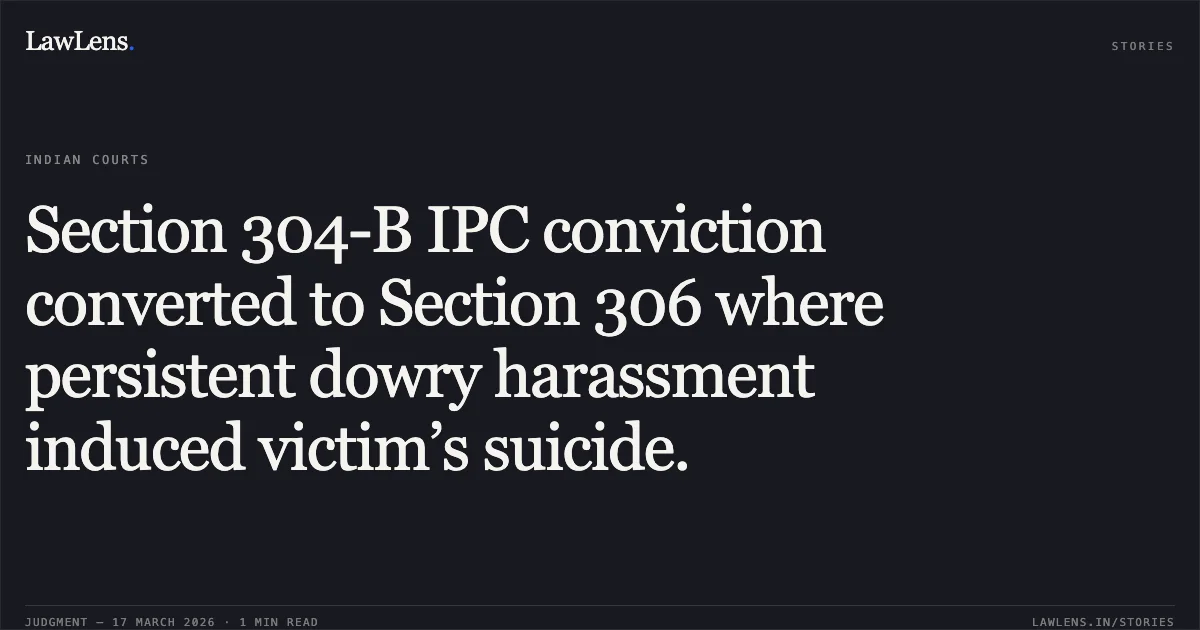
The High Court maintained the conviction under Section 498-A IPC but set aside the conviction under Section 304-B IPC, converting it to a conviction under Section 306 IPC
Regarding the sentence, the court took into account the Appellant’s long-drawn trial, his age, and the fact that he had already undergone approximately three years and eight months of incarceration
Source reference: para 37The court held that the period already undergone was sufficient to meet the ends of justice and ordered the modification of the sentence to the period of custody already served
Source reference: para 37The appeal was disposed of accordingly
Source reference: para 38Acts & Sections Cited
1 provisions across 1 statute referred to in this judgment. Each provision opens on LawLens.
Indian Penal Code, 18601
Original Court PDF
Veer PalvsState N.C.T. Of Delhi
Click to open original judgment
Original judgment, available to read, download and summarize on LawLens.in