Facts
The complainant, the deceased’s uncle, alleged that the applicant and his family subjected her to dowry-related cruelty and strangulated her on 17 May 2023, later portraying the death as suicide.
Source reference: para. 2The deceased had married the applicant in April 2021.
Source reference: para. 2After investigation, a charge-sheet was filed against the applicant, and the Magistrate took cognizance and summoned him.
Source reference: para. 3, 7The applicant sought to quash the charge-sheet, summoning order, and Sessions Trial No. 171 of 2023.
Source reference: para. 2He submitted that the complainant and other material witnesses had turned hostile, and that the post-mortem report and doctor’s statement indicated death by hanging with no external injuries.
Source reference: para. 2, 4The State opposed the application, relying on the fact that the death occurred within seven years of marriage.
Source reference: para. 5Issues
1. Whether the material on record disclosed the essential ingredients of an offence under Section 304-B of the Indian Penal Code, particularly dowry-related cruelty or harassment soon before the deceased’s death.
Source reference: para. 6–82. Whether continuation of the criminal proceedings against the applicant warranted interference by the Court in exercise of its inherent jurisdiction.
Source reference: para. 9Law Applied
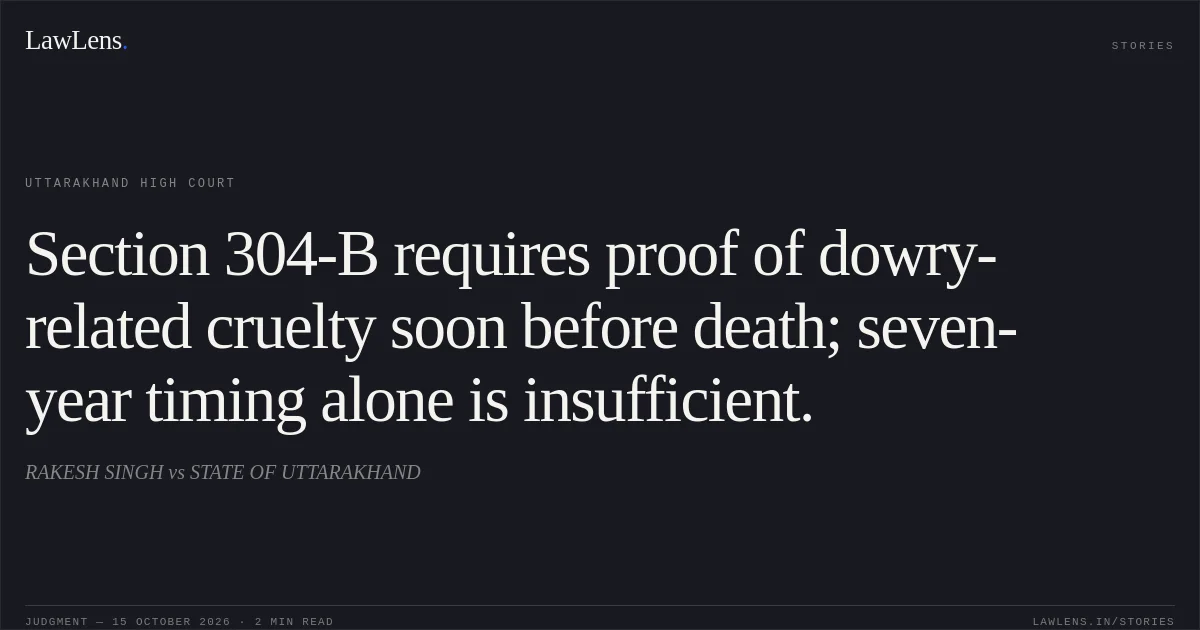
Section 304-B of the Indian Penal Code requires the prosecution to establish that a woman’s death was caused by burns or bodily injury, or occurred otherwise than under normal circumstances, within seven years of marriage, and that soon before her death she was subjected to cruelty or harassment by her husband or his relatives in connection with a demand for dowry.
Source reference: para. 6The requirement of dowry-related cruelty or harassment soon before death is an essential ingredient; death within seven years of marriage, by itself, is insufficient.
Source reference: para. 6The Court relied on Charan Singh v. State of Uttarakhand, (2024) 13 SCC 649, for these principles.
Source reference: para. 6Reasoning
Although the deceased died within seven years of marriage, that circumstance alone did not satisfy Section 304-B IPC.
Source reference: para. 7The complainant and other material witnesses did not support the prosecution case, and the medical material indicated death by hanging without external injuries.
Source reference: para. 7More importantly, the Court found no specific, cogent material showing that the deceased had been subjected to dowry-related cruelty or harassment soon before her death, or establishing the required proximate link between such conduct and the death.
Source reference: para. 8–9The essential ingredients of the alleged offence were therefore not borne out by the material before the Court.
Source reference: para. 9Holding
The Court held that the material did not disclose the essential ingredients necessary to sustain the prosecution under Section 304-B IPC and that continuing the proceedings would not serve the ends of justice.
It allowed the application and quashed the entire proceedings in Sessions Trial No. 171 of 2023 pending before the IInd Additional Sessions Judge, Rudrapur, District Udham Singh Nagar.
Source reference: para. 10Acts & Sections Cited
1 provisions across 1 statute referred to in this judgment. Linked provisions open on LawLens.
Indian Penal Code, 18601
Original Court PDF
RAKESH SINGHvsSTATE OF UTTARAKHAND
Click to open original judgment
Original judgment, available to read, download and summarize on LawLens.in