Facts
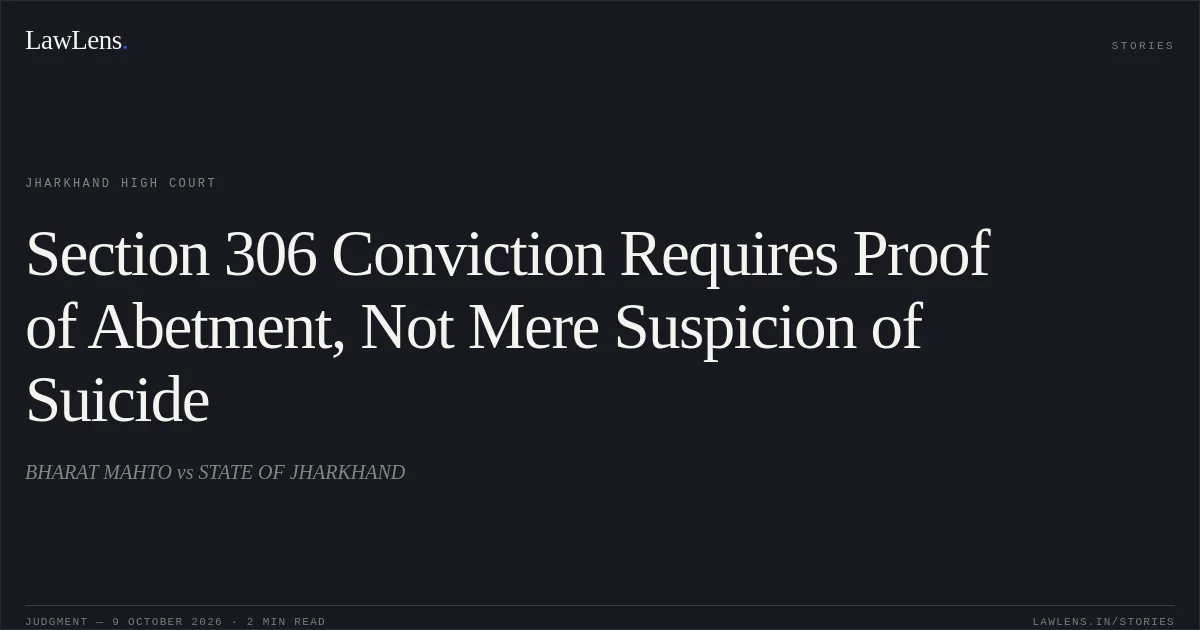
The appellant was convicted by the Sessions Judge, Hazaribag, under Section 306 IPC and Sections 3 and 4 of the Dowry Prohibition Act, and sentenced to imprisonment, with the terms to run concurrently.
Source reference: para. 2The prosecution alleged that the appellant and his family had harassed the deceased, his wife, including by calling her barren and telling her to die; the informant also alleged that she died by consuming poison.
Source reference: paras. 3–5The post-mortem disclosed no external injuries, and the cause of death was reserved pending chemical examination; the viscera report detected no poison.
Source reference: paras. 16, 20The trial court acquitted the appellant’s co-accused but convicted the appellant.
Source reference: para. 10He appealed, challenging the findings of abetment, cruelty and dowry demand.
Source reference: para. 11Issues
Whether the evidence established that the deceased committed suicide and that the appellant abetted it, so as to sustain conviction under Section 306 IPC, including by applying Section 113A of the Evidence Act.
Source reference: paras. 14, 18Whether the prosecution proved a dowry demand sufficient to sustain the appellant’s convictions under Sections 3 and 4 of the Dowry Prohibition Act.
Source reference: para. 20Law Applied
Section 306 IPC punishes a person who abets the commission of suicide; conviction requires proof of abetment.
Source reference: para. 15Under Section 113A of the Evidence Act, a court may presume abetment by a husband or his relative where a married woman commits suicide within seven years of marriage and was subjected to cruelty, having regard to all the circumstances; the court identified these as the provision’s necessary conditions.
Source reference: paras. 15, 18“Cruelty” for this purpose has the meaning assigned by Section 498A IPC, including specified wilful conduct likely to drive a woman to suicide and harassment linked to an unlawful demand.
Source reference: para. 15The court also relied on Bhupendra Nath Prasad v. State of Bihar, (1992) 2 SCC 547, for the principle that the cause of death must be established conclusively in a criminal case.
Source reference: para. 19The judgment considered the Dowry Prohibition Act charges but did not set out the text of Sections 3 or 4.
Source reference: paras. 2, 20Reasoning
The court found that the viscera examination detected no poison and that the post-mortem disclosed no injuries; it therefore considered the prosecution’s account of death by poisoning unproved and the defence evidence of snakebite more probable.
Source reference: paras. 16–17, 20It further found no reliable evidence that the appellant ill-treated or tortured the deceased after the June 1996 panchayat, and concluded that the requirements for applying Section 113A—including proof of suicide and cruelty—were not established.
Source reference: paras. 18, 20The alleged motorcycle and cash demands were absent from the informant’s initial account and the panchayat record, and the court regarded the later testimony alleging those demands as materially improved and unreliable.
Source reference: paras. 16, 20It accordingly held that neither abetment under Section 306 IPC nor the dowry-related offences had been proved.
Source reference: para. 20Holding
The High Court allowed the appeal and set aside the appellant’s convictions and sentences under Section 306 IPC and Sections 3 and 4 of the Dowry Prohibition Act.
As the appellant was on bail, he was discharged from his bail-bond liabilities and his sureties were discharged.
Source reference: para. 23Acts & Sections Cited
3 provisions across 2 statutes referred to in this judgment. Each provision opens on LawLens.
Indian Penal Code, 18601
Original Court PDF
BHARAT MAHTOvsSTATE OF JHARKHAND
Click to open original judgment
Original judgment, available to read, download and summarize on LawLens.in