Facts
The petitioners were charge-sheeted under Sections 306 read with 34 of the Indian Penal Code (IPC), based on an allegation that they assaulted and abused Nagaraj in public on 18 March 2022 and told him to “go and die”; Nagaraj died by suicide on 24 March 2022.
Source reference: para. 4, p. 3A separate prosecution relating to the alleged incident resulted in the petitioners’ acquittal after trial.
Source reference: paras. 5–6, pp. 3–6The trial court noted material discrepancies in the witnesses’ evidence and insufficient proof of the alleged assault and related offences.
Source reference: paras. 5–6, pp. 3–6The petitioners then sought to quash the proceedings in C.C. No. 21314/2023 under Section 482 of the Code of Criminal Procedure (Cr.P.C.).
Source reference: para. 1, p. 2Issues
Whether the alleged conduct attributed to the petitioners disclosed the necessary proximity and nexus to Nagaraj’s suicide, and amounted to aiding, abetting, or instigating him to commit suicide under Section 306 IPC.
Source reference: para. 8, p. 7Whether, in light of the materials on record and the acquittal in the separate prosecution arising from the alleged incident, continuation of the proceedings would amount to an abuse of process warranting quashing under Section 482 Cr.P.C.
Source reference: paras. 5–8, pp. 3–7Law Applied
Section 306 IPC requires conduct that aids, abets, or instigates the deceased to commit suicide; the alleged act must have a proximity and nexus to the death.
Source reference: para. 8, p. 7Section 34 IPC concerns joint liability for acts done in furtherance of common intention.
Source reference: no citationSection 482 Cr.P.C. preserves the High Court’s inherent power to quash criminal proceedings where their continuation would amount to an abuse of process.
Source reference: para. 1, p. 2No precedent was cited.
Source reference: no citationReasoning
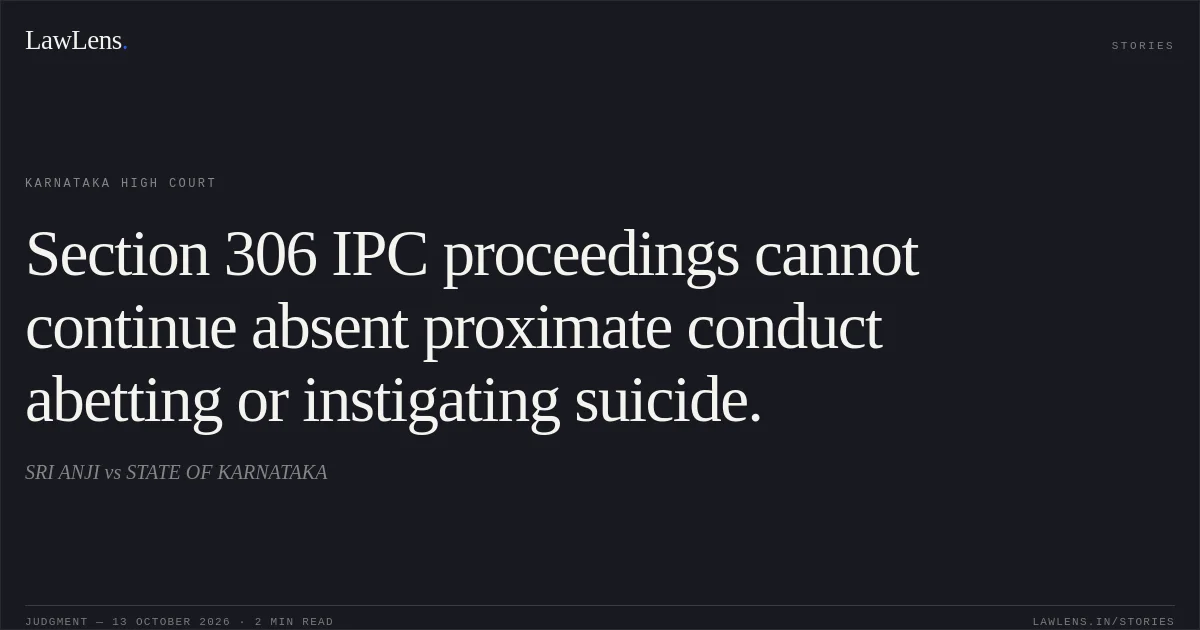
The Court considered the allegation that the petitioners’ public assault and abuse preceded Nagaraj’s suicide, but found the necessary proximity, nexus, and connection to any act of aiding, abetting, or instigating suicide absent from the materials against the petitioners.
Source reference: paras. 4, 8, pp. 3, 7It also took account of the acquittal in the separate case concerning the alleged assault and the trial court’s findings of material discrepancies and insufficient evidence.
Source reference: paras. 5–7, pp. 3–6In those circumstances, the Court held that continuing the Section 306 IPC proceedings would be an abuse of process.
Source reference: para. 8, p. 7Holding
The Court allowed the petition and quashed the entire proceedings in C.C. No. 21314/2023, arising from Crime No. 22/2022, for offences under Sections 306 read with 34 IPC, as against the petitioners.
Acts & Sections Cited
6 provisions across 2 statutes referred to in this judgment. Each provision opens on LawLens.
Code of Criminal Procedure, 19731
Indian Penal Code, 18605
Original Court PDF
SRI ANJIvsSTATE OF KARNATAKA
Click to open original judgment
Original judgment, available to read, download and summarize on LawLens.in