Facts
The appellant, Rameshwar Prasad Gupta, married the deceased, Manju, in March 1980
Source reference: para 30On November 18, 1982, Manju sustained 80–90% burn injuries and died at District Hospital, Ballia, the following morning
Source reference: para 14, 15The first informant (the deceased’s father) lodged the FIR on December 13, 1982—25 days after the incident—alleging that the appellant and his family harassed Manju for dowry, specifically a radio or ₹2,000
Source reference: para 3, 25The prosecution relied on a letter written by the deceased to her mother mentioning the demand
Source reference: para 29The Trial Court convicted the appellant under Section 306 IPC while acquitting three co-accused
Source reference: para 2, 20The appellant contended the death was accidental, occurring while cooking, and that the FIR was delayed because the informant unsuccessfully attempted to marry another daughter to the appellant
Source reference: para 16, 38Issues
1. Whether the inordinate and unexplained delay of 25 days in lodging the FIR raised a serious suspicion regarding the veracity of the prosecution's case
Source reference: para 252. Whether the acts of the appellant constituted "abetment" under Section 306 read with Section 107 of the IPC
Source reference: para 313. Whether the evidence established a "positive act" or "instigation" by the appellant proximate to the time of death that compelled the deceased to commit suicide
Source reference: para 33, 34Law Applied
The court primarily applied Section 306 (Abetment of suicide) and Section 107 (Definition of abetment) of the IPC
Source reference: para 31It relied on the principle from Meharaj Singh v. State of U.P., which holds that unexplained delay in lodging an FIR often results in colored or exaggerated versions of an incident
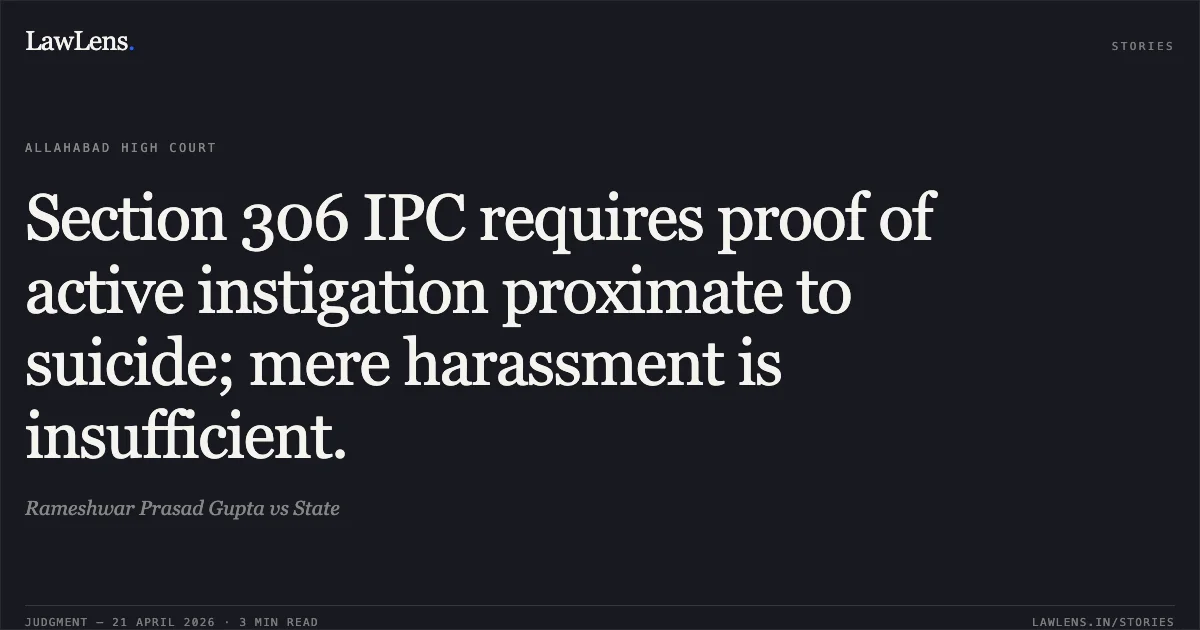
Source reference: para 27Regarding abetment, the court applied the standard from Jayedepsingh Pravinsingh Chavda v. State of Gujarat (2025) and S.S. Chheena v. Vijay Kumar Mahajan, establishing that "mere harassment" is insufficient for conviction without a clear mens rea and an active, direct act proximate to the incident that leaves the deceased with no option but suicide
Source reference: para 31, 32Reasoning
The court found the 25-day delay in lodging the FIR fatal to the prosecution, noting that the informant stayed with the appellant the night after the death yet failed to report the alleged crime immediately
Source reference: para 26, 28Upon examining the deceased’s letter (Ext. Ka-1), the court observed it was written in simple language and lacked any mention of harassment or cruelty
Source reference: para 30The court held that the prosecution failed to prove any specific overt act or omission by the appellant proximate to the suicide that could be categorized as "instigation" or "goading" under Section 107 IPC
Source reference: para 33, 34Furthermore, medical evidence from D.W.1 (Dr. S.P. Narain) showed no smell of kerosene on the body and confirmed the appellant’s family attempted to record a dying declaration and provide medical treatment, which supported the defense's version of an accidental fire
Source reference: para 36, 37Holding
The court allowed the appeal and set aside the judgment dated January 31, 1985
It held that the prosecution failed to prove the charges under Section 306 IPC beyond a reasonable doubt, as there was no evidence of active abetment or dowry-related harassment
Source reference: para 39, 40The appellant was acquitted, his bail bonds were cancelled, and he was directed to execute a personal bond under Section 481 of the Bharatiya Nagarik Suraksha Sanhita, 2023 (formerly Section 437-A Cr.P.C.)
Source reference: para 42, 43Acts & Sections Cited
8 provisions across 3 statutes referred to in this judgment. Each provision opens on LawLens.
Indian Penal Code, 18602
Code of Criminal Procedure, 19735
Bharatiya Nagarik Suraksha Sanhita, 20231
Original Court PDF
Rameshwar Prasad GuptavsState
Click to open original judgment
Original judgment, available to read, download and summarize on LawLens.in


