01Facts
A Forest Range Officer posted at Harisal committed suicide on 25.03.2021 using her official weapon and left three suicide notes alleging that the appellant, her superior officer, was responsible for her death.
pp. 1–4 · ¶ 2, 7An FIR was registered against the appellant and another senior officer for offences under Sections 306, 312, 504 and 506 of the IPC. Proceedings against the other officer were quashed, and the charge under Section 312 IPC against the appellant was subsequently quashed by the High Court.
pp. 2–3 · ¶ 2The appellant’s application for discharge under Section 227 CrPC was dismissed by the Additional Sessions Judge on 24.10.2024 and his revision was dismissed by the Bombay High Court on 24.09.2025.
p. 3 · ¶ 3The prosecution material alleged that the appellant had reprimanded the deceased, issued notices and disciplinary actions, assigned field duties, caused her humiliation, and was connected with incidents involving an atrocity FIR, miscarriage, withholding of salary and alleged harassment.
pp. 5–10 · ¶ 7–1002Issues
i.Whether the allegations and materials on record disclosed, prima facie, the ingredients of abetment of suicide under Sections 306 and 107 IPC, particularly direct or indirect instigation, intentional aid, proximity to the suicide and the requisite mens rea?
pp. 10–16, 16–19 · ¶ 14–20, 22–26ii.Whether the materials disclosed offences under Sections 504 and 506 IPC in respect of intentional insult or criminal intimidation?
p. 19 · ¶ 27iii.Whether continuation of the criminal proceedings against the appellant would amount to an abuse of the process of law warranting discharge?
pp. 18–20 · ¶ 25–2803Law Applied
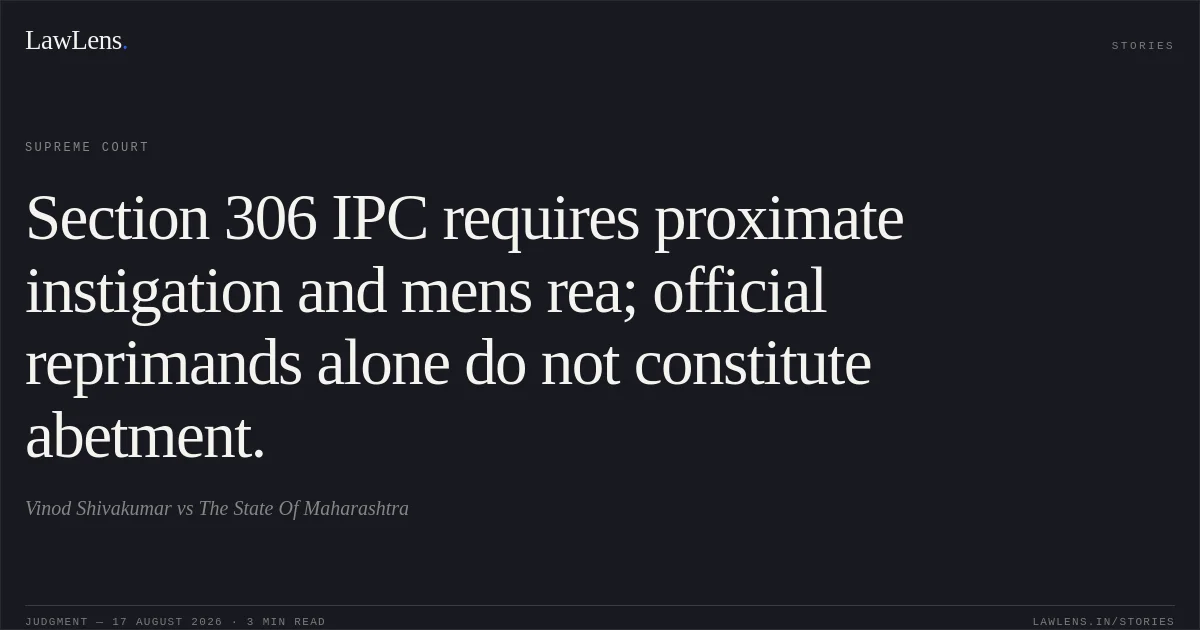
The Court applied Sections 306 and 107 IPC, holding that abetment of suicide requires suicide by the deceased together with direct or indirect instigation, conspiracy or intentional aid by the accused; such conduct must ordinarily be proximate to the suicide and accompanied by clear mens rea.
pp. 10–11 · ¶ 12–14Relying on Ude Singh v. State of Haryana, Pawan Kumar v. State of Himachal Pradesh, Madan Mohan Singh v. State of Gujarat, Amalendu Pal v. State of West Bengal, Prakash v. State of Maharashtra and Abhinav Mohan Delkar v. State of Maharashtra, the Court reiterated that mere harassment, reprimand, rude conduct or official criticism is insufficient; there must be a positive, proximate act of instigation or intentional aid which creates circumstances driving the victim to suicide, together with an intention that the accused’s conduct could lead to that result.
pp. 11–16 · ¶ 15–20For Sections 504 and 506 IPC, the Court applied the requirements of intentional insult likely to provoke breach of peace and criminal intimidation within Section 503 IPC.
p. 19 · ¶ 27Provisions in the judgment · 7 · Linked ones open on LawLens
Indian Penal Code, 1860 Section 107Section 306Section 312Section 503Section 504Section 506
Code of Criminal Procedure, 1973 Section 227
04Reasoning
The Court held that the allegations, even if accepted at face value, primarily concerned official reprimands, show-cause notices, assignment of forest and rehabilitation duties, the atrocity-related FIR and alleged trekking-related miscarriage.
pp. 16–17 · ¶ 22The alleged miscarriage occurred in October 2020, while the suicide occurred more than five months later; the encroachment incident and atrocity-related allegations dated from March 2020, and the rehabilitation work took place during 2020.
p. 17 · ¶ 23Although the prosecution referred to reprimands on 22/23.03.2021 regarding official work, the Court found no overt act immediately preceding the suicide amounting to instigation, goading or intentional aid.
pp. 17–18 · ¶ 24The suicide notes demonstrated the deceased’s anguish but did not establish that the appellant consciously intended to drive her to suicide or leave her without any reasonable alternative.
p. 18 · ¶ 25The appellant’s stern administrative conduct, without additional material showing such mens rea, could not be converted into abetment under Section 306 IPC. The allegations also failed to establish intentional insult likely to provoke breach of peace or criminal intimidation; additionally, the appellant was not competent to suspend the deceased independently.
p. 19 · ¶ 2705Holding
The Supreme Court held that no prima facie case was made out under Sections 306, 504 or 506 IPC and that the statutory ingredients of abetment of suicide were absent.
pp. 18–19 · ¶ 25–27The appeal was allowed; the Bombay High Court’s judgment dated 24.09.2025 and the Additional Sessions Judge’s order dated 24.10.2024 were set aside. The appellant was discharged from Sessions Case No. 52 of 2021, and his bail bonds, if any, were cancelled.
pp. 19–20 · ¶ 28Original Court PDF
Vinod ShivakumarvsThe State Of Maharashtra
Click to open original judgment
Original judgment, available to read, download and summarize on LawLens.in