Facts
Ramu Yadav died by suicide on 13 May 2024. The FIR alleged that the petitioners were connected with land-plot transactions and that, when Ramu sought an account of the sale proceeds, some petitioners allegedly told him that he could die if he wished. The FIR invoked Sections 306 and 34 of the IPC.
Source reference: para. 2–8, 18The investigation recorded that Ramu was not an owner or party to the relevant sale deeds; the deeds predated his death and recorded payment or receipt of consideration. CDR and location material did not corroborate the alleged meeting on 10 May 2024.
Source reference: para. 2–8, 18The petitions under Section 482 CrPC/Section 528 BNSS were filed before the charge-sheet and framing of charge; both occurred while the petitions were pending.
Source reference: para. 2–8, 18Issues
Whether the petitions remained maintainable under the High Court’s inherent jurisdiction after the charge-sheet was filed and charges were framed during their pendency, or whether the petitioners had to pursue revision.
Source reference: para. 16–21Whether the allegations and investigation material disclosed the essential elements of abetment of suicide under Sections 107 and 306 IPC, read with Section 34 IPC, so as to justify continuation of the proceedings.
Source reference: para. 22–30, 31–53Law Applied
Section 306 IPC requires abetment of suicide as defined by Section 107 IPC: instigation, conspiracy accompanied by an act or illegal omission, or intentional aid. Instigation involves provoking, inciting, urging, or encouraging the act; the accused must have the requisite mens rea, and the conduct must have a proximate nexus with the suicide (Ramesh Kumar v. State of Chhattisgarh, M. Mohan v. State, Geo Varghese v. State of Rajasthan and Ude Singh v. State of Haryana).
Source reference: para. 25–30Mere harassment, dispute, or unpleasant conduct is insufficient without the requisite intentional and proximate act of abetment.
Source reference: para. 28–30Section 34 IPC does not independently create an offence; it attributes joint liability where a criminal act is committed in furtherance of common intention.
Source reference: para. 47Under State of Haryana v. Bhajan Lal, the High Court may quash proceedings where, even accepting the allegations, no offence is disclosed or where quashing is required to prevent abuse of process.
Source reference: para. 22–23, 50Inherent jurisdiction under Section 482 CrPC and Section 528 BNSS is not absolutely barred by the availability of discharge or revision, and may be exercised at a later procedural stage where justified.
Source reference: para. 18–20Reasoning
The Court rejected the maintainability objection because the petitions had been instituted before the charge-sheet and framing of charge; those later developments did not retrospectively invalidate the petitions.
Source reference: para. 18–21On the merits, the deceased was neither an owner nor a party to the relevant sale transactions, and the registered documents recorded payment or receipt of consideration.
Source reference: para. 31–34The investigation’s CDR and location material did not corroborate the alleged meeting or instigating words on 10 May 2024; as to Hariom Batham, it disclosed only one brief call substantially earlier and no proximate conduct.
Source reference: para. 35–37, 42The Court considered the investigation material as a whole and found no sufficient basis to infer instigation, intentional aid, mens rea, or a proximate nexus between the petitioners’ conduct and the suicide. It concluded that Section 34 could not sustain the case where the substantive offence was not prima facie established.
Source reference: para. 41–47Holding
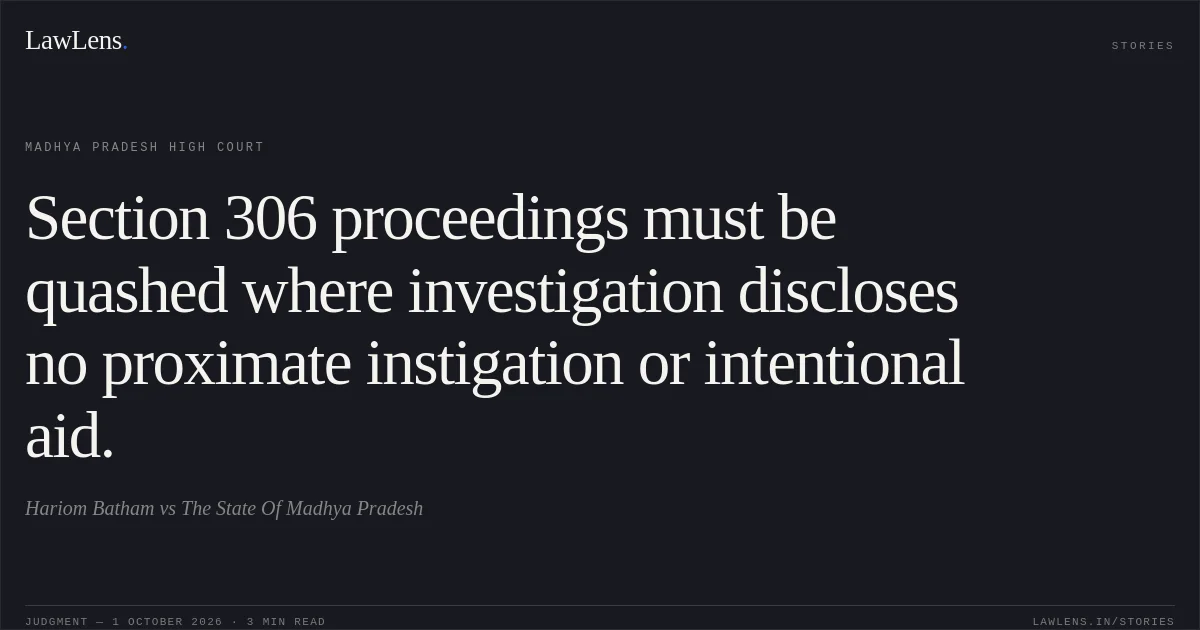
The Court held that the petitions were maintainable and that the material did not disclose the essential ingredients of abetment of suicide under Sections 107 and 306 IPC or a basis for liability under Section 34 IPC.
Both petitions were allowed. The FIR in Crime No. 180/2024, the charge-sheet, cognizance order, and consequential proceedings were quashed qua the petitioners; the order did not affect any prosecution against non-petitioners.
Source reference: para. 55–58Acts & Sections Cited
6 provisions across 3 statutes referred to in this judgment. Each provision opens on LawLens.
Code of Criminal Procedure, 19732
Bharatiya Nagarik Suraksha Sanhita, 20231
Indian Penal Code, 18603
Original Court PDF
Hariom BathamvsThe State Of Madhya Pradesh
Click to open original judgment
Original judgment, available to read, download and summarize on LawLens.in