Facts
The appellant was prosecuted for allegedly entering the house of Sundar Lal and firing a gunshot at him after becoming annoyed that Sundar Lal had left work in the appellant’s sugarcane field without permission.
Source reference: para. 2The incident allegedly occurred on 5 March 2015 at approximately 8:20 a.m. The injured witness sustained firearm injuries to his right hand and chest and was subsequently treated at Jawaharlal Nehru Medical College, Aligarh, where a bullet was extracted from his chest.
Source reference: paras. 14–18The prosecution relied principally on the testimony of the complainant Munna, eyewitness Om Prakash, injured witness Sundar Lal, and the medical evidence of Dr. Mohammad Azam Haseen.
Source reference: paras. 3–6The appellant was charged under Sections 452 and 307 of the Indian Penal Code, 1860 (“IPC”), and Section 3(2)(v) of the Scheduled Castes and the Scheduled Tribes (Prevention of Atrocities) Act, 1989 (“SC/ST Act”).
Source reference: paras. 3–6The trial court convicted the appellant and sentenced him to five years’ rigorous imprisonment under Section 452 IPC and life imprisonment each under Section 307 IPC and Section 3(2)(v) of the SC/ST Act, with the sentences directed to run concurrently.
Source reference: paras. 1, 7The appellant challenged both his conviction and sentence before the High Court.
Source reference: no citationIssues
Whether the prosecution proved beyond reasonable doubt that the appellant committed house-trespass after preparation for causing hurt and attempted to murder Sundar Lal, thereby attracting Sections 452 and 307 IPC?
Source reference: paras. 14–22Whether the alleged investigative lapses, including non-recovery of the firearm and non-examination of certain witnesses, entitled the appellant to acquittal?
Source reference: paras. 23–27Whether conviction under Section 3(2)(v) of the SC/ST Act was sustainable when the prosecution failed to establish that the IPC offence was committed on the ground of the victim’s caste and when the relevant IPC provisions did not prescribe a minimum punishment of ten years?
Source reference: paras. 28–32Whether the life sentence imposed under Section 307 IPC was disproportionate and required modification?
Source reference: para. 33Law Applied
Section 307 IPC penalises an act done with the intention or knowledge that, if death were caused, the offender would be guilty of murder; where hurt is caused, imprisonment for life may be imposed, but the provision does not prescribe a mandatory minimum sentence of ten years.
Source reference: paras. 20–21, 31–32The offence under Section 452 IPC concerns house-trespass after preparation for causing hurt, assault or wrongful restraint and carries a maximum punishment of seven years.
Source reference: para. 32Section 3(2)(v) of the SC/ST Act requires proof that the offender was not a member of an SC/ST, that the victim was an SC/ST member, that the underlying IPC offence carried a minimum punishment of ten years or more, and that the offence was committed against the victim on the ground of caste identity.
Source reference: paras. 28–30The Court relied on State of M.P. v. Mohan, 2013 AIR SCW 4663, for the principle that an injury need not be grievous, dangerous to life, or located on a vital part to attract Section 307 IPC.
Source reference: para. 21It also applied the principles in State of Karnataka v. K. Yarappa Reddy, (1999) 8 SCC 715, C. Muniappan v. State of Tamil Nadu, (2010) 9 SCC 567, and Edakkandi Dineshan @ P. Dineshan v. State of Kerala, 2025 INSC 28, that defective or negligent investigation does not by itself justify acquittal where the substantive prosecution evidence is otherwise reliable.
Source reference: paras. 24–26Reasoning
The High Court found the testimony of the injured witness reliable and materially corroborated by the complainant, the eyewitness, and the medical evidence.
Source reference: paras. 15–19The medical evidence established two firearm injuries, including a chest injury requiring surgical removal of a bullet; the Court held that both injuries could result from a single shot when the victim instinctively raised his hand to protect himself.
Source reference: paras. 15–19The absence of firearm recovery, failure to send clothes for forensic examination, and non-examination of some witnesses were treated as investigative deficiencies that did not discredit the consistent ocular and medical evidence.
Source reference: paras. 23–27Consequently, the convictions under Sections 452 and 307 IPC were upheld.
Source reference: no citationHowever, the Court held that Section 3(2)(v) of the SC/ST Act was not attracted.
Source reference: paras. 29–32The evidence did not conclusively establish that the appellant knew the victim’s caste or that the offence was committed on the ground of caste.
Source reference: paras. 29–32Further, neither Section 452 IPC, with its maximum punishment of seven years, nor Section 307 IPC, which permits punishment ranging from a term up to ten years to life imprisonment depending on the facts, prescribed a minimum punishment of ten years.
Source reference: paras. 29–32The Court also considered the appellant’s custody of more than eleven years and found the life sentence under Section 307 IPC disproportionate in the circumstances.
Source reference: para. 33Holding
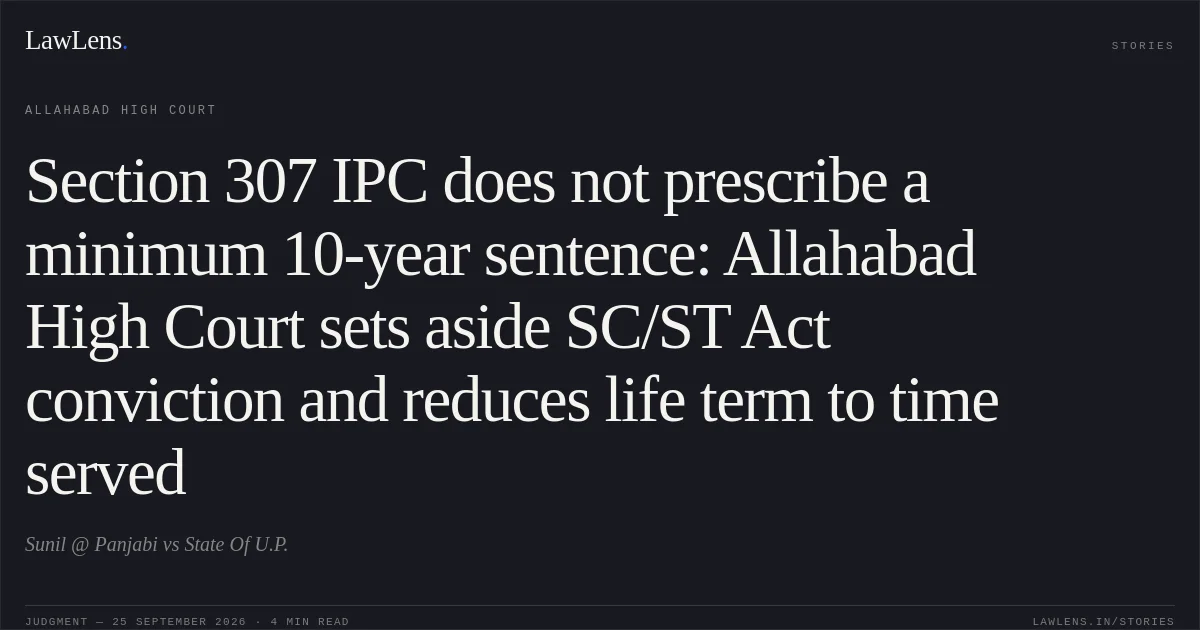
The appeal was partly allowed.
The High Court set aside the appellant’s conviction and life sentence under Section 3(2)(v) of the SC/ST Act and acquitted him of that charge.
Source reference: para. 34The convictions under Sections 452 and 307 IPC were maintained.
Source reference: para. 35However, the sentence under Section 307 IPC was reduced from life imprisonment to the period already undergone, while the remaining part of the trial court’s order, including the sentence under Section 452 IPC, was left undisturbed.
Source reference: para. 35The Court directed that the appellant be released forthwith if he was not required in any other case, and ordered the record to be remitted to the trial court.
Source reference: paras. 35–36Acts & Sections Cited
7 provisions across 3 statutes referred to in this judgment. Each provision opens on LawLens.
Indian Penal Code, 18604
Scheduled Castes and the Scheduled Tribes (Prevention of Atrocities) Act, 19891
Code of Criminal Procedure, 19732
Original Court PDF
Sunil @ PanjabivsState Of U.P.
Click to open original judgment
Original judgment, available to read, download and summarize on LawLens.in