Facts
The petitioner filed a petition under Section 482 Cr.P.C. challenging the order dated 23.02.2017 passed by the Additional Sessions Judge, Rewari, which had allowed the revision filed by respondents No. 2 to 4 and set aside the order dated 01.06.2016 of the Judicial Magistrate First Class, Kosli, summoning them under Section 319 Cr.P.C. in FIR No. 101 dated 28.07.2013, registered under Sections 148, 149, 323, 506 and 325 IPC at Police Station Rohadai.
Source reference: para. 1The FIR alleged that approximately 20 persons entered the complainant’s house, assaulted him and his daughters, caused injuries including fractures, and issued threats; specific roles were attributed to respondents No. 2 to 4, namely Yogesh Kumar, Gautam Arya and Raj Kumar @ Raju.
Source reference: para. 2After investigation, the police presented a challan against six persons and placed the remaining persons, including respondents No. 2 to 4, in Column No. 2 as persons found innocent.
Source reference: para. 3During trial, the petitioner moved an application under Section 319 Cr.P.C. The trial Court summoned respondents No. 2 to 4 to face trial for offences under Sections 148, 323, 325 and 506 read with Section 149 IPC, but the revisional Court subsequently set aside that order.
Source reference: para. 4Issues
Whether the trial Court was justified in exercising power under Section 319 Cr.P.C. to summon respondents No. 2 to 4 as additional accused on the basis of evidence recorded during trial, despite their exclusion from the police report.
Source reference: paras. 9–13Whether the revisional Court exceeded the permissible scope of review by reappreciating the prosecution evidence and setting aside the summoning order under Section 319 Cr.P.C.
Source reference: paras. 13–14Law Applied
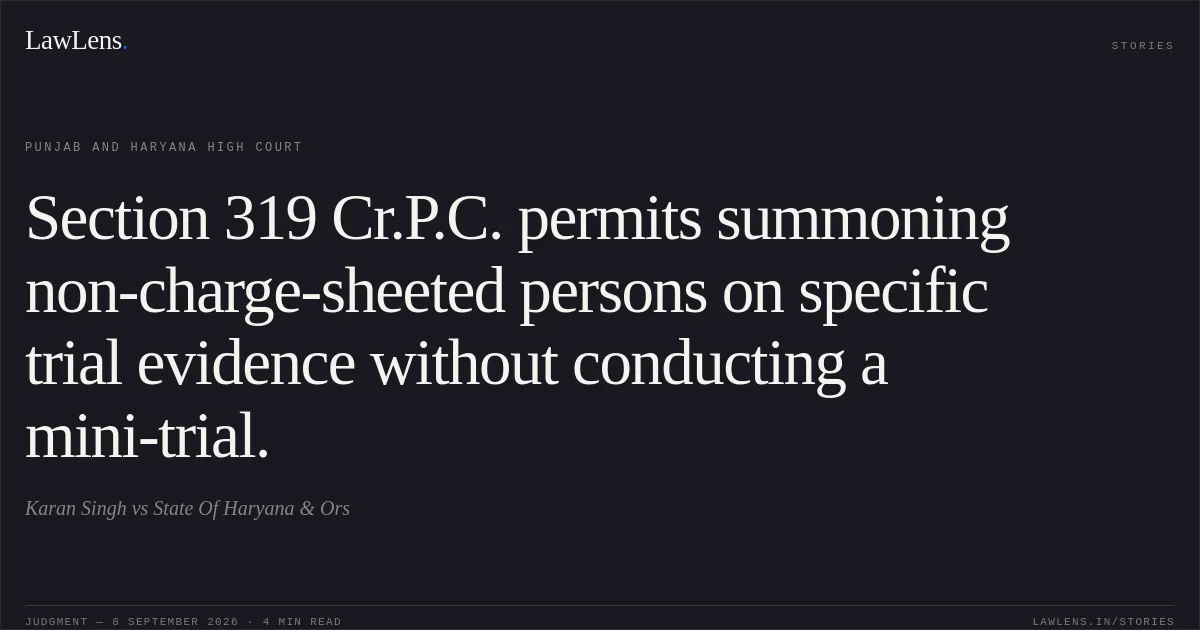
Section 319 Cr.P.C. empowers a Court, during an inquiry or trial, to proceed against a person who is not an accused but appears from the evidence to have committed an offence for which that person could be tried together with the existing accused.
Source reference: para. 9The power is discretionary and extraordinary and must be exercised sparingly on the basis of strong and cogent evidence, rather than mere probability; the required satisfaction is higher than that applicable at the stage of framing charge but lower than the certainty required for conviction, as explained in Hardeep Singh v. State of Punjab, (2014) 3 SCC 92.
Source reference: para. 11Relying on Manjeet Singh v. State of Haryana, (2021) 18 SCC 321, the Court held that Section 319 Cr.P.C. may be invoked at any stage after commencement of trial and before pronouncement of judgment, on the basis of evidence recorded before the Court, including examination-in-chief; the Court is not required to conduct a mini-trial or finally assess the credibility of the evidence at that stage.
Source reference: para. 12The Court may summon persons not charge-sheeted where evidence emerging during trial discloses their involvement, notwithstanding their placement in Column No. 2 of the police report.
Source reference: para. 12Reasoning
The Court held that PW2 Sapna, PW3 Karan Singh and PW4 Satyawati had specifically attributed roles to respondents No. 2 to 4 in their statements recorded during trial, thereby furnishing relevant evidence under Section 319 Cr.P.C.
Source reference: para. 13The fact that PW1 had reached the spot after the injuries were caused could affect the weight of his testimony but could not nullify the direct accounts of the other prosecution witnesses.
Source reference: para. 13Similarly, the site plan, the respondents’ placement in Column No. 2, and the investigating agency’s conclusion that they were innocent were matters for consideration at trial, but could not override evidence subsequently recorded before the Court.
Source reference: paras. 13–14The medical evidence corroborated the occurrence and the injuries sustained by the complainant and his family, although it did not independently establish the identity or individual role of the assailants.
Source reference: para. 14By undertaking a detailed assessment of these matters, the revisional Court effectively conducted a merits-based evaluation or mini-trial, which was impermissible at the Section 319 stage.
Source reference: paras. 13–14The trial Court had therefore correctly exercised its statutory jurisdiction.
Source reference: no citationHolding
The High Court answered the issues in favour of the petitioner. It held that the trial Court was justified in summoning respondents No. 2 to 4 under Section 319 Cr.P.C. on the basis of the specific evidence emerging during trial, and that the revisional Court was not justified in setting aside that order after reappreciating the evidence.
The petition was allowed; the order dated 23.02.2017 was set aside; the order dated 01.06.2016 summoning respondents No. 2 to 4 was restored; and the learned trial Court was directed to proceed with the trial in accordance with law.
Source reference: para. 14The interim stay dated 23.03.2017 was vacated, and the Court clarified that its observations were confined to deciding the petition and would not affect the merits of the trial.
Source reference: paras. 14–15Acts & Sections Cited
8 provisions across 2 statutes referred to in this judgment. Each provision opens on LawLens.
Indian Penal Code, 18605
Code of Criminal Procedure, 19733
Original Court PDF
Karan SinghvsState Of Haryana & Ors
Click to open original judgment
Original judgment, available to read, download and summarize on LawLens.in