Facts
The Appellant, a complainant and PW-1 in a murder trial, challenged the concurrent orders of the Trial Court and the High Court of Allahabad which refused his application under Section 319 of the CrPC to summon Rajendra and Mausam as additional accused.
Source reference: p. 1-2The case involved the murder of one Ammar on August 22, 2017.
Source reference: p. 2The FIR alleged that the murder was a result of a conspiracy hatched by several individuals, including the proposed accused, at the behest of persons already in jail.
Source reference: p. 2During the trial, PW-6 and PW-7 testified that they overheard the proposed accused discussing the conspiracy, claiming they had met the jailed conspirators approximately 15 days before the incident.
Source reference: p. 3, 7-9The Trial Court rejected the Section 319 application, citing material inconsistencies between the testimonies of PW-1, PW-6, and PW-7, the lack of official jail records confirming the meetings, and the physical implausibility of the complainant escaping injury during the shooting.
Source reference: p. 3-5, 14Issues
1. Whether the Trial Court and High Court properly exercised their discretionary power under Section 319 of the CrPC in refusing to summon additional accused based on the evidence on record.
Source reference: p. 52. Whether the Trial Court exceeded its jurisdiction by conducting a detailed assessment of witness credibility and minor contradictions at the stage of Section 319.
Source reference: p. 14-15Law Applied
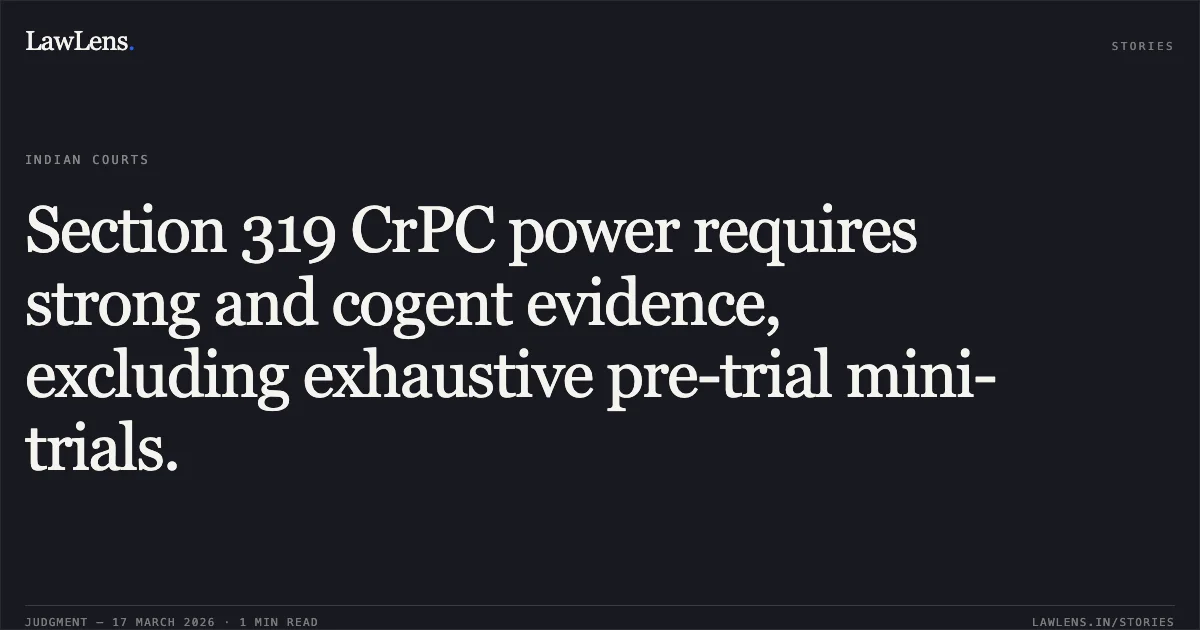
Section 319 of the Code of Criminal Procedure, which empowers a court to proceed against persons appearing to be guilty of an offence but not named as accused.
Source reference: p. 2The Constitution Bench decision in Hardeep Singh v. State of Punjab (2014), which established that the power is extraordinary and requires a standard of evidence that is "strong and cogent"—more than a mere prima facie case but less than proof beyond reasonable doubt.
Source reference: p. 14The court further referenced Neeraj Kumar v. State of UP (2025) to emphasize that the scrutiny at this stage should not devolve into a "mini-trial".
Source reference: p. 14-15Reasoning
The Supreme Court observed that the Trial Court misdirected itself by applying an excessively high standard of proof.
Source reference: p. 15The Court clarified the three levels of evidentiary thresholds: the lowest for framing charges, the middle ("strong and cogent") for Section 319, and the highest ("beyond reasonable doubt") for conviction.
Source reference: p. 5-7The Court found that the Trial Court erred by conducting a "mini-trial," focusing on minor contradictions regarding jail visit details and the lack of physical injuries to the complainant.
Source reference: p. 15It held that the Trial Court took a "fragmented approach" by isolating inconsistencies rather than assessing the "cumulative weight" of the testimonies.
Source reference: p. 15The Court noted that oral evidence on oath by three witnesses (PW-1, PW-6, and PW-7) naming the proposed accused in a conspiracy is sufficient to meet the "strong and cogent" standard, regardless of the lack of documentary corroboration like jail registers at this preliminary stage.
Source reference: p. 15-16Holding
The Supreme Court allowed the appeals and set aside the judgments of the Trial Court and the High Court.
It held that the testimony of three witnesses on oath met the requisite "strong and cogent" standard for summoning additional accused.
Source reference: p. 16The Court ordered that Rajendra and Mausam be summoned and proceeded against as additional accused in accordance with the law.
Source reference: p. 16Acts & Sections Cited
5 provisions across 2 statutes referred to in this judgment. Each provision opens on LawLens.
Indian Penal Code, 18602
Code of Criminal Procedure, 19733
Original Court PDF
Mohammad KaleemvsThe State Of Uttar Pradesh
Click to open original judgment
Original judgment, available to read, download and summarize on LawLens.in


