Facts
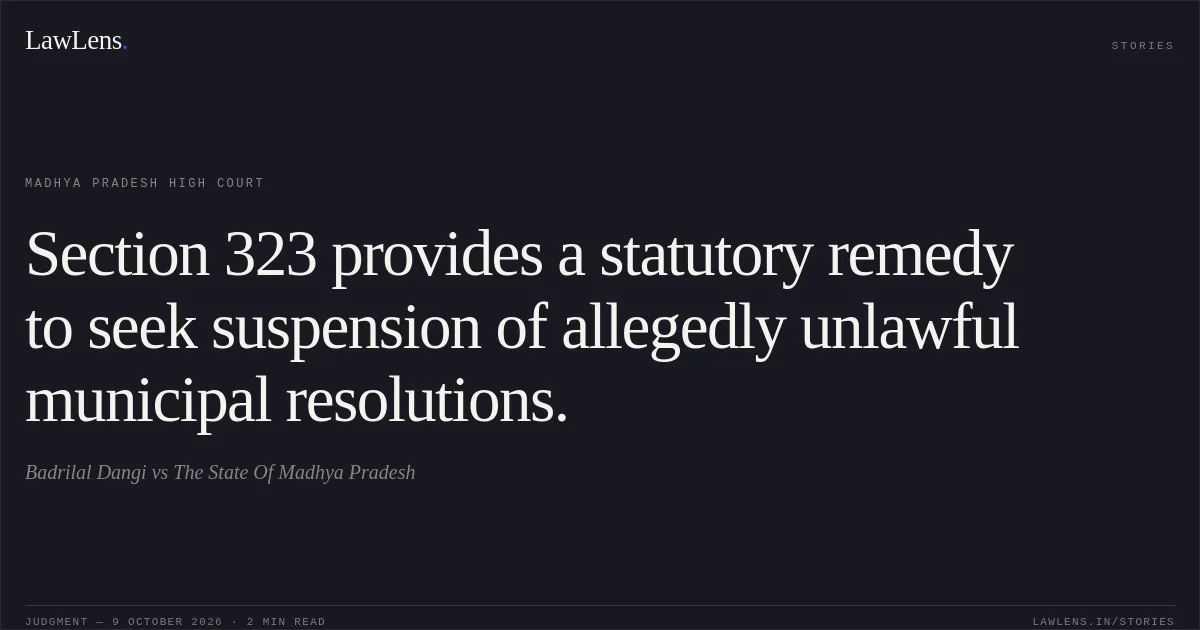
The petitioner filed a public-interest petition under Article 226 challenging Nagar Parishad, Khilchipur Resolution No. 371(06), dated 4 November 2025, which granted a no-objection for allotment of 1.416 hectares of land in Survey No. 667/2 to Janpad Panchayat, Khilchipur, for a new office building.
Source reference: paras. 1–4, pp. 1–3He alleged that the resolution was not passed by a majority and that the land had traditionally been used for religious congregations, fairs, and other public activities.
Source reference: paras. 1–4, pp. 1–3The respondents relied on public notices inviting objections, approvals and funding for the project, and the construction already undertaken; the Janpad Panchayat President also asserted the need for a new building.
Source reference: paras. 5–8, pp. 3–4The Court had earlier granted status quo while leaving open the respondents’ objection that the petitioner should pursue the remedy under Section 323 of the Madhya Pradesh Municipalities Act, 1961.
Source reference: para. 9, p. 4Issues
1. Whether the petitioner could challenge the Nagar Parishad resolution by a writ petition under Article 226, despite the remedy available under Section 323 of the Madhya Pradesh Municipalities Act, 1961.
Source reference: paras. 9–11, pp. 4–52. Whether the record established grounds to interfere with the resolution, including the claim that it was not passed by a majority and that the land’s public use required protection.
Source reference: paras. 12–13, pp. 5–6Law Applied
Article 226 empowers the High Court to review public decisions, while Section 323 of the Madhya Pradesh Municipalities Act, 1961 provides that the Divisional Commissioner, Collector, or another officer authorised by the State Government may suspend a Council resolution or order where the statutory grounds are met—including non-conformity with law or applicable rules or bye-laws, detriment to the Council or public, likely public injury or annoyance, or risk of breach of peace.
Source reference: paras. 9–11, pp. 4–5The judgment cites no precedent and does not state a broader rule displacing the High Court’s writ jurisdiction.
Source reference: paras. 9–11, pp. 4–5Reasoning
The Court held that Section 323 provided an available avenue to challenge the resolution before the designated authority.
Source reference: paras. 10–11, p. 5It also found that, although an objection signed by councillors was on record, no councillor had filed an affidavit supporting the petition, and none had challenged the resolution under Section 323.
Source reference: para. 12, p. 5The Court further noted that public notices had invited objections, none had been raised by the petitioner or others, and the petition was filed only after substantial construction had taken place.
Source reference: para. 12, pp. 5–6In those circumstances, and considering the petitioner’s acknowledged political role, the Court viewed the petition as an attempt to stall the project for a personal purpose and found no basis for interference.
Source reference: para. 12, pp. 5–6Holding
The Court dismissed the petition, holding that no case for interference had been made out.
It directed the petitioner to pay costs of ₹5,000 to the specified account of the High Court Employees Union within two weeks and obtain a receipt.
Source reference: para. 13, p. 6Acts & Sections Cited
1 provisions across 1 statute referred to in this judgment. Linked provisions open on LawLens.
M.P. Municipalities Act, 19611
Original Court PDF
Badrilal DangivsThe State Of Madhya Pradesh
Click to open original judgment
Original judgment, available to read, download and summarize on LawLens.in