Facts
The Appellant (A1), a corporate entity, was convicted of offences under Sections 420 and 120B of the Indian Penal Code (IPC) relating to Coal Block Allocation cases
Source reference: para 1On 08.07.2025, the Special Judge (CBI) sentenced the Appellant to pay a fine of ₹50,00,000 for each offence
Source reference: para 1The Appellant moved an application under Section 430 read with Section 528 of the Bhartiya Nagrik Suraksha Sanhita (BNSS), 2023, seeking suspension of the sentence of fine during the pendency of the appeal
Source reference: para 1The Appellant contended that since it had been under insolvency since 2019 and liquidation since 2020, past criminal liabilities must cease under the Insolvency and Bankruptcy Code, 2016 (IBC)
Source reference: para 2The Respondent (CBI) opposed the plea, arguing that the chargesheet was filed in 2014 (pre-insolvency) and that no resolution plan had been approved to trigger statutory immunity
Source reference: para 3Issues
1. Whether the liability of a corporate debtor for criminal offences committed prior to the Corporate Insolvency Resolution Process (CIRP) ceases under Section 32A of the IBC in the absence of an approved resolution plan.
Source reference: para 5-62. Whether the moratorium provisions under Section 14 or liquidation proceedings under Section 33(5) of the IBC necessitate the suspension of a criminal sentence of fine.
Source reference: para 7-8Law Applied
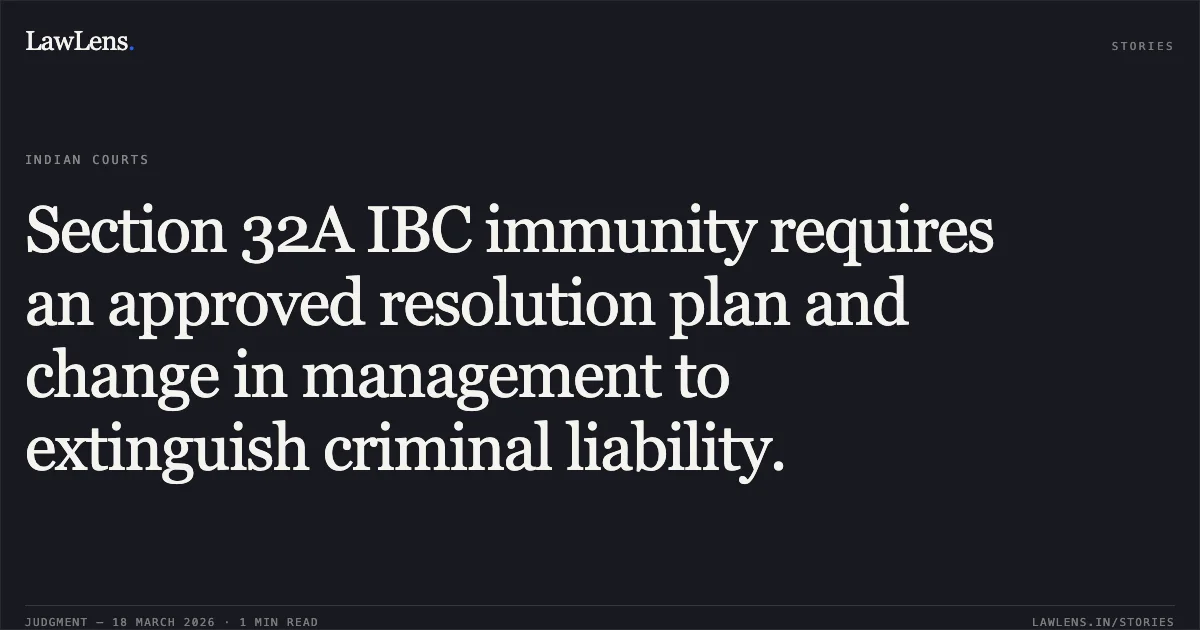
The Court applied Section 32A of the IBC, which provides that criminal liability of a corporate debtor ceases only from the date a resolution plan is approved, provided there is a change in management to persons unrelated to the original promoters or offenders
Source reference: para 5It relied on the precedent in Manish Kumar v. Union of India (2021), which established that Section 32A aims to provide a "clean slate" to new management and not to allow wrongdoers to evade liability
Source reference: para 6The Court further distinguished Section 14 of the IBC, noting that a moratorium is a temporary suspension (a "shadow") of proceedings that does not extinguish civil or criminal liability, unlike the discharge contemplated under Section 32A
Source reference: para 7Reasoning
The Court observed that the Appellant failed to satisfy the essential conditions of Section 32A of the IBC, primarily because no resolution plan had been approved by the adjudicating authority
Source reference: para 6, 8The Court reasoned that immunity from prosecution is contingent upon the fulfillment of specific conditions, including a change in control to a party not involved in the original offence
Source reference: para 5It was noted that the present criminal proceedings were initiated in 2014, significantly prior to the commencement of insolvency
Source reference: para 7The Court held that Section 32A is intended to protect "new management" to encourage asset acquisition, rather than providing an escape for the original corporate debtor when no takeover has occurred
Source reference: para 6-7Consequently, the "shadow" of the moratorium does not equate to the extinguishment of the fine imposed
Source reference: para 7Holding
The Court dismissed the application for suspension of sentence
It held that the Appellant did not meet the necessary criteria for immunity under Section 32A of the IBC and, given the gravity of the offence, the court was not inclined to suspend the sentence of fine
Source reference: para 8The main appeal was listed for further hearing on 15.10.2026
Source reference: para 10Acts & Sections Cited
5 provisions across 3 statutes referred to in this judgment. Each provision opens on LawLens.
Indian Penal Code, 18601
Insolvency and Bankruptcy Code, 2016.2
Bharatiya Nagarik Suraksha Sanhita, 20232
Original Court PDF
M/S Jas Infrastructure And Power LtdvsCentral Bureau Of Investigation
Click to open original judgment
Original judgment, available to read, download and summarize on LawLens.in


