Facts
The National Highways Authority of India (“NHAI”) awarded the respondent a contract dated 26 March 2002 for four-laning and strengthening of NH-2 in Uttar Pradesh.
Source reference: paras. 1–2, 8The project was to be completed in three phases by March 2005, but completion was extended until 31 March 2009 due to, inter alia, delays in handing over the site, physical obstructions, land-acquisition issues and delays concerning the Tundla Railway Over Bridge.
Source reference: paras. 10–13The respondent raised claims for prolongation costs, reimbursement of additional Service Tax and Education Cess, and separate payment for filler-type expansion joints.
Source reference: paras. 3, 16–18After the disputes were unsuccessfully considered by the Disputes Review Board, they were referred to a three-member arbitral tribunal.
Source reference: paras. 3, 16–18The Tribunal partly allowed Claims 1, 3 and 4: it awarded ₹45,88,91,806 towards prolongation costs with interest; declared the respondent entitled to reimbursement of specified additional taxes; and directed separate payment for filler-type expansion joints used in retaining walls, separators and drains, subject to verification by the Engineer.
Source reference: paras. 21–24NHAI challenged the award under Section 34 of the Arbitration and Conciliation Act, 1996, alleging patent illegality, perversity, improper quantification, impermissible delegation to the Engineer and invalidity of the interest award.
Source reference: paras. 25–35Issues
1. Whether the Tribunal’s finding that delay was attributable principally to NHAI, and its award of prolongation costs under Clauses 6.4, 12.2 and 42.2 of the Contract, disclosed patent illegality or perversity warranting interference under Section 34.
Source reference: paras. 48–592. Whether the Tribunal’s use of the MoRTH Standard Data Book, contractual percentages and estimated deductions to quantify prolongation costs was arbitrary, speculative or unsupported by evidence.
Source reference: paras. 60–783. Whether the respondent was entitled under Sub-Clause 70.8 to reimbursement of additional Service Tax and Education Cess imposed by subsequent legislation.
Source reference: paras. 79–814. Whether separate payment was payable for filler-type expansion joints used in retaining walls, separators and drains, despite the BOQ and technical specifications.
Source reference: paras. 82–835. Whether the Tribunal could validly determine entitlement under Claims 3 and 4 while leaving verification and computation of the payable amount to the Engineer.
Source reference: paras. 84–906. Whether the Tribunal’s award of interest from the date of invocation of arbitration until the date of the award was legally sustainable.
Source reference: paras. 91–94Law Applied
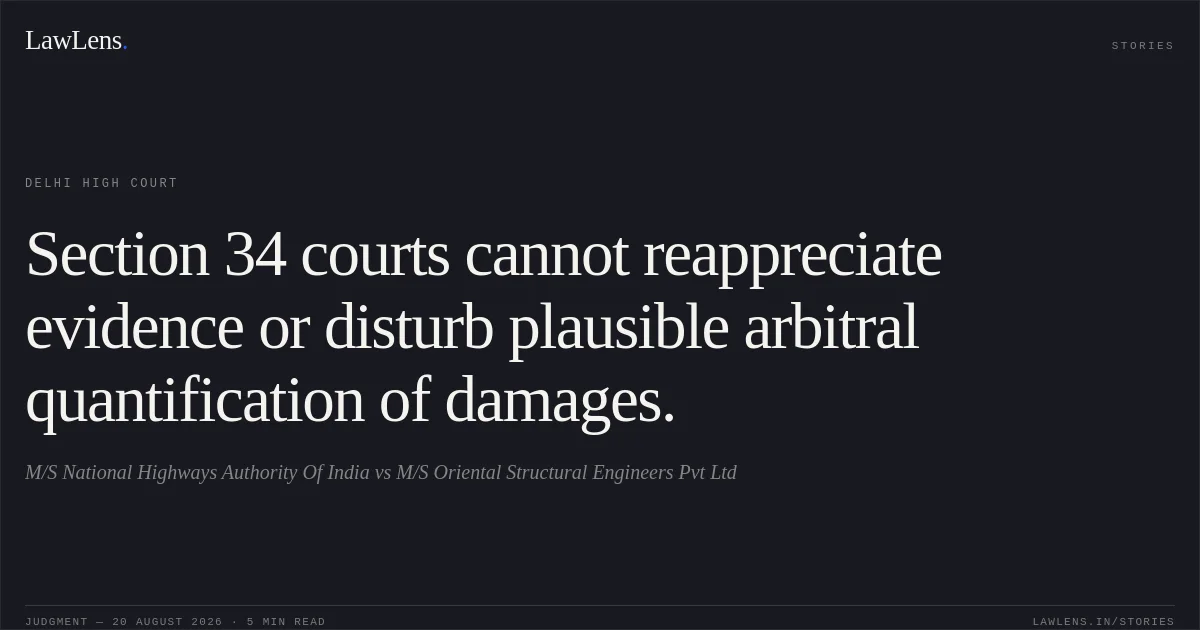
Section 34 of the Arbitration and Conciliation Act, 1996 confers a limited supervisory jurisdiction and does not permit appellate reappreciation of evidence or substitution of a plausible arbitral interpretation; interference is justified only on the statutory grounds, including patent illegality, perversity, conflict with public policy or contravention of the Contract.
Source reference: paras. 41–44Under Sections 28(1)(a) and 28(3), an arbitral tribunal must apply substantive Indian law and the terms of the Contract, but the tribunal remains the primary interpreter of the contractual provisions.
Source reference: paras. 44, 50–54Clauses 6.4, 12.2 and 42.2 entitled the contractor to additional costs where delay arose from delayed drawings, unforeseeable physical conditions or failure to provide possession of the site; the contractual definition of “Cost” excluded profit but included properly incurred expenditure and overheads.
Source reference: paras. 46, 53–55A reasonable, evidence-based formula may be used to quantify damages where precise proof is impracticable, as recognised in McDermott International Inc. v. Burn Standard Co. Ltd. and the decisions concerning MoRTH/industry-based quantification.
Source reference: paras. 63–77Sub-Clause 70.8 permitted reimbursement of additional statutory burdens caused by subsequent legislative changes where those burdens were not already covered by the price-adjustment mechanism.
Source reference: paras. 79–81A declaratory arbitral award is permissible where it finally determines entitlement and leaves only ministerial verification or arithmetic computation, not a further adjudicatory exercise, to be undertaken.
Source reference: paras. 86–89Pendente lite interest is governed by Section 31(7)(a), and may also be supported by the contractual interest provision in Clause 60.8.
Source reference: paras. 91–93Reasoning
The Court held that the Tribunal had independently examined the causes of delay and had found, on the contractual allocation of risk and the evidentiary record, that NHAI’s failure to provide a hindrance-free site and related obstructions were the principal causes of prolongation; the Engineer’s references to slow progress did not require a different conclusion because the Tribunal treated those delays as concurrent or insufficient to displace NHAI’s responsibility.
Source reference: paras. 50–59The Tribunal did not mechanically equate extension of time with entitlement to compensation; it considered audited expenditure details, salary and wage records, overheads, monthly progress reports and contractual resource requirements, rejected the respondent’s uniform extrapolation, and separately assessed the project sections and the Tundla bridge.
Source reference: paras. 61–72Its reliance on contractual percentages, the MoRTH Standard Data Book, deductions for unutilised equipment and a 20% mitigation deduction constituted a reasonable estimation methodology rather than speculation, and did not amount to patent illegality or perversity.
Source reference: paras. 67–77In relation to Claim 3, the Tribunal plausibly distinguished statutory burdens already reflected in the price-adjustment formula from Service Tax and related Education Cess on services not so covered.
Source reference: paras. 79–81In relation to Claim 4, its examination of the BOQ, drawings and specifications supported the conclusion that filler-type expansion joints were priced only for crash barriers and not for retaining walls, separators and drains.
Source reference: paras. 82–83The Engineer’s role under Claims 3 and 4 was confined to verification and calculation on the basis of findings already conclusively made by the Tribunal; hence, there was no impermissible delegation of adjudicatory power.
Source reference: paras. 87–90Finally, the interest awarded was pendente lite interest from invocation of arbitration, not pre-reference interest, and was therefore sustainable under Section 31(7)(a) and Clause 60.8.
Source reference: paras. 91–94Holding
The Court answered all issues against NHAI.
It found no patent illegality, perversity or other ground under Section 34 warranting interference with the Tribunal’s award of prolongation costs, reimbursement of eligible Service Tax and Education Cess, separate payment for filler-type expansion joints, or pendente lite interest.
Source reference: paras. 78, 90, 94The petition under Section 34 was dismissed, pending applications were disposed of, and there was no order as to costs.
Source reference: paras. 95–100Acts & Sections Cited
7 provisions across 2 statutes referred to in this judgment. Each provision opens on LawLens.
Arbitration and Conciliation Act, 19964
Indian Contract Act, 18723
Original Court PDF
M/S National Highways Authority Of IndiavsM/S Oriental Structural Engineers Pvt Ltd
Click to open original judgment
Original judgment, available to read, download and summarize on LawLens.in