Facts
The Petitioner, a cooperative group housing society, awarded the Respondent a contract dated 23 July 1998 for construction of 110 flats at Vasundhara, Ghaziabad, for approximately Rs.7.53 crore, with completion contemplated within two years.
Source reference: pp.1–2Disputes subsequently arose regarding delays, structural drawings, measurements, alleged incomplete or defective work, payments, escalation, and the parties’ respective liabilities.
Source reference: pp.2–5On 25 March 2002, the parties executed a Memorandum of Compromise/Supplementary Agreement under which the Respondent agreed to complete the balance work for Rs.36.25 lakh; an additional sum of Rs.6.50 lakh was made subject to verification after measurement.
Source reference: pp.4, 21–23The Sole Arbitrator awarded Rs.14,25,000 to the Respondent with interest at 18% per annum from 25 August 2005 to 30 June 2013, quantified at Rs.20,13,525, while rejecting the Petitioner’s counterclaims.
Source reference: p.12The Petitioner challenged the award under Section 34 of the Arbitration and Conciliation Act, 1996, alleging violation of public policy, patent illegality, failure to decide an issue, disregard of contractual terms and evidence, and procedural violations.
Source reference: pp.12–15Issues
Whether the arbitral award was liable to be set aside under Section 34 of the Arbitration and Conciliation Act, 1996 on the ground that it violated the public policy of India or suffered from patent illegality?
Source reference: pp.16–20Whether the Sole Arbitrator failed to determine whether the proceedings were to be conducted ex aequo et bono or as an amiable compositeur under Section 19 of the Act?
Source reference: p.12Whether failure to expressly adjudicate Issue No. 7A—concerning the Petitioner’s entitlement to claim amounts despite having proceeded against the architect—invalidated the award?
Source reference: pp.6–7, 25Whether the Sole Arbitrator disregarded the Contract and the Supplementary Agreement by allowing Rs.14,25,000 and rejecting the Petitioner’s claims concerning incomplete work, overpayment, delay, defects, collusion, and rate differentials?
Source reference: pp.13–15, 24–26Whether the alleged failure to obtain expert evidence or comply with Sections 18, 24 and 26 of the Act rendered the award unsustainable?
Source reference: pp.12–15Law Applied
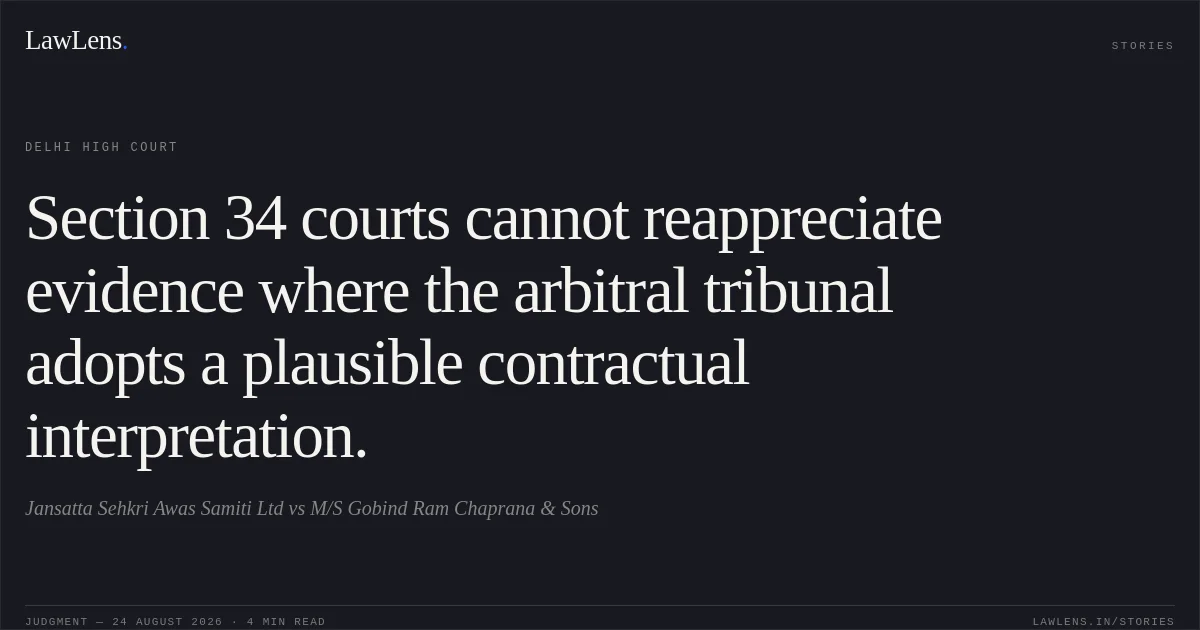
The Court applied Section 34 of the Arbitration and Conciliation Act, 1996, under which an arbitral award may be set aside only on the statutorily prescribed grounds, including conflict with the public policy of India and, in a domestic arbitration, patent illegality appearing on the face of the award.
Source reference: pp.16–19After the 2015 amendments, public policy is confined to fraud or corruption, violation of Sections 75 or 81, contravention of the fundamental policy of Indian law, or conflict with the most basic notions of justice or morality; patent illegality must go to the root of the matter and an award cannot be set aside merely for an erroneous application of law or reappreciation of evidence.
Source reference: pp.17–18Relying on MMTC Ltd. v. Vedanta Ltd., (2019) 4 SCC 163, Associate Builders v. DDA, (2015) 3 SCC 49, Delhi Airport Metro Express Pvt. Ltd. v. DMRC, 2021 SCC OnLine SC 695, and OPG Power Generation (P) Ltd. v. Enexio Power Cooling Solutions (India) (P) Ltd., (2025) 2 SCC 417, the Court held that judicial review under Section 34 is supervisory, not appellate, and that a plausible and reasoned view taken by the arbitrator cannot be substituted by the Court.
Source reference: pp.16–20Mere violation of municipal law or an alleged factual or contractual error does not, by itself, constitute a violation of the fundamental policy of Indian law or public policy.
Source reference: pp.19–20Reasoning
The Court held that the challenge essentially sought a reappraisal of evidence and reconsideration of contractual disputes, which was impermissible under Section 34.
Source reference: pp.23–26The Sole Arbitrator had considered the disputed 18th Running Bill, the parties’ payments, the joint measurements, and the Supplementary Agreement.
Source reference: pp.21–25Since the Supplementary Agreement was undisputed and constituted a fresh arrangement governing the balance work and payment mechanism, the arbitrator was justified in treating it as superseding the earlier disputes and in limiting the Respondent’s entitlement to Rs.14,25,000, after accounting for Rs.22 lakh already paid against the agreed consideration of Rs.36.25 lakh.
Source reference: pp.21–25The Petitioner’s objections regarding incomplete work, payment to another contractor, alleged defects, collusion with the architect, delay, damages, and rate differentials required reassessment of factual findings.
Source reference: p.25The arbitrator had found insufficient evidence of defective work, collusion, or delay attributable solely to the Respondent, particularly since changes in flat areas, an increase in the number of flats, and late supply of plans had contributed to the delay.
Source reference: p.25Even assuming that Issue No. 7A was not separately answered, the award read as a whole demonstrated consideration of the contractual relationship and relevant circumstances, and the alleged omission did not go to the root of the award.
Source reference: p.25The Court further found no demonstrated violation of natural justice, no necessity for expert evidence under Section 26, and no patent illegality or conflict with fundamental legal policy.
Source reference: pp.12–15, 25–26Holding
The Court answered the principal issue against the Petitioner and held that the Impugned Award did not violate the public policy of India, suffer from patent illegality, or disclose any ground warranting interference under Section 34(2) or Section 34(2A) of the Arbitration and Conciliation Act, 1996.
The award of Rs.14,25,000 in favour of the Respondent, together with interest of Rs.20,13,525 calculated at 18% per annum from 25 August 2005 to 30 June 2013, was therefore maintained.
Source reference: p.12The petition and pending applications were dismissed.
Source reference: p.27Acts & Sections Cited
10 provisions across 2 statutes referred to in this judgment. Linked provisions open on LawLens.
Arbitration and Conciliation Act, 1996
Indian Contract Act, 18721
Original Court PDF
Jansatta Sehkri Awas Samiti LtdvsM/S Gobind Ram Chaprana & Sons
Click to open original judgment
Original judgment, available to read, download and summarize on LawLens.in