Facts
The petitioner, a developer claiming possession under a development agreement, alleged that Respondent Nos. 2 and 3, directors of Utsav Infrastructure Pvt. Ltd., caused Respondent No. 4, their supervisor, to enter the disputed property and damage its gate and the petitioner’s boards on 21 and 31 May 2011.
Source reference: para. 3.2–3.9The petitioner complained of offences under Sections 427, 447, 452 and 34 of the IPC.
Source reference: para. 3.2–3.9The Magistrate issued process against all three accused.
Source reference: para. 4On revision, the Sessions Court set aside the process against Respondent Nos. 2 and 3, but maintained it against Respondent No. 4.
Source reference: para. 5The petitioner challenged that order before the High Court.
Source reference: para. 1Issues
Whether the complaint and accompanying material disclosed a prima facie basis to proceed against Respondent Nos. 2 and 3 for the alleged offences, read with Section 34 of the IPC
Source reference: para. 9, 15–18Whether Respondent Nos. 2 and 3’s alleged instruction to Respondent No. 4 could attract joint liability under Section 34 despite their absence from the scene and the absence of pleaded facts showing common intention or participation
Source reference: para. 14–18Law Applied
Sections 427, 447, 452 and 34 of the IPC formed the basis of the complaint.
Source reference: no citationSection 34 does not create a separate offence but provides for joint liability where a criminal act is done by several persons in furtherance of their common intention; common intention and participation must be established from the facts, and physical presence is not a universal prerequisite, its necessity depending on the offence alleged.
Source reference: para. 15–16The Court relied on Jaikrishnadas Manohardas Desai v. State of Bombay and Aizaz v. State of U.P. on participation and the inference of common intention, and on Sanjay Puran Bagde v. State of Maharashtra concerning Section 34’s deeming effect and the need for a prior meeting of minds.
Source reference: para. 11, 17–18It also noted that Shreekantiah Ramayya Munipalli v. State of Bombay is not universally applicable to every Section 34 case.
Source reference: para. 17The Court referred to its power to interfere where no prima facie case is made out or intervention is necessary to prevent abuse of process or secure justice.
Source reference: para. 15Reasoning
The complaint alleged that Respondent Nos. 2 and 3 sent Respondent No. 4 and others to the property, but did not explain how the petitioner knew this or plead facts showing a meeting of minds, a common plan, or participation by the directors.
Source reference: para. 9–11, 18The Court considered the earlier alleged incident of 2008 distinct from the 2011 incidents and found it insufficient to establish common intention for the later events.
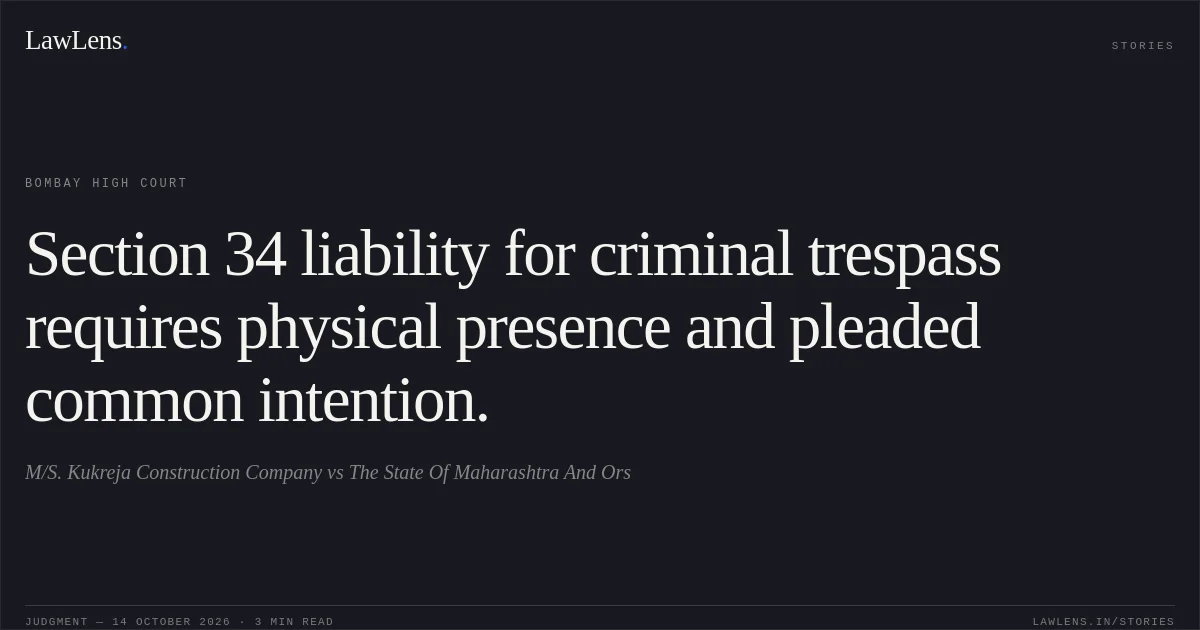
Source reference: para. 12Although physical presence is not invariably required under Section 34, the Court held that, on the facts and for the alleged trespass and house-trespass offences, the directors’ absence from the scene, combined with the lack of pleaded facts establishing common intention or participation, meant that no prima facie case was made out against them.
Source reference: para. 14–18Holding
The High Court held that the petitioner had not shown grounds to interfere with the Sessions Court’s order.
It dismissed the petition, leaving in place the quashing of process against Respondent Nos. 2 and 3; the process against Respondent No. 4, which the Sessions Court had sustained, remained undisturbed.
Source reference: para. 5, 19Acts & Sections Cited
7 provisions across 2 statutes referred to in this judgment. Each provision opens on LawLens.
Indian Penal Code, 18604
Code of Criminal Procedure, 19733
Original Court PDF
M/S. Kukreja Construction CompanyvsThe State Of Maharashtra And Ors
Click to open original judgment
Original judgment, available to read, download and summarize on LawLens.in