Facts
The appellant received the arbitral award on 29 January 2015. He filed objections under Section 34 of the Arbitration and Conciliation Act, 1996, before the High Court on 26 May 2015, but did not cure the defects identified by the Registry the following day or re-file the objections.
Source reference: p. 2; p. 5After receiving execution summons in May 2024, he filed fresh objections before the Commercial Court on 6 July 2024 with an application for condonation of delay; he also filed another petition before the High Court on 24 July 2024, which was not pursued after a maintainability objection was raised. The Commercial Court dismissed the objections as time-barred, and the appellant appealed under Section 37.
Source reference: p. 2; p. 6; p. 1Issues
Whether the Commercial Court could condone the delay in filing the Section 34 objections beyond the statutory period, given that the award was received in 2015 and fresh objections were filed in 2024.
Source reference: p. 4; pp. 6–7Whether the appellant’s initial 2015 filing, counsel’s alleged failure to communicate or cure defects, the change in pecuniary jurisdiction, or the asserted fraud and absence of an arbitration agreement justified entertaining the objections.
Source reference: pp. 3, 6–7Law Applied
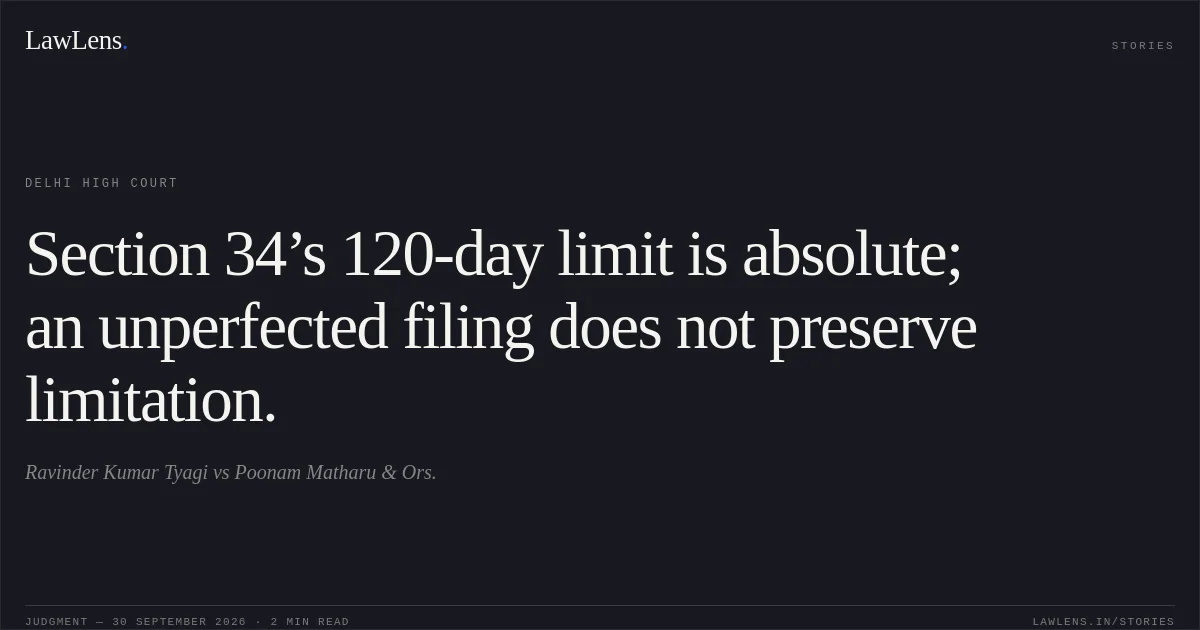
Section 34(3) of the Arbitration and Conciliation Act, 1996 requires an application to set aside an arbitral award to be made within three months of receipt of the award; for sufficient cause, the court may entertain it within a further thirty days, “but not thereafter”.
Source reference: p. 4P. Radha Bai v. P. Ashok Kumar, (2019) 13 SCC 445, and Simplex Infrastructure Ltd. v. Union of India, (2019) 2 SCC 455, confirm that the 120-day outer limit is mandatory and cannot be extended.
Source reference: pp. 4–5Oriental Aroma Chemical Industries Ltd. v. Gujarat Industrial Development Corporation, (2010) 5 SCC 459, supports a stricter approach to inordinate delay.
Source reference: p. 8Under Rajneesh Kumar v. Ved Prakash, 2024 SCC OnLine SC 3380, counsel’s negligence alone does not justify condoning long and inordinate delay where the litigant also failed to remain vigilant.
Source reference: pp. 8–9The Court distinguished State of Uttar Pradesh v. R.K. Pandey, 2025 INSC 48, as addressing execution proceedings rather than Section 34 limitation.
Source reference: p. 6Reasoning
The award was received in 2015, and the appellant neither cured the Registry’s defects nor pursued the objections for about nine years; the 2024 proceedings were fresh filings, not merely delayed re-filing of the 2015 objections.
Source reference: pp. 5–7Section 34(3) therefore barred condonation beyond the additional thirty-day period. The later change in pecuniary jurisdiction did not explain the failure to cure defects before that change, and the alleged lapse by counsel did not excuse the appellant’s prolonged inactivity.
Source reference: pp. 7–9The Court also declined to consider the fraud argument because the objections lacked requisite pleadings, and treated the asserted absence of an arbitration agreement as a merits issue that could arise only if the objections were entertained.
Source reference: p. 6Holding
The Court held that the Commercial Court correctly found it lacked power to condone the delay beyond the limit prescribed by Section 34(3), and that no basis existed to interfere under Section 37.
The appeal was dismissed, and the pending applications were also dismissed.
Source reference: p. 9Acts & Sections Cited
7 provisions across 3 statutes referred to in this judgment. Each provision opens on LawLens.
Arbitration and Conciliation Act, 19963
Limitation Act, 19633
Code of Civil Procedure, 19081
Original Court PDF
Ravinder Kumar TyagivsPoonam Matharu & Ors.
Click to open original judgment
Original judgment, available to read, download and summarize on LawLens.in