Facts
The applicant was arraigned as an accused in 2013 for alleged corruption involving forged bills submitted to the Airports Authority of India.
Source reference: para. 3-4On 19.12.2013, the High Court granted him bail subject to an onerous condition: depositing ₹64,00,000/- as a fixed deposit in favor of the beneficiary.
Source reference: para. 2the prosecution sanction against co-accused government servants was quashed by the High Court (affirmed by the Supreme Court), leading the trial court to close proceedings and consign the file to the record room in 2022 without a conclusion of trial.
Source reference: para. 7-9The applicant, now 77 years old, filed this application under Section 482 Cr.P.C. seeking revocation of the deposit condition, arguing the trial is stalled indefinitely while his funds remain locked.
Source reference: para. 39Issues
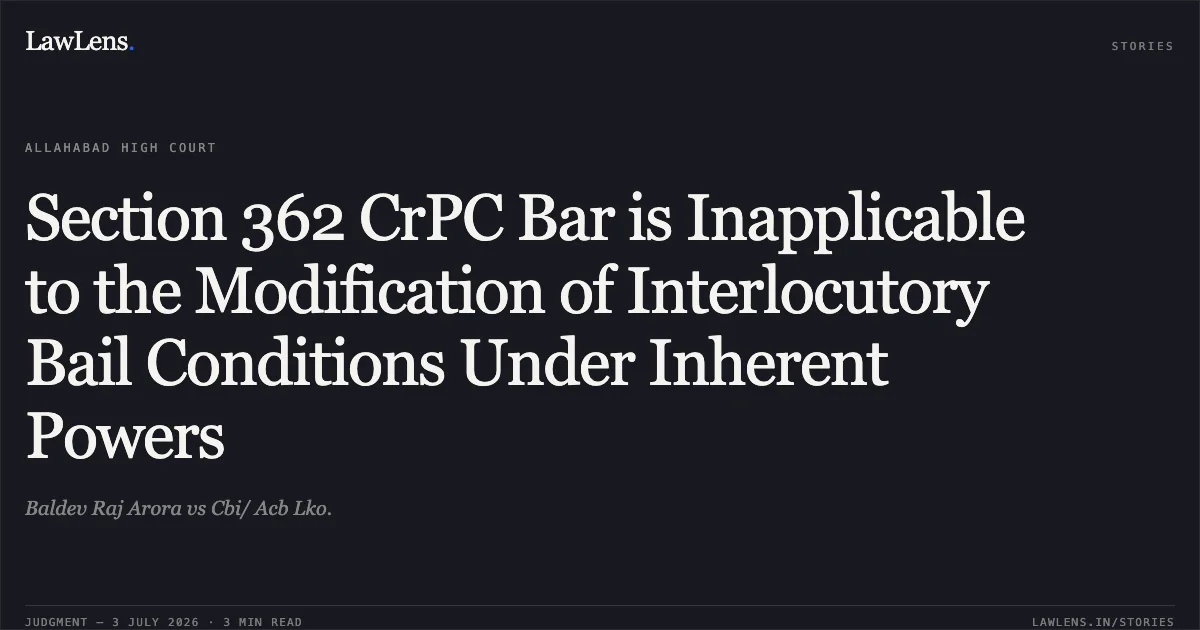
1. Whether an application to modify bail conditions is barred by Section 362 Cr.P.C., which prohibits the review or alteration of a "judgment or final order".
Source reference: para. 14-152. Whether the High Court has the inherent power to relax or revoke a bail condition previously imposed by a coordinate bench due to a change in circumstances.
Source reference: para. 41, 46Law Applied
The Court applied Section 362 Cr.P.C., which bars the alteration of a judgment or final order except for clerical errors.
Source reference: para. 21The principle from Usmanbhai Dawoodbhai Memon v. State of Gujarat and Amar Nath v. State of Haryana establishes that a bail order is an "interlocutory order" and not a "final judgment," thereby exempting it from the bar of Section 362.
Source reference: para. 26-27The Court followed Ramadhar Sahu v. State of M.P., holding that conditions of bail can be varied based on changed circumstances.
Source reference: para. 28The Court invoked Section 482 Cr.P.C. and Article 215 of the Constitution of India, affirming that the High Court’s inherent power is a constitutional manifestation intended to secure the ends of justice and is not restricted by statutory procedural bars when preventing an abuse of process.
Source reference: para. 45-46Reasoning
The Court first rejected the CBI's preliminary objection regarding Section 362 Cr.P.C., reasoning that since bail is an interlocutory stage in a pending trial, any order granting it does not finally dispose of the case.
Source reference: para. 25, 34It deemed the contrary view in Aparna Purohit v. State of U.P. as per incuriam for failing to consider the statutory definition of "judgment".
Source reference: para. 33The Court observed that the deposit condition was "unreasonably onerous," violating the principle in Sumit Mehta v. State (NCT of Delhi) that criminal courts should not act as "recovery agents" during bail.
Source reference: para. 36-37The Court found a significant "change in circumstances": the trial had reached a standstill following the quashing of prosecution sanctions against co-accused, and the trial court had consigned the records.
Source reference: para. 39, 42Given the applicant's advanced age (77) and the indefinite suspension of the trial, the Court determined that continuing to withhold his funds constituted a failure of justice.
Source reference: para. 49Holding
The Court held that Section 362 Cr.P.C. does not bar the modification of bail conditions and that the High Court possesses inherent powers under Section 482 and Article 215 to ensure justice in light of changed facts.
The Court revoked the condition requiring the deposit of ₹64,00,000/- and directed the immediate release of the fixed deposit along with accrued interest to the applicant within thirty days.
Source reference: para. 50Acts & Sections Cited
18 provisions across 4 statutes referred to in this judgment. Each provision opens on LawLens.
Code of Criminal Procedure, 1973
Indian Penal Code, 18604
Prevention of Corruption Act, 19881
Original Court PDF
Baldev Raj AroravsCbi/ Acb Lko.
Click to open original judgment
Original judgment, available to read, download and summarize on LawLens.in