Facts
JSW Steel claimed Rs. 98,15,442 for a shortage of 205.559 MT of TMT bars, Rs. 26,26,250 for damage to 55 MT of TMT bars, and Rs. 41,86,333 for loss relating to HR coils and HR plates.
Source reference: para. 3, p. 2The Arbitral Tribunal rejected the claims in its award dated 11 September 2017, finding that JSW Steel had not proved them.
Source reference: no citationA Single Judge dismissed JSW Steel’s petition under Section 34 of the Arbitration and Conciliation Act, 1996, by order dated 7 January 2019.
Source reference: no citationJSW Steel appealed under Section 37, contending that material evidence had not been properly considered and that the respondent had not denied the supply, damage, or loss.
Source reference: paras. 1, 4, p. 1Issues
Whether the Arbitral Tribunal and the Single Judge failed to properly consider material evidence, resulting in legal perversity warranting appellate interference.
Source reference: paras. 4–5, pp. 1–2Whether the rejection of the claims could be disturbed in an appeal under Section 37 when the claimant had failed to prove the quantum of loss and both forums had reached concurrent findings.
Source reference: paras. 5–8.2, pp. 2–4Law Applied
Section 19(1) of the Arbitration and Conciliation Act, 1996 provides that arbitral tribunals are not bound by the Code of Civil Procedure, 1908 or the Indian Evidence Act, 1872; their broad governing principles may apply, but those statutes do not strictly govern arbitral proceedings.
Source reference: para. 6, p. 2Accordingly, the pleading rule discussed in Badat and Co. Bombay v. East India Trading Co., 1963 SCC OnLine SC 9, requiring specific and non-evasive denials in a written statement, did not apply to the arbitration in the same manner.
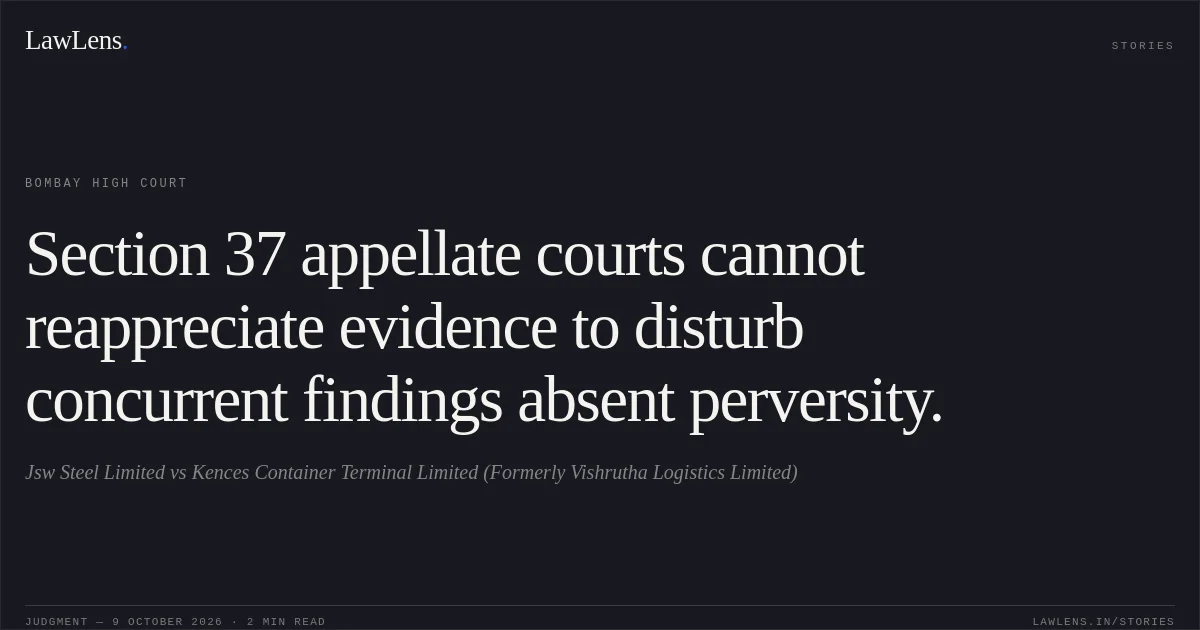
Source reference: para. 6, p. 2On an appeal under Section 37, the court cannot reappreciate evidence to reach a wholly different conclusion, and concurrent findings warrant interference only where legal perversity is established.
Source reference: para. 8.1, p. 4Reasoning
The Court held that JSW Steel had failed to prove the quantum of its losses.
Source reference: paras. 5–6, pp. 2–3In particular, when asked in cross-examination about the basis for valuing TMT bars at Rs. 47,750 per MT, its witness acknowledged that there was nothing on record to support that figure and merely stated that the bars would have been sold at that price.
Source reference: paras. 5–6, pp. 2–3The Court also noted that JSW Steel had several opportunities to substantiate the material’s value and its claims, but relied on a circular only at the rejoinder-argument stage.
Source reference: paras. 7–8, pp. 3–4The Single Judge had considered these matters; the concurrent findings disclosed no legal perversity.
Source reference: paras. 7–8.2, pp. 3–4Reappreciating the evidence to reach a different result was therefore impermissible under Section 37.
Source reference: paras. 7–8.2, pp. 3–4Holding
The Court answered the issues against JSW Steel, finding no legal perversity in the award or the Single Judge’s order and no basis for appellate interference.
It dismissed the appeal as devoid of merit.
Source reference: paras. 8.1–9, p. 4Acts & Sections Cited
3 provisions across 1 statute referred to in this judgment. Each provision opens on LawLens.
Arbitration and Conciliation Act, 19963
Original Court PDF
Jsw Steel LimitedvsKences Container Terminal Limited (Formerly Vishrutha Logistics Limited)
Click to open original judgment
Original judgment, available to read, download and summarize on LawLens.in