Facts
The applicant, Rajat Kumar, was in judicial custody in connection with FIR/Case Crime No. 0074 of 2026, registered at Police Station Muni-Ki-Reti, District Tehri Garhwal, under Sections 8/20 and 60 of the Narcotic Drugs and Psychotropic Substances Act, 1985 (“NDPS Act”).
Source reference: para. 3The prosecution alleged that, during routine checking on 30 June 2026, the applicant and a co-accused were intercepted while travelling on a motorcycle. A black backpack allegedly carried by the co-accused was searched, resulting in the recovery of a rod-shaped substance wrapped in black polythene, stated to be 940 grams of charas.
Source reference: paras. 5–6The applicant denied involvement and claimed that he had merely accompanied the co-accused to visit a fair/viewpoint and was falsely implicated following an altercation with the police concerning vehicle documents.
Source reference: para. 6He further relied on the absence of independent public witnesses, alleged non-compliance with Section 50 of the NDPS Act, lack of criminal antecedents, and deficiencies in the description and documentation of the alleged sticks of charas.
Source reference: paras. 7–9The State opposed bail but conceded that the alleged recovery was below the notified commercial quantity and that the restrictions under Section 37 of the NDPS Act were therefore not attracted.
Source reference: para. 10Issues
1. Whether the applicant should be enlarged on bail in a prosecution under Sections 8/20 and 60 of the NDPS Act involving the alleged recovery of 940 grams of charas.
Source reference: paras. 3, 5, 112. Whether the statutory embargo under Section 37 of the NDPS Act applied when the alleged quantity of charas was below the notified commercial quantity.
Source reference: paras. 7, 10–113. Whether the applicant’s lack of criminal antecedents, period of custody, and the alleged deficiencies in the recovery proceedings justified grant of bail without expressing an opinion on the merits.
Source reference: paras. 7–9, 11Law Applied
The Court applied Sections 8/20 and 60 of the NDPS Act, under which the alleged possession and related liability for cannabis may constitute an offence.
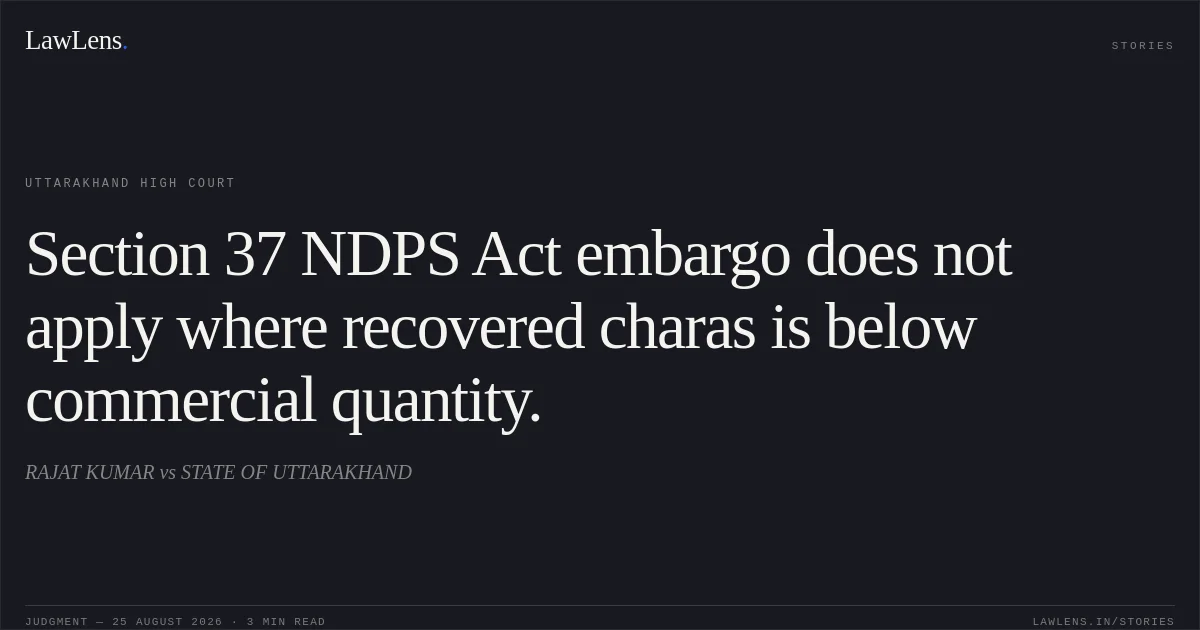
Source reference: no citationIt considered Section 37 of the NDPS Act, which imposes stringent conditions for bail in cases involving offences meeting the statutory thresholds, particularly commercial quantity; the Court held that the Section 37 embargo is not attracted where the alleged recovery is below the notified commercial quantity.
Source reference: paras. 10–11The Court also considered the safeguards associated with Section 50 of the NDPS Act as raised by the applicant, although it did not finally adjudicate that issue at the bail stage.
Source reference: para. 7Bail remains discretionary and may be granted after considering the nature of the accusation, the material on record, the applicant’s antecedents, custody period, investigation status, and the likelihood of misuse of liberty.
Source reference: paras. 9, 11–13Reasoning
The Court noted that the alleged recovery was 940 grams of charas, which was below the notified commercial quantity; consequently, the statutory restrictions under Section 37 were held inapplicable.
Source reference: para. 11The Court also took into account that the applicant had no previous criminal antecedents and had remained in judicial custody since 30 June 2026.
Source reference: para. 11The applicant’s contentions regarding the absence of independent witnesses, alleged Section 50 non-compliance, and deficiencies in the description of the recovered substance raised issues for consideration at trial, but the Court did not express any final opinion on the merits.
Source reference: paras. 7–8, 11Considering the quantity, custody period, antecedent-free status, and the fact that the trial was not likely to conclude shortly, the Court found that the applicant had made out a case for bail.
Source reference: paras. 9, 11Holding
The bail application was allowed.
The applicant was directed to be released on bail upon furnishing a personal bond and two reliable sureties of the like amount to the satisfaction of the trial court.
Source reference: para. 12(a)The release was subject to conditions that he not leave India without prior permission, appear before and cooperate with the investigating officer, refrain from tampering with evidence or witnesses and from committing any criminal activity, and surrender his passport, if any.
Source reference: paras. 12(b)–(e)Bail was made liable to cancellation upon violation of the conditions or misuse of the liberty granted.
Source reference: para. 13Acts & Sections Cited
5 provisions across 1 statute referred to in this judgment. Linked provisions open on LawLens.
Narcotic Drugs and Psychotropic Substances Act, 19855
Original Court PDF
RAJAT KUMARvsSTATE OF UTTARAKHAND
Click to open original judgment
Original judgment, available to read, download and summarize on LawLens.in
![Courts will not interfere with transfers absent mala fides or violation of statutory rules.. M Ramya vs EMPLOYEES STATE INSURANCE CORPORATION (ESIC). CAT - ['Chennai']. LawLens](/stories/thumbnails/courts-will-not-interfere-with-transfers-absent-mala-fides-or-violation-of-statutory-rules-a6845e9ca6f548fca284c51c8351957f.webp)
![Courts cannot direct one-time recruitment age relaxation absent authority in the governing rules or advertisement.. UT OF PUDUCHERRY vs M ANDAL. CAT - ['Chennai']. LawLens](/stories/thumbnails/courts-cannot-direct-one-time-recruitment-age-relaxation-absent-authority-in-the-governing-895d78fde47143e2a8ed0207c4b6a44f.webp)
![A review cannot correct an allegedly erroneous decision absent an error apparent on the record.. Ajit Kumar Jha vs RAILWAY BOARD. CAT - ['Delhi']. LawLens](/stories/thumbnails/a-review-cannot-correct-an-allegedly-erroneous-decision-absent-an-error-apparent-on-the-re-8ac952fd4eba470c92f7da20af72a220.webp)