Facts
The appellant, a casual labourer employed by the respondents, suffered a right-leg injury when struck by a rolling boulder while drilling on a road on 20 September 2006.
Source reference: p. 1–3His monthly wages were ₹3,170, and his permanent disability was assessed at 30%.
Source reference: p. 1–3The Commissioner awarded ₹93,000 as compensation, with interest of ₹47,400 at 12% per annum from the accident date to the award date.
Source reference: p. 1–3The appellant challenged the amount, the assessment of earning-capacity loss, and the failure to impose a penalty under Section 4-A(3)(b) of the Employees’ Compensation Act, 1923 (“the Act”).
Source reference: p. 1–3Issues
1. Whether the Commissioner’s assessment of compensation based on the appellant’s 30% disability, rather than 100% loss of earning capacity, involved an error warranting interference under Section 30 of the Act.
Source reference: p. 4–52. Whether the Commissioner’s failure to consider a further sum by way of penalty under Section 4-A(3)(b), where compensation had not been deposited within one month of the accident, required the matter to be remitted.
Source reference: p. 5–7Law Applied
Under Section 4(1)(c)(ii) of the Act, compensation for permanent partial disablement resulting from an injury not specified in Part II of Schedule I is proportionate to the loss of earning capacity permanently caused by the injury; the amount is calculated by reference to the compensation payable for permanent total disablement under Section 4(1)(b) and the relevant factor in Schedule IV.
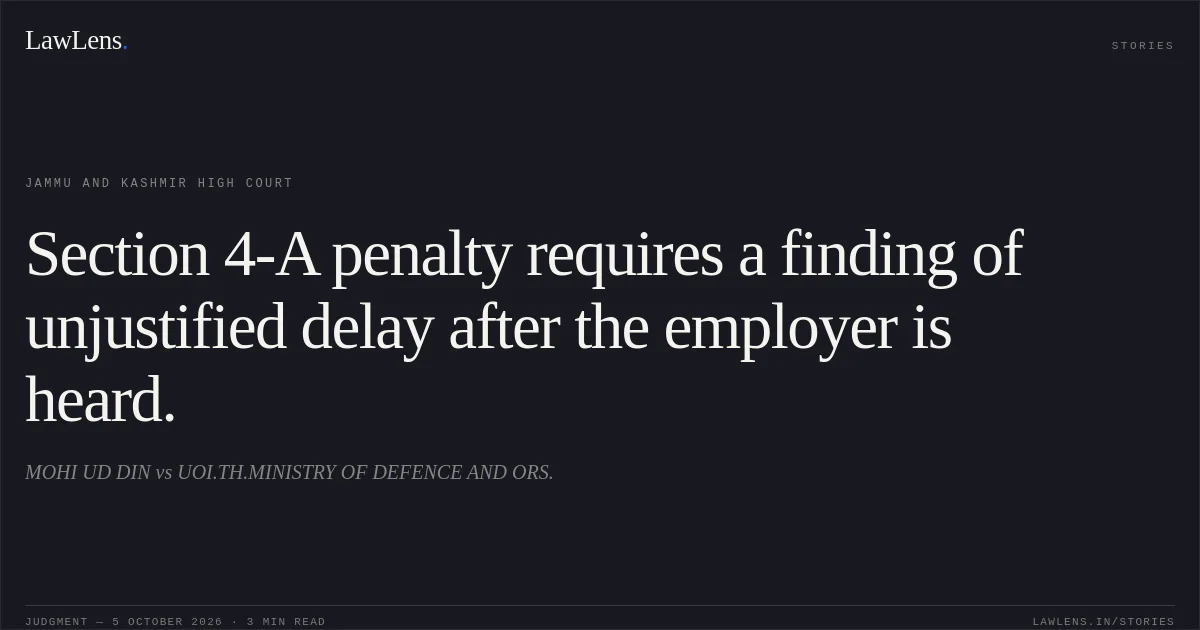
Source reference: p. 3–4Section 4-A(3)(a) provides for interest where compensation is in default, while Section 4-A(3)(b) permits a penalty of up to 50% if the Commissioner finds no justification for the delay, after giving the employer a reasonable opportunity to show cause.
Source reference: p. 5–6In The Oriental Insurance Co. Ltd. v. Siby George and Ors., (2012) 12 SCC 540, the Supreme Court distinguished interest, which follows default, from a penalty, which requires a finding of unjustified delay after the employer has been heard.
Source reference: p. 5Under Section 30, the High Court does not reappreciate factual findings absent perversity.
Source reference: p. 5Reasoning
Applying Section 4, the Court calculated 60% of the appellant’s monthly wages of ₹3,170, multiplied that figure by the relevant factor of 163.07, and then applied the 30% disability percentage.
Source reference: p. 3–4The resulting amount of approximately ₹93,048 differed from the Commissioner’s ₹93,000 only by rounding; the appellant’s alternative figure of ₹2,58,465 incorrectly applied the death-compensation measure.
Source reference: p. 3–4The appellant’s challenge to the disability assessment raised a factual question. Given the evidence, including his statement that he worked as a watchman, and the absence of demonstrated perversity, the Court declined to reassess that finding under Section 30.
Source reference: p. 5On penalty, the Commissioner had issued no show-cause notice, recorded no opinion on whether the delay was unjustified, and had no evidence before him on that issue.
Source reference: p. 5–7The High Court held that it could not form the required opinion in the first instance; the Commissioner had to consider the matter after following the statutory procedure.
Source reference: p. 5–7Holding
The Court answered the substantial question of law concerning the Commissioner’s failure to consider penalty in the affirmative.
It upheld the compensation and interest award, but allowed the appeal in part and remitted the penalty issue to the Commissioner to hear both sides and comply with the proviso to Section 4-A(3)(b).
Source reference: p. 7–8The Commissioner was directed to dispose of that issue within three months of receiving a certified copy of the judgment.
Source reference: p. 7–8Acts & Sections Cited
3 provisions across 1 statute referred to in this judgment. Linked provisions open on LawLens.
Employee3
Original Court PDF
MOHI UD DINvsUOI.TH.MINISTRY OF DEFENCE AND ORS.
Click to open original judgment
Original judgment, available to read, download and summarize on LawLens.in