Facts
The Petitioner entered into agreements dated 9 June 1995 and 31 December 1999 with the landowners concerning land at Pashan, Pune, for aggregate consideration of ₹5 crore.
Source reference: paras. 2–3; pp. 2–4The agreements conferred substantial development, construction and transfer rights upon the Petitioner and dealt with possession of the property.
Source reference: paras. 2–3; pp. 2–4Supplementary Agreements dated 4 September 2003 confirmed the earlier transactions and recorded that possession had already been handed over.
Source reference: para. 4; p. 4A Conveyance Deed was executed on 19 March 2012 for the remaining area of the property, after part of the land had been acquired for road widening.
Source reference: para. 4; p. 4Subsequently, the Sub-Registrar determined the 2012 market value of the conveyed property at ₹61,09,89,500 and demanded deficient stamp duty of ₹2,60,49,475, together with penalty at 2% per month.
Source reference: paras. 5–7; pp. 5–7The Collector of Stamps confirmed the demand on 19 July 2014, and the Deputy Inspector General of Registration dismissed the Petitioner’s appeal on 16 March 2015.
Source reference: paras. 5–7; pp. 5–7Issues
Whether the agreements of 1995 and 1999, the supplementary agreements of 2003, and the Conveyance Deed of 2012 constituted several instruments employed for completing a single transaction within the meaning of Section 4 of the Maharashtra Stamp Act, 1958?
Source reference: paras. 19–27, 40–41; pp. 13–17, 24–26Whether the authorities could disregard the earlier instruments and levy fresh ad valorem stamp duty on the market value prevailing on the date of the 2012 Conveyance as though it were an independent transaction?
Source reference: paras. 32–36, 41–42; pp. 19–22, 25–27Whether the consequential demand for penalty and other recovery could survive once the alleged deficit stamp duty demand was found unsustainable?
Source reference: para. 39; pp. 23–24Law Applied
The Court applied Section 4 of the Maharashtra Stamp Act, 1958, under which, when several instruments are employed to complete a single transaction of sale, development agreement, lease, mortgage or settlement, only the principal instrument bears the prescribed duty and the other instruments attract the specified nominal duty; where the principal instrument is not selected, the officer must determine it, subject to the requirement that it bear the highest duty chargeable among the instruments.
Source reference: paras. 20–23; pp. 14–15The Court applied Section 2(na), which defines market value as the price the property would have fetched in the open market on the date of execution of the relevant instrument or the stated consideration, whichever is higher.
Source reference: para. 32; p. 19It further applied the principle that stamp-duty liability is determined by the substance, legal effect, rights created and nature of possession under an instrument, rather than merely by its nomenclature.
Source reference: paras. 18, 29–31; pp. 13–14, 18–19Article 5(g-a) and Article 25 of Schedule I were considered in determining the stamp-duty treatment of development agreements and conveyances.
Source reference: paras. 12–14, 31; pp. 9–10, 19The Court also referred to Jitendra Manohardas Thakker v. Deputy Inspector General of Registration, Suhas Damodar Sathe v. State of Maharashtra and Thakkar Investment and Finance Company v. Chief Controlling Revenue Authority, although the decision principally rested on the statutory scheme of Section 4.
Source reference: para. 11; p. 9Reasoning
The Court held that the nomenclature of the 1995 and 1999 instruments as an “Agreement” or “Development Agreement” was not conclusive.
Source reference: paras. 17–18; pp. 12–14Their terms conferred extensive rights to enter upon, develop and construct on the land, and the 1999 agreement expressly recorded delivery of open and actual possession for development purposes.
Source reference: paras. 17–18; pp. 12–14The agreements, supplementary instruments and 2012 Conveyance concerned the same parties and substantially the same property, with the Conveyance completing the transfer contemplated by the earlier arrangements.
Source reference: para. 27; pp. 16–17The reduction in area was attributable to municipal acquisition for road widening and did not establish a new transaction.
Source reference: para. 27; pp. 16–17The authorities had themselves treated the earlier agreements as connected with the 2012 Conveyance when calculating duty on the aggregate consideration of ₹5 crore and granting credit for the ₹5 lakh previously paid.
Source reference: paras. 24–25, 33–34; pp. 15–16, 19–21They could not subsequently treat the Conveyance as wholly independent and impose fresh duty on the 2012 market value.
Source reference: paras. 24–25, 33–34; pp. 15–16, 19–21The Petitioner’s inconsistent descriptions of the instruments and the delay in registration could not override the statutory requirement to determine the real nature and continuity of the transaction.
Source reference: paras. 29–30, 38–39; pp. 18–19, 23–24The Court rejected reliance on Income Tax certificates as determinative of stamp-duty market value, but found that issue immaterial because Section 4 applied.
Source reference: para. 35; p. 21Holding
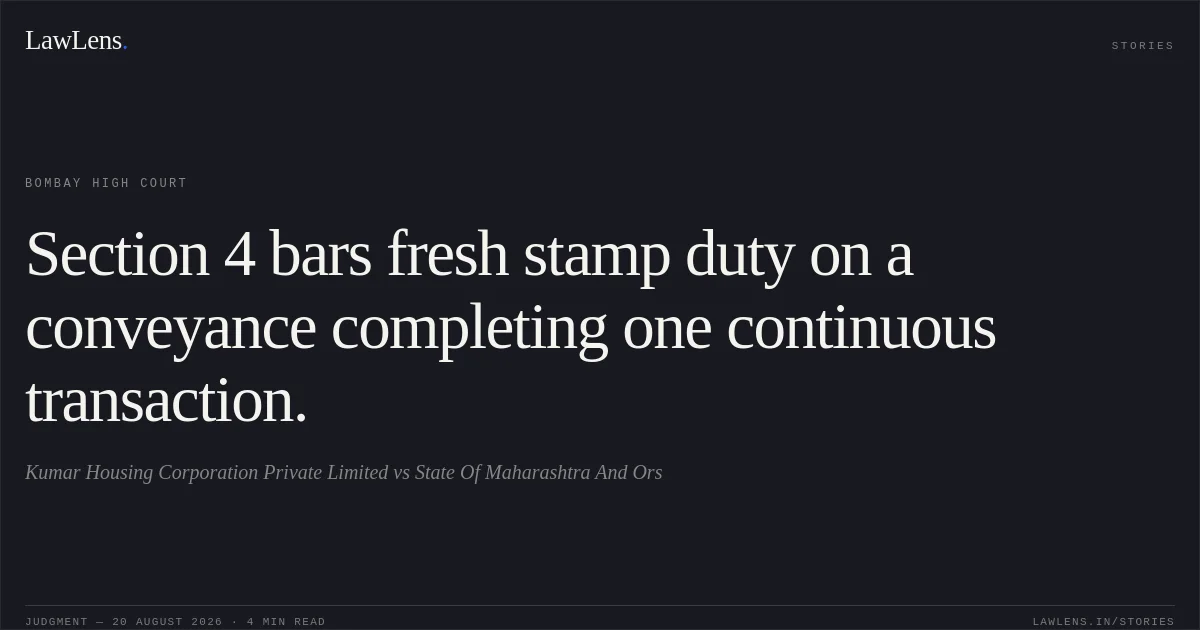
The Court held that the earlier agreements, supplementary instruments and the 2012 Conveyance were several instruments employed to complete one transaction under Section 4 of the Maharashtra Stamp Act.
The authorities therefore could not treat the 2012 Conveyance as an independent transfer attracting fresh stamp duty on the market value prevailing in 2012.
Source reference: paras. 40–42; pp. 24–27The orders dated 19 July 2014 and 16 March 2015 were quashed and set aside.
Source reference: para. 43; pp. 26–27The demand for deficient stamp duty of ₹2,60,49,475, together with penalty and other consequential charges, was also quashed.
Source reference: para. 43; pp. 26–27The writ petition was allowed, the Rule was made absolute, and there was no order as to costs.
Source reference: para. 43; pp. 26–27Acts & Sections Cited
5 provisions across 1 statute referred to in this judgment. Each provision opens on LawLens.
Maharashtra Stamp Act5
Original Court PDF
Kumar Housing Corporation Private LimitedvsState Of Maharashtra And Ors
Click to open original judgment
Original judgment, available to read, download and summarize on LawLens.in