Facts
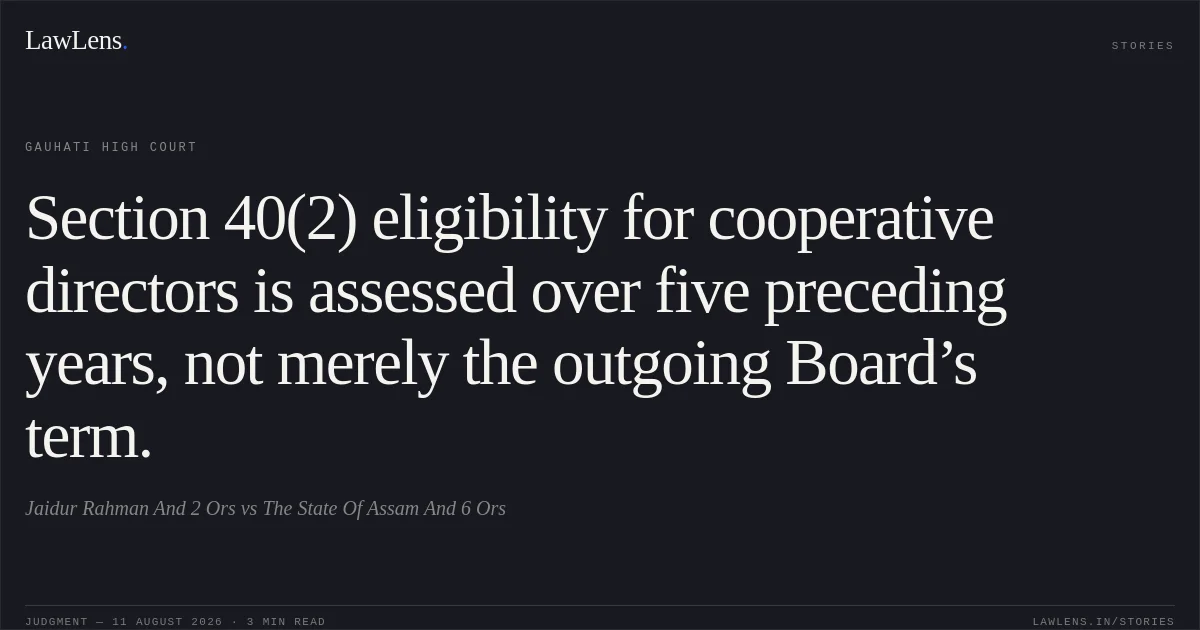
The petitioners challenged the order dated 03.11.2023 upholding the nominations and election of respondent Nos. 6 and 7 as Directors of Tengaguri Samabay Samiti, Morigaon. The election was held on 27.08.2023, and the results were declared on 29.08.2023.
Source reference: paras. 2–3During the previous Board’s tenure, five Annual General Meetings (“AGMs”) were required, but meetings were held only for 2016–17, 2017–18 and 2018–19; no AGM was held for 2019–20 or 2020–21.
Source reference: para. 4The petitioners contended that respondent Nos. 6 and 7 had not attended at least two AGMs in the previous five years, as required by Section 40(2) of the Assam Co-operative Societies Act, 2007 (“2007 Act”).
Source reference: paras. 5–7, 14The Registrar rejected the election challenges, holding that Section 40(2) could not operate against the respondents where the AGMs had not been convened due to the default of the Board.
Source reference: para. 7The writ petition followed.
Source reference: no citationThe Court also noted that the Registrar’s subsequent affidavit relied on facts concerning AGM attendance that were not stated in the impugned order; applying Mohinder Singh Gill v. Chief Election Commissioner, the Court held that such post facto reasons could not supplement the impugned decision.
Source reference: para. 12Issues
1. Whether respondent Nos. 6 and 7 were disqualified under Section 40(2) of the 2007 Act from being elected as Directors because they had not attended at least two AGMs in the previous five years.
Source reference: paras. 6, 19–202. Whether the “previous five years” under Section 40(2) had to be confined to the tenure of the outgoing Board or could include AGMs held before that Board’s tenure.
Source reference: paras. 16, 21–223. Whether the election petitions were barred for non-compliance with the three-day period prescribed under Rule 27 of the Assam Co-operative Societies’ Election Rules, 2019.
Source reference: paras. 17–18Law Applied
Section 40(2) of the 2007 Act requires a member seeking election as a Director to have attended at least two AGMs in the previous five years.
Source reference: paras. 19–20Section 31 prescribes a five-cooperative-year term for the Board, but Section 40(2) refers to the “previous five years” and not to the term of the particular Board.
Source reference: para. 21Section 39 requires an AGM at least once in every cooperative year, within six months of the close of the financial year, and provides that the Board automatically stands dissolved for failure to hold the AGM within the statutory period.
Source reference: paras. 23–24Section 130A permitted extension of the relevant period during the circumstances specified in the Act, including the periods affected by the COVID-19 pandemic.
Source reference: para. 25The Court applied the principle in Mohinder Singh Gill v. Chief Election Commissioner, (1978) 1 SCC 405, that the validity of an administrative or quasi-judicial order must be tested on the reasons contained in the order itself and cannot be supported by additional reasons supplied later.
Source reference: para. 12The Court did not decide whether Rule 27’s three-day period for filing an election petition was mandatory or directory.
Source reference: para. 29Reasoning
The Court held that Section 40(2) was not restricted to the five cooperative years forming the tenure of the outgoing Board because the provision expressly speaks of the previous five years, unlike Section 31, which refers to cooperative years and the Board’s tenure.
Source reference: paras. 21–22Although the AGM for 2019–20 was not held, the Board ought to have stood dissolved by operation of Section 39, and its tenure legally ended no later than 31.03.2021.
Source reference: para. 26Accordingly, the relevant five-year period for assessing eligibility was to be reckoned backward from 31.03.2021.
Source reference: no citationWithin that period, the records showed that respondent Nos. 6 and 7 had attended at least two AGMs, including the meetings held on 16.09.2016 and 20.07.2017.
Source reference: para. 27Therefore, they satisfied the statutory requirement under Section 40(2), irrespective of the failure of the Board to convene later AGMs.
Source reference: no citationSince this finding independently resolved the eligibility issue, the Court considered it unnecessary to determine the maintainability or limitation objection under Rule 27.
Source reference: para. 29Holding
The Court held that respondent Nos. 6 and 7 were not disqualified under Section 40(2) of the 2007 Act, as they had attended at least two AGMs during the relevant previous five-year period.
Their election as Directors could therefore not be invalidated on that ground.
Source reference: no citationThe Court left open the question whether Rule 27’s three-day limitation for election petitions was mandatory or directory and dismissed the writ petition without costs.
Source reference: paras. 29–30Acts & Sections Cited
6 provisions across 1 statute referred to in this judgment. Each provision opens on LawLens.
Assam Co-operative Societies Act, 20076
Original Court PDF
Jaidur Rahman And 2 OrsvsThe State Of Assam And 6 Ors
Click to open original judgment
Original judgment, available to read, download and summarize on LawLens.in