Facts
The claimant, a doctor residing in Thrissur, alleged that Sharekhan had sold his shares without his consent.
Source reference: p. 3The Appellate Arbitrators awarded him ₹12,50,053 with 18% interest, but he challenged the award under Section 34 of the Arbitration and Conciliation Act, 1996, seeking additional relief.
Source reference: p. 3–4The Single Judge dismissed the Section 34 petition for want of jurisdiction and directed the claimant to approach the Bombay High Court. In this appeal, the parties contested only the jurisdictional ruling; Sharekhan also argued that its own Section 34 petition was already pending before the Bombay High Court and that Section 42 applied.
Source reference: p. 4–5, 12Issues
1. Whether the Madras High Court had jurisdiction to entertain the claimant’s Section 34 application under the depository agreement, NSE trading regulations and bye-laws.
Source reference: p. 8–112. Whether Section 42 of the Arbitration and Conciliation Act required the claimant’s application to be brought before the Bombay High Court, where Sharekhan had first filed a Section 34 application.
Source reference: p. 11–15Law Applied
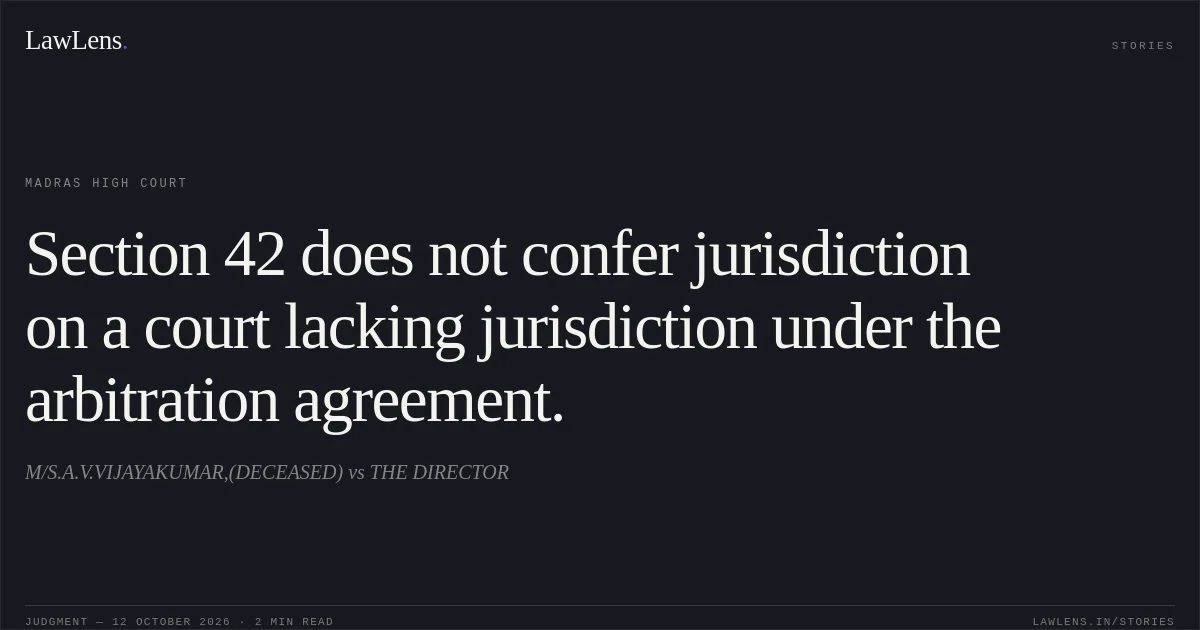
Section 42 of the Arbitration and Conciliation Act provides that, once an application under Part I is made in a court, that court alone has jurisdiction over the arbitral proceedings and subsequent applications arising from the arbitration agreement.
Source reference: p. 11–15The Court interpreted this rule to apply where the first court approached is a competent court—that is, one with jurisdiction under the parties’ governing agreement—and not to confer jurisdiction on a court lacking it.
Source reference: p. 11–15The parties’ depository agreement provided for Mumbai courts’ jurisdiction, subject to its clause incorporating the NSE bye-laws and regulations.
Source reference: p. 6–7NSE Trading Regulation 5.3 directed that a Section 34 application be filed in the competent court nearest to the regional centre where the appellate arbitration was conducted; NSE Bye-law 17 provided for filing in the competent court nearest to the constituent’s KYC address.
Source reference: p. 8–9Reasoning
The Court read the Mumbai-jurisdiction clause in the depository agreement together with the clause making transactions subject to NSE rules, bye-laws and regulations. It held that the Mumbai clause was therefore subject to the NSE provisions governing the court for a Section 34 application.
Source reference: p. 10–11The claimant’s KYC address was in Thrissur, and the Court found Chennai to be the relevant regional centre and the competent court under the applicable provisions.
Source reference: p. 9–11Although Sharekhan had first filed in Bombay, the Court held that this filing did not activate Section 42 because the Bombay High Court was not the competent court under the agreement and incorporated NSE provisions.
Source reference: p. 12–15Holding
The Court held that the Madras High Court had jurisdiction to hear the claimant’s Section 34 application and that the Bombay High Court was not the competent court for purposes of Section 42.
It set aside the Single Judge’s order and remanded the matter for consideration of the Section 34 application on its merits; the parties were directed to bear their own costs.
Source reference: p. 15–16Acts & Sections Cited
3 provisions across 1 statute referred to in this judgment. Each provision opens on LawLens.
Arbitration and Conciliation Act, 19963
Original Court PDF
M/S.A.V.VIJAYAKUMAR,(DECEASED)vsTHE DIRECTOR
Click to open original judgment
Original judgment, available to read, download and summarize on LawLens.in
![Competent authority must reconsider transfer-waiting-list priority through a reasoned order.. Prabhat Kumar Srivastwa vs NORTH CENTRAL RAILWAY. CAT - ['Allahabad']. LawLens](/stories/thumbnails/competent-authority-must-reconsider-transfer-waiting-list-priority-through-a-reasoned-orde-e23ccd4eaf154e82b09ea183b25e32fb.webp)
![Excess-pay recovery from retired Group C employees is impermissible absent fraud or misrepresentation.. SATYA NAND YADAV vs NORTH EASTERN RAILWAY. CAT - ['Allahabad']. LawLens](/stories/thumbnails/excess-pay-recovery-from-retired-group-c-employees-is-impermissible-absent-fraud-or-misrep-c357cbdd195c44d68331385eea2a3c9a.webp)