Facts
The appellant claimed ownership of Apartment E-101 in the Forum Atmosphere complex and membership in the respondent, a Section 8 company.
Source reference: para. 1–4The respondent’s notice dated 3 August 2026 for its second AGM disputed her ownership and share certificate and stated that the notice did not recognize her membership or related rights.
Source reference: para. 1–4The appellant invoked arbitration under Section 21 of the Arbitration and Conciliation Act, 1996, and applied under Section 9 for interim relief, including protection of her rights to attend and vote at the AGM scheduled for 26 August 2026.
Source reference: para. 1–4The District Judge refused ad interim relief, prompting this appeal.
Source reference: para. 1–4The appellant relied on KMC records regularising the construction and on her share certificate; the High Court also considered these materials and the terms of the company’s Articles.
Source reference: para. 5–11, 25–29Issues
1. Whether the disputes concerning the appellant’s apartment ownership and shareholder rights fell within the arbitration clause in the respondent’s Articles, and whether Sections 6 and 430 of the Companies Act, 2013, barred recourse to arbitration and Section 9 relief.
Source reference: para. 20–24, 34–412. Whether the Section 21 notice and Section 9 application became infructuous once the AGM of 26 August 2026 had been held.
Source reference: para. 19, 30–333. Whether the appellant established a prima facie case, balance of convenience and urgency warranting interim protection of her membership, attendance and voting rights.
Source reference: para. 25–29, 42–44Law Applied
Section 7(1)–(3) of the Arbitration and Conciliation Act, 1996 recognises a written arbitration agreement covering disputes arising from a defined legal relationship, whether contractual or not, and permits that agreement to take the form of an arbitration clause in a contract.
Source reference: para. 21–23Section 21 concerns commencement of arbitral proceedings; a notice need only identify the rudiments of the dispute, with the full case to be developed in the statement of claim.
Source reference: para. 30Section 9 permits interim measures in aid of arbitration.
Source reference: para. 11, 13–17, 24Under Section 47 of the Companies Act, 2013, voting rights attach to a member’s shareholding; Sections 241, 242 and 244 provide a statutory remedy for oppression or prejudicial conduct subject to the eligibility requirements in Section 244, while Section 430 bars civil-court jurisdiction over matters the NCLT or NCLAT is empowered to determine.
Source reference: para. 11, 13–17, 24Section 6 gives the Companies Act overriding effect over repugnant provisions in a company’s memorandum or articles.
Source reference: para. 12, 34–37The Court relied on Life Insurance Corporation of India v. Escorts Ltd., (1986) 1 SCC 264, and Vodafone International Holding BV v. Union of India, (2012) 6 SCC 613, for the proposition that voting and participation in company management are incidents of shareholding.
Source reference: para. 9, 24, 27Reasoning
The Court treated the arbitration clause as a written, standalone agreement under Section 7, notwithstanding its inclusion in the Articles.
Source reference: para. 20–24, 35–37Because the clause covered disputes relating both to the Articles and to the premises, the appellant’s claims concerning her ownership and shareholder rights were within its scope.
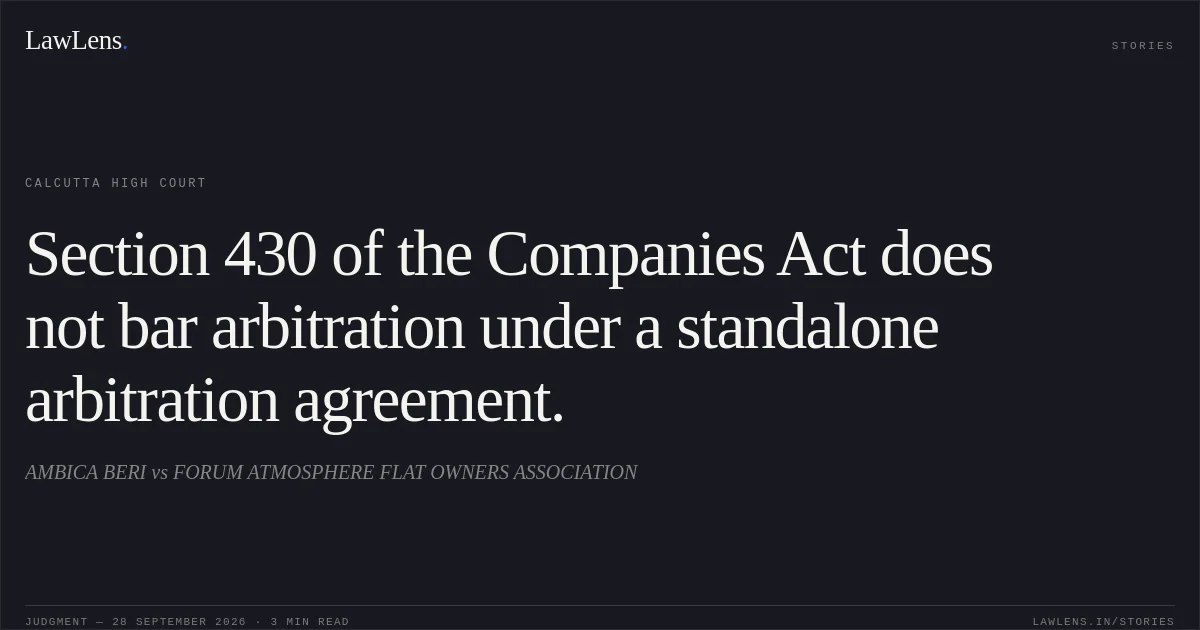
Source reference: para. 20–24, 35–37It held that Section 430’s bar concerns civil-court jurisdiction, not arbitration, and that the dispute was not confined to a statutory oppression claim; accordingly, the Companies Act provisions did not defeat the arbitration agreement or the Section 9 application.
Source reference: para. 34–41The Section 21 notice identified the shareholder-rights dispute, and the underlying controversy extended beyond the particular AGM, so the application was not rendered infructuous by that meeting having taken place.
Source reference: para. 30–33KMC records prima facie showed regularisation of the construction, while the share certificate supported the appellant’s membership.
Source reference: para. 25–29, 42–44The respondent’s general denial did not identify a basis for disputing either, and the Court considered the AGM notice itself supportive of the appellant’s claimed membership.
Source reference: para. 25–29, 42–44These materials established a prima facie case, with the balance of convenience and urgency favouring interim protection.
Source reference: para. 25–29, 42–44Holding
The High Court allowed the appeal, set aside the District Judge’s order, and restrained the respondent from giving effect to the 3 August 2026 letter insofar as it prevented the appellant from exercising her rights of membership, attendance and voting at the respondent’s meetings, pending disposal of the Section 9 application.
CAN 1 of 2026 was disposed of, with no order as to costs.
Source reference: para. 46–48The Court stated that its findings were tentative and would not unduly influence the further determination of the Section 9 application.
Source reference: para. 46–48Acts & Sections Cited
10 provisions across 2 statutes referred to in this judgment. Each provision opens on LawLens.
Arbitration and Conciliation Act, 19963
Companies Act, 20137
Original Court PDF
AMBICA BERIvsFORUM ATMOSPHERE FLAT OWNERS ASSOCIATION
Click to open original judgment
Original judgment, available to read, download and summarize on LawLens.in