Facts
The appellant had been in custody since 13 August 2022 and was facing trial in an NIA case involving alleged offences under the IPC, Arms Act and UAPA.
Source reference: pp. 3–8, 21–23The prosecution alleged, among other things, that he belonged to the People’s Liberation Army (PLA), conspired to plan attacks, and received a pistol and ammunition from co-accused A-2.
Source reference: pp. 3–8, 21–23The Special Court framed seven charges, including charges under Sections 18, 20 and 38 of the UAPA.
Source reference: pp. 3–8, 21–23After rejection of his fourth bail application, the appellant appealed under Section 21 of the NIA Act.
Source reference: pp. 3–8, 21–23The Special Court had refused bail, finding a prima facie case under Chapter IV of the UAPA and applying the restriction in Section 43D(5).
Source reference: pp. 3–8, 21–23The NIA opposed bail, relying on the alleged abscondence of A-2 and A-3, the appellant’s other pending FIRs, and its submission that the trial could conclude by March 2027.
Source reference: pp. 10–11, 24–26Issues
1. Whether the Special Court applied the correct test under the proviso to Section 43D(5) of the UAPA when rejecting bail
Source reference: pp. 19–212. Whether the appellant’s custody, anticipated progress of the trial, and the risk of abscondence justified granting bail notwithstanding the UAPA charges
Source reference: pp. 24–28, 32–33Law Applied
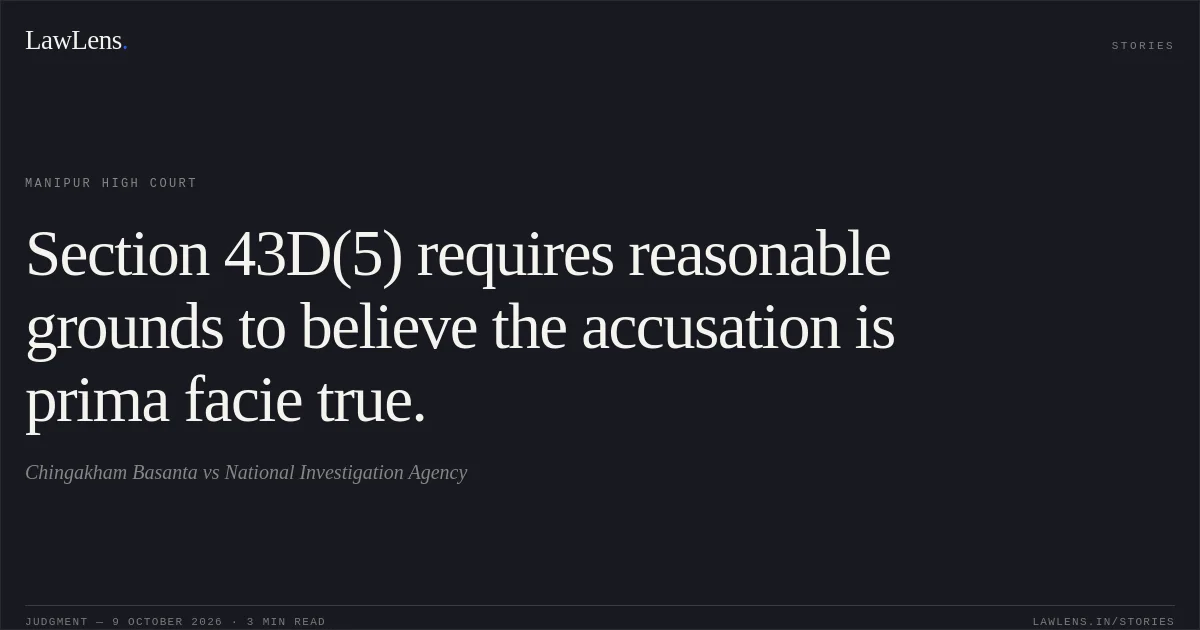
Section 43D(5) of the UAPA bars release on bail where, on perusal of the case diary or the report under Section 173 of the CrPC, the court finds reasonable grounds for believing that the accusation is prima facie true; the statutory test is not merely whether a prima facie case exists.
Source reference: pp. 19–21Under Union of India v. K.A. Najeeb, constitutional courts may grant bail notwithstanding that restriction where prolonged pre-trial detention and the absence of a reasonably foreseeable trial offend the Article 21 right to speedy trial.
Source reference: pp. 12–13, 18–19The Court also considered the bail factors reiterated in Satender Kumar Antil v. CBI, including prior criminal record, community ties, and risk of non-appearance.
Source reference: pp. 17–18, 27–28It held that an unchallenged charge-framing order does not, by itself, bar a subsequent bail application.
Source reference: p. 32Reasoning
The High Court held that the Special Court had misstated the Section 43D(5) test by asking whether a prima facie case existed, rather than whether there were reasonable grounds to believe the accusations were prima facie true; it also noted that Section 38 falls under Chapter VI, which the Special Court had not addressed.
Source reference: pp. 20–22It nevertheless declined to determine whether the evidence met the statutory test, because it considered that the trial could reasonably conclude by March 2027: the case had been transferred to a functioning exclusive NIA Special Court, and the NIA represented that it would complete its evidence within four months.
Source reference: pp. 24–26, 32–33The Court also considered A-2’s alleged abscondence and the prosecution’s claim that he had crossed into Myanmar relevant to the risk of the appellant absconding, particularly given the allegation that A-2 supplied the weapon.
Source reference: pp. 26–27, 31–32The appellant’s other FIRs did not, on the facts, establish that he had previously breached bail or absconded.
Source reference: pp. 28–29Balancing these circumstances, the Court found no basis to grant bail at that time, while preserving the appellant’s ability to renew his application if the trial or efforts to secure A-2 extended beyond March 2027.
Source reference: pp. 32–33Holding
The appeal was dismissed, and bail was not granted.
The Court directed that the trial proceed on its merits, uninfluenced by its observations on bail.
Source reference: pp. 32–34It further held that delay beyond March 2027, or the securing or continued non-securing of A-2, would constitute a change of circumstances on which the appellant could seek bail before the Trial Court.
Source reference: pp. 32–34Acts & Sections Cited
27 provisions across 7 statutes referred to in this judgment. Each provision opens on LawLens.
National Investigation Agency Act, 20081
Unlawful Activities (Prevention) Act, 1967
Arms Act, 19592
Indian Penal Code, 18605
Narcotic Drugs and Psychotropic Substances Act, 19854
Code of Criminal Procedure, 19733
Original Court PDF
Chingakham BasantavsNational Investigation Agency
Click to open original judgment
Original judgment, available to read, download and summarize on LawLens.in