Facts
The complainant alleged that Chandan Kumar, Director of Rauli Infra Build Real Estate Pvt. Ltd., agreed to purchase land for a total consideration of ₹52,29,000 and initially paid ₹8,00,000. A subsequent agreement allegedly provided for payment of the remaining consideration after execution and registration of the sale deed. The petitioner allegedly issued a cheque for ₹44,29,000, which was dishonoured; information of dishonour was received on 13 March 2019. The complainant issued a statutory notice on 4 April 2019, but the amount allegedly remained unpaid.
Source reference: pp. 2–3, paras. 3–4The complainant instituted Complaint Case No. 1292 of 2019 alleging offences under Sections 420, 406, 467 and 468 of the IPC and Section 138 of the Negotiable Instruments Act, 1881 (“N.I. Act”). The A.C.J.M.-XIV, Saran, took cognizance only under Section 138 of the N.I. Act and issued summons on 8 August 2019.
Source reference: p. 3, para. 4The petitioner sought quashing of the cognizance order and the consequential criminal proceedings under Section 482 Cr.P.C., contending that the cheque was not issued by him, that no legally enforceable liability existed, that the registered sale deed acknowledged full payment, and that the statutory notice was not served.
Source reference: pp. 3–4, paras. 5–6Issues
Whether the High Court should exercise its inherent jurisdiction under Section 482 Cr.P.C. to quash the order taking cognizance under Section 138 of the N.I. Act and the consequential criminal proceedings?
Source reference: p. 5, para. 9Whether the petitioner’s disputed defences—non-issuance of the cheque, absence of legally enforceable liability, the recital in the registered sale deed, and non-service of statutory notice—could be conclusively determined at the pre-trial stage?
Source reference: pp. 10–12, paras. 12–14Whether the complaint and supporting materials prima facie disclosed the essential ingredients of an offence under Section 138 of the N.I. Act?
Source reference: pp. 9–10, para. 12Law Applied
The Court applied Section 482 Cr.P.C., under which inherent jurisdiction may be exercised sparingly to prevent abuse of process and secure the ends of justice, without ordinarily conducting a mini-trial or deciding disputed questions of fact.
Source reference: p. 6, para. 10Section 138 of the N.I. Act was applied concerning dishonour of a cheque issued towards a legally enforceable debt or liability, while Section 139 creates a rebuttable statutory presumption that the holder received the cheque for discharge of such debt or liability.
Source reference: pp. 7–10, paras. 11–12Relying on Sri Om Sales v. Abhay Kumar @ Abhay Patel, 2025 SCC OnLine SC 2897, as well as Maruti Udyog Ltd. v. Narender, Rangappa v. Sri Mohan, Rajeshbhai Muljibhai Patel v. State of Gujarat and Rathish Babu Unnikrishnan v. State (NCT of Delhi), the Court held that the question whether the cheque was issued towards a legally enforceable liability ordinarily requires determination at trial and should not be adjudicated under Section 482 Cr.P.C. at the threshold.
Source reference: pp. 6–9, para. 11The Court also applied the illustrative principles in State of Haryana v. Bhajan Lal, 1992 Supp (1) SCC 335, permitting quashing where the allegations, even if accepted in full, do not constitute an offence or the prosecution is manifestly mala fide, while cautioning against using inherent powers to stifle a legitimate prosecution.
Source reference: p. 12, para. 15Reasoning
The complaint specifically alleged issuance of the ₹44,29,000 cheque, its presentation and dishonour, service of the statutory demand notice, and non-payment within the prescribed period, thereby prima facie satisfying the foundational requirements of Section 138 of the N.I. Act.
Source reference: pp. 9–10, para. 12The statutory presumption under Section 139 consequently operated in favour of the complainant, subject to rebuttal by the petitioner through evidence at trial.
Source reference: p. 10, para. 12The petitioner’s reliance on the registered sale deed and his assertions that he neither issued the cheque nor owed the alleged amount raised disputed factual and evidentiary questions concerning the actual liability, the effect of the sale deed, the genuineness of the subsequent agreement, the cheque’s issuance and the service of notice.
Source reference: pp. 10–12, paras. 13–14Those questions could not be conclusively resolved on the basis of rival assertions in a Section 482 proceeding.
Source reference: pp. 10–12, paras. 13–14The Court further held that a detailed or elaborate reasoning order at the stage of cognizance was not indispensable where the materials demonstrated application of judicial mind.
Source reference: p. 11, para. 13Since the complaint was not inherently absurd, did not fail to disclose an offence, and did not fall within the Bhajan Lal categories, interference was unwarranted.
Source reference: p. 13, para. 16Holding
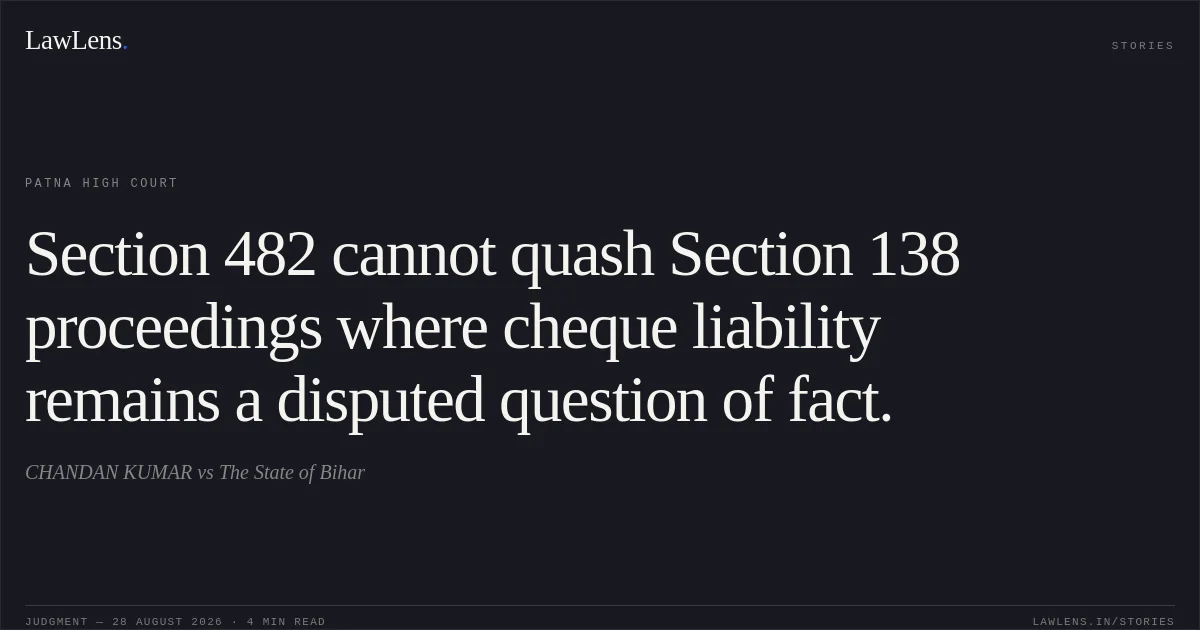
The High Court held that the complaint prima facie disclosed the essential ingredients of Section 138 of the N.I. Act and that the petitioner’s defences involved disputed questions of fact requiring adjudication at trial.
It therefore declined to exercise jurisdiction under Section 482 Cr.P.C. and dismissed the application challenging the cognizance order dated 8 August 2019 and the consequential proceedings.
Source reference: p. 13, paras. 17–18The trial court was directed to proceed in accordance with law, uninfluenced by the observations made in the judgment, which were confined to the prayer for quashing at the preliminary stage.
Source reference: p. 14, para. 19Any interim order was vacated.
Source reference: p. 14, para. 20Acts & Sections Cited
7 provisions across 3 statutes referred to in this judgment. Each provision opens on LawLens.
Code of Criminal Procedure, 19731
Negotiable Instruments Act, 18812
Indian Penal Code, 18604
Original Court PDF
CHANDAN KUMARvsThe State of Bihar
Click to open original judgment
Original judgment, available to read, download and summarize on LawLens.in
![Courts will not interfere with transfers absent mala fides or violation of statutory rules.. M Ramya vs EMPLOYEES STATE INSURANCE CORPORATION (ESIC). CAT - ['Chennai']. LawLens](/stories/thumbnails/courts-will-not-interfere-with-transfers-absent-mala-fides-or-violation-of-statutory-rules-a6845e9ca6f548fca284c51c8351957f.webp)
![Courts cannot direct one-time recruitment age relaxation absent authority in the governing rules or advertisement.. UT OF PUDUCHERRY vs M ANDAL. CAT - ['Chennai']. LawLens](/stories/thumbnails/courts-cannot-direct-one-time-recruitment-age-relaxation-absent-authority-in-the-governing-895d78fde47143e2a8ed0207c4b6a44f.webp)
![A review cannot correct an allegedly erroneous decision absent an error apparent on the record.. Ajit Kumar Jha vs RAILWAY BOARD. CAT - ['Delhi']. LawLens](/stories/thumbnails/a-review-cannot-correct-an-allegedly-erroneous-decision-absent-an-error-apparent-on-the-re-8ac952fd4eba470c92f7da20af72a220.webp)