Facts
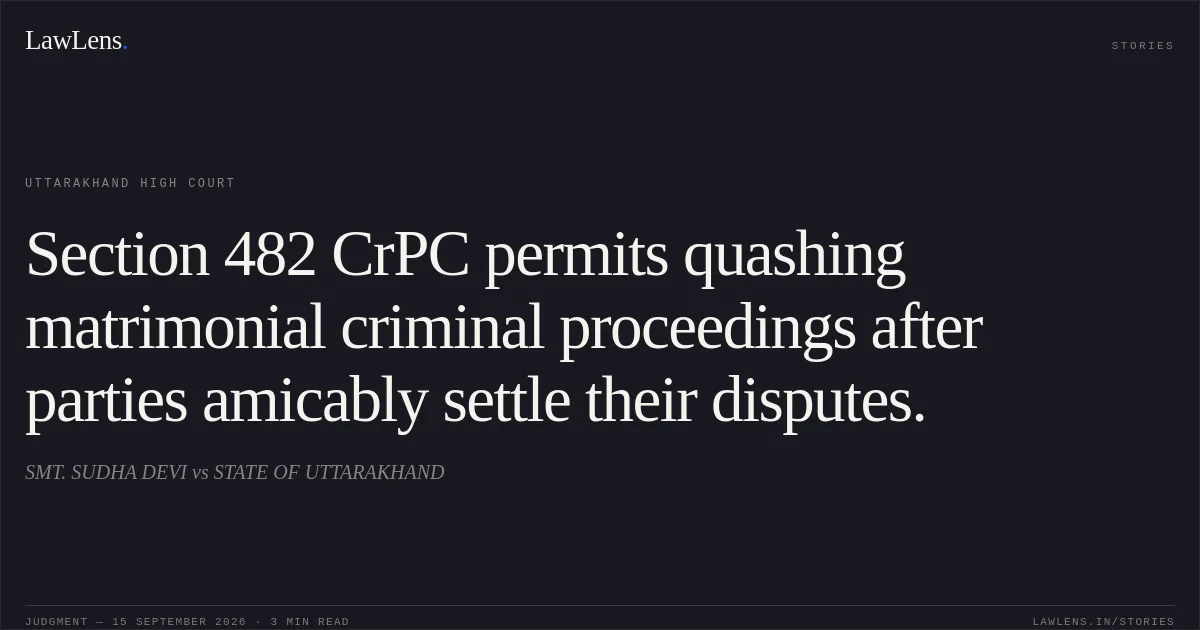
The applicants—Smt. Sudha Devi, Sri Sudha Raj alias Sudhakar, and Smt. Deepa Rani, respectively the mother-in-law, brother-in-law, and sister-in-law of respondent no. 2—challenged, under Section 482 of the Code of Criminal Procedure, 1973, the charge-sheet dated 9 June 2018, summoning order dated 23 July 2018, and criminal proceedings in Criminal Case No. 4009 of 2018 arising from FIR No. 77 of 2018.
Source reference: pp. 1–3, para. 1The proceedings concerned offences under Sections 498A, 323, 504 and 506 of the Indian Penal Code and Sections 3/4 of the Dowry Prohibition Act.
Source reference: pp. 1–3, paras. 1, 5–10During the proceedings, the parties appeared before the Court and filed affidavits, a Compounding Application, and a Compromise Memo, stating that they had voluntarily and amicably resolved their matrimonial dispute.
Source reference: pp. 1–3, paras. 5–10Respondent no. 2 stated that she did not wish to pursue the criminal case, and the State expressed no objection to the compromise.
Source reference: pp. 1–3, paras. 7–10Issues
Whether the High Court should exercise its inherent jurisdiction under Section 482 CrPC to quash the charge-sheet, summoning order, and consequential criminal proceedings arising out of a matrimonial dispute after the parties had amicably settled the matter.
Source reference: p. 3, paras. 10–12Whether the voluntary compromise and the complainant’s unwillingness to proceed justified termination of proceedings involving Sections 498A, 323, 504 and 506 IPC and Sections 3/4 of the Dowry Prohibition Act.
Source reference: pp. 2–3, paras. 7–12Law Applied
The Court applied Section 482 of the Code of Criminal Procedure, 1973, which preserves the High Court’s inherent power to pass orders necessary to give effect to the CrPC, prevent abuse of the process of any court, or secure the ends of justice.
Source reference: pp. 1–3, paras. 1, 7–12The Court also considered the effect of the parties’ compromise in matrimonial criminal proceedings, particularly where the complainant voluntarily states that she does not wish to continue the prosecution and the State raises no objection.
Source reference: pp. 1–3, paras. 7–12The offences alleged were under Sections 498A, 323, 504 and 506 IPC and Sections 3/4 of the Dowry Prohibition Act.
Source reference: pp. 1–3, paras. 1, 7–12No specific judicial precedent was cited or discussed in the judgment.
Source reference: pp. 1–3, paras. 1, 7–12Reasoning
The Court verified that the applicants and respondent no. 2 had appeared through counsel or in person and had filed the Compounding Application, affidavits, and Compromise Memo of their own free will and without pressure.
Source reference: pp. 1–3, paras. 5–11Since the dispute arose out of matrimonial differences, the parties had resolved their dispute amicably, and respondent no. 2 expressly declined to pursue the criminal case.
Source reference: pp. 1–3, paras. 5–11The State also had no objection to the settlement.
Source reference: pp. 1–3, paras. 7–11In these circumstances, the Court concluded that continuation of the prosecution would not advance the interests of justice and that quashing the proceedings would secure the ends of justice.
Source reference: pp. 1–3, paras. 10–11Holding
The High Court allowed the compromise-based request and quashed the charge-sheet dated 9 June 2018, summoning order dated 23 July 2018, and the entire proceedings in Criminal Case No. 4009 of 2018 arising out of FIR No. 77 of 2018, pending before the Additional Chief Judicial Magistrate, Kashipur, for offences under Sections 498A, 323, 504 and 506 IPC and Sections 3/4 of the Dowry Prohibition Act.
The application under Section 482 CrPC was accordingly disposed of, and the Compounding Application and Compromise Memo were directed to form part of the order.
Source reference: pp. 3–4, paras. 11–14Acts & Sections Cited
6 provisions across 3 statutes referred to in this judgment. Each provision opens on LawLens.
Code of Criminal Procedure, 19731
Indian Penal Code, 18603
Original Court PDF
SMT. SUDHA DEVIvsSTATE OF UTTARAKHAND
Click to open original judgment
Original judgment, available to read, download and summarize on LawLens.in