Facts
The complainant alleged that he advanced ₹5,50,000 to the applicant for arranging a proposed ₹48-crore loan and, towards repayment, the applicant issued Cheque No. 000009 dated 25 November 2016. The cheque was dishonoured on 28 November 2016 with the endorsement “payment stopped by drawer”; a statutory notice was issued on 30 November 2016, to which the applicant replied on 20 December 2016, and Criminal Case No. 4 of 2017 under Section 138 of the Negotiable Instruments Act, 1881 was filed on 29 December 2016.
Source reference: pp.2–3, 6, 10The applicant contended that the cheque was one of six security cheques handed over in connection with the proposed loan and that the complainant had misused them. Before the complaint was instituted, the applicant had lodged FIR C.R. No. I-259 of 2016 dated 13 December 2016, alleging cheating, forgery, criminal breach of trust and conspiracy in relation to the transaction and misuse of the cheques; the investigation culminated in a charge-sheet and the trial was pending.
Source reference: pp.3–5, 10–13The applicant also relied on an affidavit of another cheque complainant, who stated that he had deposited a cheque at the complainant’s instance and later realised that the security cheque had been misused.
Source reference: pp.5–6, 13The applicant consequently sought quashing of the complaint and the summoning order dated 2 January 2017 under Section 482 of the Code of Criminal Procedure, 1973.
Source reference: p.1Issues
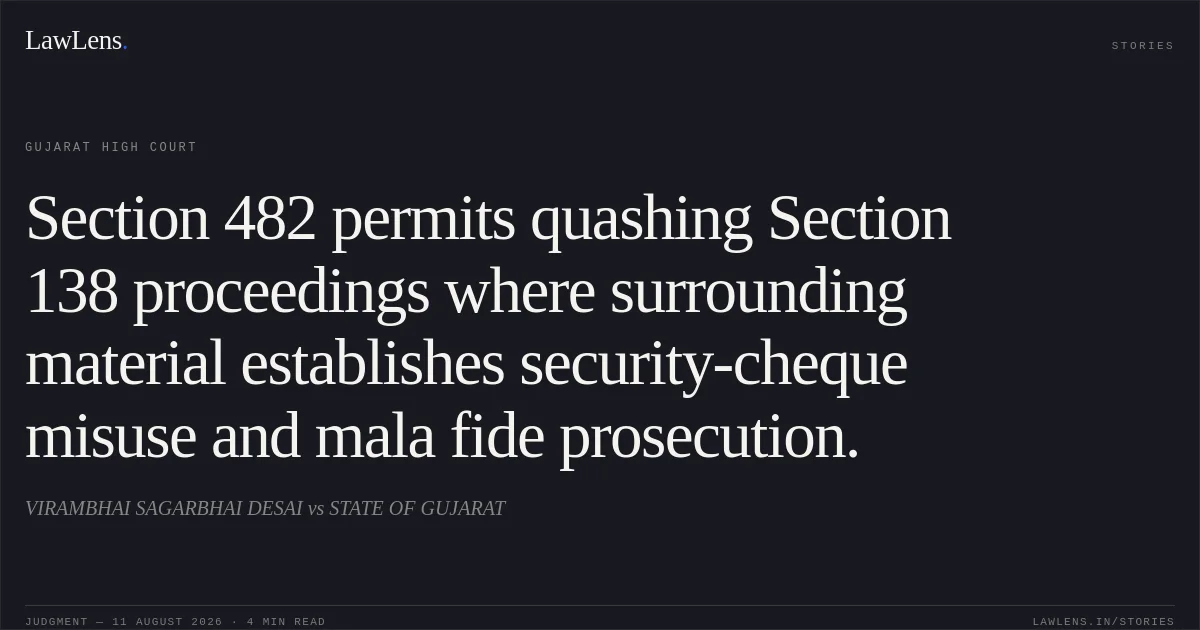
Whether the High Court should quash Criminal Case No. 4 of 2017 and the consequential summoning order under Section 482 CrPC where the complaint under Section 138 NI Act concerns cheques alleged to have been misused as security cheques.
Source reference: pp.1, 13–14, 16Whether the surrounding circumstances—including the applicant’s prior FIR concerning misuse of the same cheques, the pending charge-sheet proceedings, related quashing orders and supporting affidavit—demonstrated that continuation of the Section 138 proceedings would constitute an abuse of process and a proceeding instituted with an ulterior motive.
Source reference: pp.10–14Whether the statutory presumption under Section 139 NI Act barred quashing at the threshold on the ground that the existence of a legally enforceable debt ordinarily requires determination at trial.
Source reference: pp.7–9, 13Law Applied
The Court applied Section 482 CrPC, which preserves the High Court’s inherent jurisdiction to prevent abuse of the process of court and secure the ends of justice, together with Sections 138 and 139 of the NI Act.
Source reference: pp.7–9Section 139 ordinarily raises a rebuttable presumption that a cheque was received towards discharge of a debt or other liability, and disputed questions concerning such liability are generally matters for trial.
Source reference: pp.7–9However, relying on Haji Iqbal alias Bala through S.P.O.A. v. State of Uttar Pradesh , 2023 INSC 688, the Court held that where proceedings are alleged to be frivolous, vexatious or motivated by personal vengeance, the High Court must examine not only the complaint but also the attending circumstances and materials on record with care and circumspection.
Source reference: pp.11–13The Court also applied the categories in State of Haryana v. Bhajan Lal , particularly the category concerning proceedings manifestly attended by mala fides or instituted maliciously with an ulterior motive to wreak vengeance.
Source reference: pp.14–16It distinguished M/s. Sri Om Sales v. Abhay Kumar @ Abhay Patel , 2025 (0) AIJEL-SC 76310, where quashing was held impermissible merely because the existence of debt or liability was disputed at the pre-trial stage.
Source reference: pp.7–9, 13Reasoning
Although the complaint prima facie contained the formal ingredients of Section 138 NI Act and the Section 139 presumption ordinarily favoured the complainant, the Court held that the present case involved circumstances extending beyond a bare dispute regarding liability.
Source reference: pp.6–9, 13The applicant had alleged misuse of the very six cheques in a prior FIR lodged before institution of the complaint; that FIR had resulted in a charge-sheet, and the related factual dispute remained pending before the criminal court.
Source reference: pp.10–13The Court further considered the supporting affidavit, the multiple related cheque complaints and criminal proceedings, and the quashing of several connected proceedings.
Source reference: pp.13–14On this cumulative and substantially uncontroverted material, the Court was prima facie satisfied that the cheques had not been issued in discharge of a legally enforceable debt and that the complaint had been instituted to exert pressure and wreak vengeance.
Source reference: pp.13–14Accordingly, this was treated as an exceptional case warranting intervention under Section 482 CrPC, rather than a case requiring the ordinary determination of rebuttal of the Section 139 presumption at trial.
Source reference: pp.13–16Holding
The Court answered the issues in favour of the applicant. It held that continuation of the Section 138 proceedings would amount to an abuse of the process of law and that the case fell within the mala fide/ulterior-motive category recognised in Bhajan Lal .
Criminal Case No. 4 of 2017 pending before the 4th Additional Civil Judge and JMFC, Himmatnagar, along with the summoning order dated 2 January 2017 and all consequential proceedings, was quashed and set aside. The application was allowed and the rule was made absolute.
Source reference: p.16Acts & Sections Cited
12 provisions across 3 statutes referred to in this judgment. Each provision opens on LawLens.
Code of Criminal Procedure, 19733
Negotiable Instruments Act, 18812
Indian Penal Code, 18607
Original Court PDF
VIRAMBHAI SAGARBHAI DESAIvsSTATE OF GUJARAT
Click to open original judgment
Original judgment, available to read, download and summarize on LawLens.in